

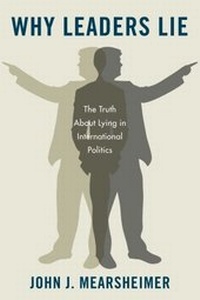
Why Leaders Lie
The Truth About Lying in International Politics
1st Edition
Published in February 2011
Book
Hardback
160 pages
978-0-19-975873-9 (ISBN)
Description
For more than two decades, John J. Mearsheimer has been regarded as one of the foremost realist thinkers on foreign policy. Clear and incisive, a fearlessly honest analyst, his coauthored 2007 New York Times bestseller, The Israel Lobby and U.S. Foreign Policy, aroused a firestorm with its unflinching look at the making of America's Middle East policy. Now he takes a look at another controversial but understudied aspect of international relations: lying.
In Why Leaders Lie, Mearsheimer provides the first systematic analysis of lying as a tool of statecraft, identifying the varieties, the reasons, and the potential costs and benefits. Drawing on a trove of examples, he argues that leaders often lie for good strategic reasons, so a blanket condemnation is unrealistic and unwise. Yet there are other kinds of deception besides lying, including concealment and spinning. Perhaps no distinction is more important than that between lying to
another state and lying to one's own people. Mearsheimer was amazed to discover how unusual interstate lying has been; given the atmosphere of distrust among the great powers, he found that outright deceit is difficult to pull off and thus rarely worth the effort. Plus it sometimes backfires when it does occur.
Khrushchev lied about the size of the Soviet missile force, sparking an American build-up. Eisenhower got caught lying about U-2 spy flights in 1960, which scuttled an upcoming summit with Krushchev. Leaders more often mislead their own publics, sometimes with damaging consequences. Though the reasons may be noble--Franklin Roosevelt, for example, lied to the American people about German U-boats attacking the destroyer Greer in 1940, to build a case for war against Hitler--they can easily lead
to disaster, as with the Bush administration's falsehoods about Iraq's weapons of mass destruction.
There has never been a full discussion of international lying. Now a leading expert fills the gap with a richly informed and powerfully argued book.
In Why Leaders Lie, Mearsheimer provides the first systematic analysis of lying as a tool of statecraft, identifying the varieties, the reasons, and the potential costs and benefits. Drawing on a trove of examples, he argues that leaders often lie for good strategic reasons, so a blanket condemnation is unrealistic and unwise. Yet there are other kinds of deception besides lying, including concealment and spinning. Perhaps no distinction is more important than that between lying to
another state and lying to one's own people. Mearsheimer was amazed to discover how unusual interstate lying has been; given the atmosphere of distrust among the great powers, he found that outright deceit is difficult to pull off and thus rarely worth the effort. Plus it sometimes backfires when it does occur.
Khrushchev lied about the size of the Soviet missile force, sparking an American build-up. Eisenhower got caught lying about U-2 spy flights in 1960, which scuttled an upcoming summit with Krushchev. Leaders more often mislead their own publics, sometimes with damaging consequences. Though the reasons may be noble--Franklin Roosevelt, for example, lied to the American people about German U-boats attacking the destroyer Greer in 1940, to build a case for war against Hitler--they can easily lead
to disaster, as with the Bush administration's falsehoods about Iraq's weapons of mass destruction.
There has never been a full discussion of international lying. Now a leading expert fills the gap with a richly informed and powerfully argued book.
More details
Language
English
Place of publication
Oxford
United Kingdom
Publishing group
Oxford University Press
Target group
College/higher education
Dimensions
Height: 210 mm
Width: 140 mm
ISBN-13
978-0-19-975873-9 (9780199758739)
Copyright in bibliographic data and cover images is held by Nielsen Book Services Limited or by the publishers or by their respective licensors: all rights reserved.
Schweitzer Classification
Person
John J. Mearsheimer, geb. 1947, ist Professor für Politologie an der Universität Chicago.