

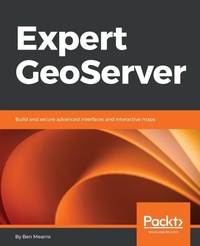
Expert GeoServer
Build and secure advanced interfaces and interactive maps
Published on 31. July 2018
Book
Paperback/Softback
134 pages
978-1-78953-860-1 (ISBN)
Description
A fast-paced guide to putting your GeoServer-based application into fast, user-friendly, and secure production
Key Features
[*] Resolve bottlenecks, optimize data stores, and cluster server resources
[*] Use identity management and authentication for a user-specific, secure web application
[*] Go beyond traditional web hosting to explore the full range of hosting options in the cloud
Book DescriptionGeoServer is open source, server-side software written in Java that allows users to share and edit geospatial data. In this book, you'll start by learning how to develop a spatial analysis platform with web processing services. Then you'll see how to develop an algorithm by chaining together geospatial analysis processes, which you can share with anyone in the world.
Next you'll delve into a very important technique to improve the speed of your map application-tile caching. Here, you'll understand how tile caching works, how to develop an effective tile cache-supported web service, and how to leverage tile caching in your OpenLayers web application.
Further on, you'll explore important tweaks to produce a performant GeoServer-backed web mapping application. Moving on, you'll enable authentication on the frontend and backend to protect sensitive map data, and deliver sensitive data to your end user. Finally, you'll see how to put your web application into production in a secure and user-friendly way. You'll go beyond traditional web hosting to explore the full range of hosting options in the cloud, and maintain a reliable server instance.What you will learn
[*] Develop a WPS-processing service to allow web-based geospatial data processing
[*] Get to know important techniques to improve the speed of your web map application-tile caching, raster data optimization, and server clustering
[*] Find out which GeoServer settings resolve bottlenecks
[*] Develop an algorithm by chaining geospatial analysis processes together
[*] Put your application into production with hosting, monitoring, and automated backup and recovery
[*] Understand how to develop an effective tile cache-supported web service
[*] Master techniques that ensure resilient server deployment
Who this book is forThis book is for anyone who wants to learn about advanced interfaces, security, and troubleshooting techniques in GeoServer. A basic understanding of GeoServer is required
Key Features
[*] Resolve bottlenecks, optimize data stores, and cluster server resources
[*] Use identity management and authentication for a user-specific, secure web application
[*] Go beyond traditional web hosting to explore the full range of hosting options in the cloud
Book DescriptionGeoServer is open source, server-side software written in Java that allows users to share and edit geospatial data. In this book, you'll start by learning how to develop a spatial analysis platform with web processing services. Then you'll see how to develop an algorithm by chaining together geospatial analysis processes, which you can share with anyone in the world.
Next you'll delve into a very important technique to improve the speed of your map application-tile caching. Here, you'll understand how tile caching works, how to develop an effective tile cache-supported web service, and how to leverage tile caching in your OpenLayers web application.
Further on, you'll explore important tweaks to produce a performant GeoServer-backed web mapping application. Moving on, you'll enable authentication on the frontend and backend to protect sensitive map data, and deliver sensitive data to your end user. Finally, you'll see how to put your web application into production in a secure and user-friendly way. You'll go beyond traditional web hosting to explore the full range of hosting options in the cloud, and maintain a reliable server instance.What you will learn
[*] Develop a WPS-processing service to allow web-based geospatial data processing
[*] Get to know important techniques to improve the speed of your web map application-tile caching, raster data optimization, and server clustering
[*] Find out which GeoServer settings resolve bottlenecks
[*] Develop an algorithm by chaining geospatial analysis processes together
[*] Put your application into production with hosting, monitoring, and automated backup and recovery
[*] Understand how to develop an effective tile cache-supported web service
[*] Master techniques that ensure resilient server deployment
Who this book is forThis book is for anyone who wants to learn about advanced interfaces, security, and troubleshooting techniques in GeoServer. A basic understanding of GeoServer is required
More details
Language
English
Place of publication
Birmingham
United Kingdom
Target group
Professional and scholarly
US School Grade: College Graduate Student
Dimensions
Height: 235 mm
Width: 191 mm
Thickness: 8 mm
Weight
266 gr
ISBN-13
978-1-78953-860-1 (9781789538601)
Copyright in bibliographic data and cover images is held by Nielsen Book Services Limited or by the publishers or by their respective licensors: all rights reserved.
Schweitzer Classification
Other editions
Additional editions
E-Book
09/2024
Packt Publishing
€23.49
Available for download
Person
Ben Mearns was previously the Lead Geospatial Information Consultant at the University of Delaware, where he was the senior GIS professional charged with leading, developing, and advising on GIS solutions. He developed the GeoServer-based campus mapping system. He has held GIS and data positions at the University of Pennsylvania Cartographic Modeling Lab, Princeton University Department of Sociology, and Macalester College Department of Geography.
Content
Table of Contents
Developing a Spatial Analysis Platform with WPS
Speed Up Your App with Tile Caching
Optimizing GeoServer
Secure Authentication
Putting it into Production
Developing a Spatial Analysis Platform with WPS
Speed Up Your App with Tile Caching
Optimizing GeoServer
Secure Authentication
Putting it into Production