

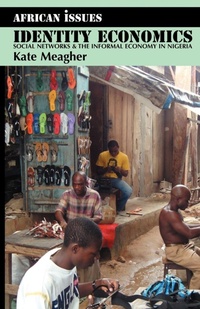
Identity Economics
Social Networks and the Informal Economy in Nigeria
Published on 18. February 2010
Book
Paperback/Softback
224 pages
978-1-84701-016-2 (ISBN)
Description
This book is essential reading for those interested in the role of the informal economy in contemporary processes of growth and economic governance in Africa.
Why have informal enterprise networks failed to promote economic development in Africa? Although social networks were thought to offer a solution to state incapacity and market failure, the proliferation of socially embedded enterprise networks across Africa has generated disorder and economic decline rather than development. This book challenges the prevailing assumption that the problem of African development lies in bad cultural institutions by showingthat informal economic governance in Nigeria is shaped, not just by culture, but by the disruptive effects of rapid liberalization, state decline and political capture.
Identity Economics traces the rise of two dynamic informal enterprise clusters in Nigeria, and explores their slide into trajectories of Pentecostalism, poverty and violent vigilantism. Drawing on over twenty years of empirical research on African informal economies, the author highlights the institutional legacies, networking strategies and globalizing dynamics that shape the regulatory role of social networks in Africa's largest and most turbulent economy. Through an ethnography of informal economicgovernance, this book shows how ties of ethnicity, class, gender and religion are used to restructure enterprise networks in response to contemporary economic challenges. Moving beyond primordialist interpretations of African culture, attention is drawn to the critical role of the state and the macro-economic policy environment in shaping trajectories of informal economic governance.
KATE MEAGHER is a former Research Associate at Queen Elizabeth House, University of Oxford and is currently a Lecturer in the Development Studies Institute at the London School of Economics.
Nigeria: HEBN
Why have informal enterprise networks failed to promote economic development in Africa? Although social networks were thought to offer a solution to state incapacity and market failure, the proliferation of socially embedded enterprise networks across Africa has generated disorder and economic decline rather than development. This book challenges the prevailing assumption that the problem of African development lies in bad cultural institutions by showingthat informal economic governance in Nigeria is shaped, not just by culture, but by the disruptive effects of rapid liberalization, state decline and political capture.
Identity Economics traces the rise of two dynamic informal enterprise clusters in Nigeria, and explores their slide into trajectories of Pentecostalism, poverty and violent vigilantism. Drawing on over twenty years of empirical research on African informal economies, the author highlights the institutional legacies, networking strategies and globalizing dynamics that shape the regulatory role of social networks in Africa's largest and most turbulent economy. Through an ethnography of informal economicgovernance, this book shows how ties of ethnicity, class, gender and religion are used to restructure enterprise networks in response to contemporary economic challenges. Moving beyond primordialist interpretations of African culture, attention is drawn to the critical role of the state and the macro-economic policy environment in shaping trajectories of informal economic governance.
KATE MEAGHER is a former Research Associate at Queen Elizabeth House, University of Oxford and is currently a Lecturer in the Development Studies Institute at the London School of Economics.
Nigeria: HEBN
Reviews / Votes
A contemporary archaeology of real institutions [as] Meagher uncovers the structures and dynamics of a political economy. * JOURNAL OF AFRICA * The depth and scholarly range of the book will certainly stimulate further research on the subject of identity economics. * NEW AGENDA * Informed by theory as well as sustained fieldwork, Meagher's study is a useful antidote to the purveyors of magic-bullet solutions for African development. It should be read by anyone interested in Africa's industrialization. * FOREIGN AFFAIRS *More details
Series
Language
English
Place of publication
Oxford
United Kingdom
Target group
Professional and scholarly
Product notice
Paperback (trade)
Illustrations
4 s/w Zeichnungen
4 line illus.
Dimensions
Height: 216 mm
Width: 140 mm
Thickness: 12 mm
Weight
291 gr
ISBN-13
978-1-84701-016-2 (9781847010162)
Copyright in bibliographic data and cover images is held by Nielsen Book Services Limited or by the publishers or by their respective licensors: all rights reserved.
Schweitzer Classification
Other editions
Additional editions
E-Book
02/2010
1st Edition
De Gruyter
€14.99
Available for download
Person
KATE MEAGHER is Associate Professor in Development Studies, London School of Economics. Her books include Identity Economics: Social Networks and the Informal Economy in Nigeria (2010), and, co-edited with Abdul Raufu Mustapha, Overcoming Boko Haram: Faith, Society & Islamic Radicalization in Northern Nigeria (2020).
Content
Introduction: Social networks & economic ungovernance in Africa
Beyond the cultural turn: Rethinking African informality
Oracles, secret societies & hometown identities: An institutional history of Igbo economic networks
Unleashing popular entrepreneurship: Informal manufacturing & economic restructuring
The scramble for weak ties: Restructuring informal enterprise networks
Negotiating the web of associational life: Popular associations & networking strategies
Collective efficiency or cutthroat cooperation?: Networks of accumulation & networks of survival
Informality, cliental networks & vigilantes: Producers' associations & the state
Missing link or missed opportunity?: Social networks & economic development in Africa
Beyond the cultural turn: Rethinking African informality
Oracles, secret societies & hometown identities: An institutional history of Igbo economic networks
Unleashing popular entrepreneurship: Informal manufacturing & economic restructuring
The scramble for weak ties: Restructuring informal enterprise networks
Negotiating the web of associational life: Popular associations & networking strategies
Collective efficiency or cutthroat cooperation?: Networks of accumulation & networks of survival
Informality, cliental networks & vigilantes: Producers' associations & the state
Missing link or missed opportunity?: Social networks & economic development in Africa