

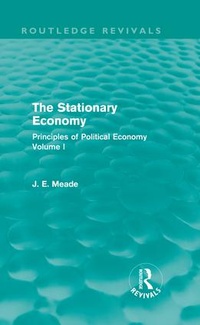
The Stationary Economy (Routledge Revivals)
Principles of Political Economy Volume I
1st Edition
Published on 27. April 2012
Book
Hardback
238 pages
978-0-415-52647-0 (ISBN)
Description
First published in 1965, this is a reissue of the first volume in Professor Meade's highly influential Principles of Political Economy, which aimed to provide an overview of economic analysis in light of contemporary developments in the subject. This volume is based on models of economic systems in which conditions are such as to make possible a state of perfect competition, in which there are no capital goods, in which consumers' tastes, technical knowledge, and the size and composition of the goods are static.
More details
Series
Language
English
Place of publication
London
United Kingdom
Publishing group
Taylor & Francis Ltd
Target group
College/higher education
Dimensions
Height: 216 mm
Width: 138 mm
Weight
453 gr
ISBN-13
978-0-415-52647-0 (9780415526470)
Copyright in bibliographic data and cover images is held by Nielsen Book Services Limited or by the publishers or by their respective licensors: all rights reserved.
Schweitzer Classification
Other editions
Additional editions
Book
10/2013
1st Edition
Routledge
€74.46
Shipment within 15-20 days
E-Book
05/2013
Routledge
€61.99
Available for download
E-Book
05/2013
1st Edition
Routledge
€61.99
Available for download
Person
Meade, James E.
Content
1. Ten Assumpions 2. Consumers' Choice 3. The Market for Consumption Goods 4. The Terms of Trade 5. Constant Costs 6. Increasing Costs: (i) Comparative Advantages 7. Increasing Costs: (ii) A Fixed Factor 8. Increasing Costs: (iii) Differences in Factor Proportions 9. Many Factors and Many Products 10. Changes in Technical Knowledge and in Factor Supplies 11. Fixed Technical Co-efficients 12. Economic Efficiency and the Distribution of Income 13. The Centrally Planned Economy: (i) The Organization of Consumption 14. The Centrally Planned Economy: (ii) The Organization of Production 15. The Centrally Planned Economy: (iii) The Deployment of Labour - Conclusion