


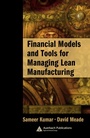
Financial Models and Tools for Managing Lean Manufacturing
1st Edition
Published on 15. August 2006
Book
Hardback
220 pages
978-0-8493-9185-9 (ISBN)
Description
The effect Lean Manufacturing programs have on profit and loss statements during the early months of their implementation often causes them to be viewed as failures. The length of time it will take traditional financial reports to reflect lean manufacturing improvements depends upon how poorly the operation was doing in terms of inventory management prior to the initiation of the lean effort. As yet, no one has put forth a set of methods for dealing with the finances and financial reporting issues dynamically during the implementation of lean practices, until now.
Financial Models and Tools for Managing Lean Manufacturing provides an understanding of the impact that traditional accounting practices have on operational improvement programs. The book shows managers of supply chains how to prepare for and present the impact of Lean Manufacturing to top management and stakeholders. To illustrate the impact of lean manufacturing on the income statement, the authors present a multi-month, Excel (TM) and Pro-Model (TM) based manufacturing operation environment that incorporates actual sales, sales forecasts, and production results. Their text gives supply chain managers the financial skills they need to successfully manage Lean Manufacturing and its impacts.
In short, the book explains how existing accounting practices have a tendency to report the results of operational improvement programs in a negative light. Other books have identified this issue but have not attempted to quantify the impact to a firm's profit and loss nor have they shown the impact over a series of reporting periods. As a consequence, although Lean Manufacturing practices are being adopted at an ever-increasing rate, they have not been eagerly embraced by manufacturers and supply chain managers. Identifying the effects of past poor manufacturing practices that are being cleaned up by the operational improvements brought by the lean program, the book arms you with the knowledge you need to defend the lean program through the months when income statements indicate a decline in profitability.
Financial Models and Tools for Managing Lean Manufacturing provides an understanding of the impact that traditional accounting practices have on operational improvement programs. The book shows managers of supply chains how to prepare for and present the impact of Lean Manufacturing to top management and stakeholders. To illustrate the impact of lean manufacturing on the income statement, the authors present a multi-month, Excel (TM) and Pro-Model (TM) based manufacturing operation environment that incorporates actual sales, sales forecasts, and production results. Their text gives supply chain managers the financial skills they need to successfully manage Lean Manufacturing and its impacts.
In short, the book explains how existing accounting practices have a tendency to report the results of operational improvement programs in a negative light. Other books have identified this issue but have not attempted to quantify the impact to a firm's profit and loss nor have they shown the impact over a series of reporting periods. As a consequence, although Lean Manufacturing practices are being adopted at an ever-increasing rate, they have not been eagerly embraced by manufacturers and supply chain managers. Identifying the effects of past poor manufacturing practices that are being cleaned up by the operational improvements brought by the lean program, the book arms you with the knowledge you need to defend the lean program through the months when income statements indicate a decline in profitability.
More details
Series
Language
English
Place of publication
London
United Kingdom
Publishing group
Taylor & Francis Ltd
Target group
Professional and scholarly
Professional and Professional Practice & Development
Illustrations
40 s/w Abbildungen
40 Illustrations, black and white
Dimensions
Height: 240 mm
Width: 161 mm
Thickness: 17 mm
Weight
499 gr
ISBN-13
978-0-8493-9185-9 (9780849391859)
Copyright in bibliographic data and cover images is held by Nielsen Book Services Limited or by the publishers or by their respective licensors: all rights reserved.
Schweitzer Classification
Other editions
Additional editions
E-Book
08/2006
Auerbach
€205.99
Available for download
E-Book
08/2006
Auerbach
€205.99
Available for download
Person
David Meade
Content
Introduction. Review of Professional Literature. Analytical Framework. Findings and Results. Conclusions and Implications.