

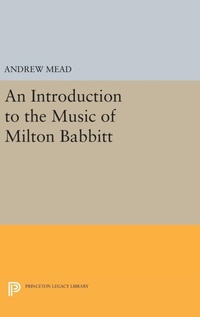
An Introduction to the Music of Milton Babbitt
Will be published approx. on 19. April 2016
Book
Hardback
336 pages
978-0-691-63078-6 (ISBN)
Description
In this celebration of Milton Babbitt's art, Andrew Mead explores the development of a central figure in contemporary American music. As a teacher and writer, Babbitt has influenced two generations of students, including such notable musicians as Stephen Sondheim and Donald Martino. He has helped establish the study of music theory as a serious academic pursuit, and his articles on Schoenberg, Stravinsky, and the twelve-tone system constitute a seminal body of research. But Babbitt is first and last a composer, whose works are, in Mead's words, "truly music to be heard." With Mead as a guide, we discover the strong emotional and expressive charge of Babbitt's music that is inextricably entwined with its structure. Babbitt is a twelve-tone composer, unabashedly so, and it is precisely his profound understanding of Arnold Schoenberg's epochal insight that gives Babbitt's music its special quality. By examining the underlying principles of twelve-tone composition, Mead allows us to appreciate Babbitt's music on its own terms, as a richly varied yet unified body of work. In achieving this purpose, he provides an excellent introduction to twelve-tone music in general.
Without relying on professional jargon, he lucidly and succinctly explains Babbitt's complexities. A catalog of compositions, a discography, and a bibliography complete a book that will interest performers, music theorists, and music historians, as well as other readers who are enthusiastic or curious about contemporary musical works. Originally published in 1994. The Princeton Legacy Library uses the latest print-on-demand technology to again make available previously out-of-print books from the distinguished backlist of Princeton University Press. These editions preserve the original texts of these important books while presenting them in durable paperback and hardcover editions. The goal of the Princeton Legacy Library is to vastly increase access to the rich scholarly heritage found in the thousands of books published by Princeton University Press since its founding in 1905.
Without relying on professional jargon, he lucidly and succinctly explains Babbitt's complexities. A catalog of compositions, a discography, and a bibliography complete a book that will interest performers, music theorists, and music historians, as well as other readers who are enthusiastic or curious about contemporary musical works. Originally published in 1994. The Princeton Legacy Library uses the latest print-on-demand technology to again make available previously out-of-print books from the distinguished backlist of Princeton University Press. These editions preserve the original texts of these important books while presenting them in durable paperback and hardcover editions. The goal of the Princeton Legacy Library is to vastly increase access to the rich scholarly heritage found in the thousands of books published by Princeton University Press since its founding in 1905.
Reviews / Votes
"This book provides a helpful introduction to twelve-tone music in general without the use of technical jargon."--Music Educators JournalMore details
Series
Language
English
Place of publication
New Jersey
United States
Target group
College/higher education
Professional and scholarly
Product notice
Trade binding
Dimensions
Height: 240 mm
Width: 161 mm
Thickness: 23 mm
Weight
669 gr
ISBN-13
978-0-691-63078-6 (9780691630786)
Copyright in bibliographic data and cover images is held by Nielsen Book Services Limited or by the publishers or by their respective licensors: all rights reserved.
Schweitzer Classification
Other editions
Additional editions
Andrew Mead
An Introduction to the Music of Milton Babbitt
E-Book
07/2014
1st Edition
Princeton University Press
€55.99
Available for download
Person
Andrew Mead - A Full-stack Developer & TeacherAndrew is a full-stack developer living in beautiful Philadelphia! He launched his first course in 2014 and had a blast teaching and helping others. Since then, he has launched 3 courses with over 110,000 students and over 18,000 5-star reviews. He currently teaches JavaScript, React, and Node. Before he ever thought about teaching, he created a web app development company. He has helped companies of all sizes launch production web applications to their customers. He had the honor of working with awesome companies like Siemens, Mixergy, and Parkloco. He had a Computer Science degree from Temple University, and I've been programming for just over a decade. I love creating, programming, launching, learning, teaching, and biking. He can't wait to see you inside one of my courses!
Content
AcknowledgmentsPrologue31Milton Babbitt's Compositional World5The Twelve-Tone System9Babbitt's Pitch Structures20Babbitt's Rhythmic Structures382Mapping Trichordal Pathways (1947-1960)54A Wellspring of Possibilities: The Composition for Four Instruments55Realizing the Implications of the Composition for Four Instruments76Additional Compositional Strategies1053Expansion and Consolidation (1961-1980)124Effects of All-Partition Arrays127A Brief Venture into Comparative Anatomy162Two (Short) Analyses1714The Grand Synthesis (1981-)204Superarray Structure and Projection209Superarray Compositions210Concerted Superarray Compositions226Trichordal Arrays and Superarrays239Miniatures, Pieces D'Occasion243New Departures252Epilogue264Catalog of Compositions by Milton Babbit267All-Partition Arrays271Notes295Bibliography305Discography315Index319