

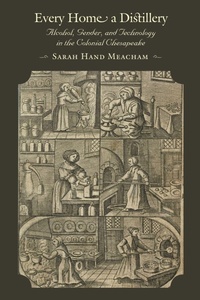
Every Home a Distillery
Alcohol, Gender, and Technology in the Colonial Chesapeake
Published on 27. May 2013
Book
Paperback/Softback
208 pages
978-1-4214-0963-4 (ISBN)
Description
In this original examination of alcohol production in early America, Sarah Hand Meacham uncovers the crucial role women played in cidering and distilling in the colonial Chesapeake. Her fascinating story is one defined by gender, class, technology, and changing patterns of production. Alcohol was essential to colonial life; the region's water was foul, milk was generally unavailable, and tea and coffee were far too expensive for all but the very wealthy. Colonists used alcohol to drink, in cooking, as a cleaning agent, in beauty products, and as medicine. Meacham finds that the distillation and brewing of alcohol for these purposes traditionally fell to women. Advice and recipes in such guidebooks as The Accomplisht Ladys Delight demonstrate that women were the main producers of alcohol until the middle of the 18th century. Men, mostly small planters, then supplanted women, using new and cheaper technologies to make the region's cider, ale, and whiskey. Meacham compares alcohol production in the Chesapeake with that in New England, the middle colonies, and Europe, finding the Chesapeake to be far more isolated than even the other American colonies.
She explains how home brewers used new technologies, such as small alembic stills and inexpensive cider pressing machines, in their alcoholic enterprises. She links the importation of coffee and tea in America to the temperance movement, showing how the wealthy became concerned with alcohol consumption only after they found something less inebriating to drink. Taking a few pages from contemporary guidebooks, Every Home a Distillery includes samples of historic recipes and instructions on how to make alcoholic beverages. American historians will find this study both enlightening and surprising.
She explains how home brewers used new technologies, such as small alembic stills and inexpensive cider pressing machines, in their alcoholic enterprises. She links the importation of coffee and tea in America to the temperance movement, showing how the wealthy became concerned with alcohol consumption only after they found something less inebriating to drink. Taking a few pages from contemporary guidebooks, Every Home a Distillery includes samples of historic recipes and instructions on how to make alcoholic beverages. American historians will find this study both enlightening and surprising.
Reviews / Votes
A well-composed, clearly written, highly informative study that significantly contributes to our understanding of how alcohol was brewed, distributed, and consumed in the colonial Chesapeake area. -- Susan C. Imbarrato Journal of American History This exceptionally well-researched book provides important new information about alcohol practices in colonial America. -- W. J. Rorabaugh North Carolina Historical Review Meacham's style is eminently readable, informative, and entertaining. Her detailed 'Essay on sources' is particularly useful. This work would appeal to students of early American studies, American history, and women's history. -- M. Susan Anthony Journal of American Culture Meacham has studied and interrelated a broad variety of primary sources for this book: diaries, letters, account books, probate inventories and wills, cookbooks, court and local government records. The result is an eminently insightful, readable, and usefully annotated history. -- Carolyn Cooper Technology and Culture This book does a real service in putting free women's work (enslaved women receive far briefer attention) at the center of colonial experience... With its focus on the methods and organization of alcohol production, Every Home a Distillery will appeal to anyone interested in early business history. -- Ellen Hartigan-O'Connor Common-Place Meacham offers an engaging, thoughtful analysis of the gendered nature of alcohol production, using original sources and challenging historians to think in more complex ways about colonial men, women and gendered labor. -- Monica D. Fitzgerald Register of the Kentucky Historical Society [Meacham] convincingly argues that alcohol consumption was central to the lives of men and women in the colonial period... This book provides an important look at the gendered production of alcohol. It is useful to anyone interested in colonial history, women's history, or the history of alcohol. -- Gina Hames Journal of Social History What is instructive about Meacham's book is that it examines the whole landscape of drink production and consumption in the eighteenth-century Chesapeake and explores the linkages between domestic and commercial output, the tavern trade and the nature and impact of alcohol drinking... An interesting, well-written book that makes an important contribution to the literature. -- Peter Clark Enterprise and Society Anyone interested in daily life in the colonial Chesapeake would certainly benefit from reading this work. -- Alexa S. Cawley Journal of Southern History It is a great pleasure when one comes across a brilliant interpretation of primary sources... [Meacham] tells a most fascinating and unique story... Every Home a Distillery offers a penetrating look at how people produced and acquired alcohol in the Chesapeake, the microcosm that greatly influenced the creation of the United States. -- Cynthia D. Bertelsen Gastronomica Meacham's study is a welcome addition... By focusing her narrative on the production side of the alcohol market, Meacham establishes the basis for the ultimate microbrewery-the home, but, in her case, the plantation. -- Linda L. Sturtz HistorianMore details
Series
Language
English
Place of publication
Baltimore, MD
United States
Target group
Professional and scholarly
Product notice
Paperback (trade)
Illustrations
9 s/w Photographien bzw. Rasterbilder
9 Halftones, black and white
Dimensions
Height: 229 mm
Width: 152 mm
Thickness: 12 mm
Weight
336 gr
ISBN-13
978-1-4214-0963-4 (9781421409634)
DOI
10.1353/book.3438
Copyright in bibliographic data and cover images is held by Nielsen Book Services Limited or by the publishers or by their respective licensors: all rights reserved.
Schweitzer Classification
Other editions
Additional editions
E-Book
12/2009
Johns Hopkins University Press
€20.99
Available for download
Book
12/2009
Johns Hopkins University Press
€74.56
Article not available for order
Person
Sarah Hand Meacham is an associate professor of early American history at Virginia Commonwealth University.
Content
Preface
Introduction
1. "It Was Being Too Abstemious That Brought This Sickness upon Me": Alcoholic Beverage Consumption in the Early Chesapeake
2. "They Will be Adjudged by Their Drinke, What Kind of Housewives They Are": Gender, Technology, and Household Cidering inEngland and the Chesapeake, 1690 to 1760
3. "This Drink Cannot Be Kept During the Summer": Large Planters, Science, and Community Networks in the Early Eighteenth Century
4. "Anne Howard . . . Will Take in Gentlemen": White Middling Women and the Tavernkeeping Trade in Colonial Virginia
5. "Ladys Here All Go to Market to Supply Their Pantry": Alcohol for Sale, 1760 to 1776
6. "Every Man His Own Distiller": Technology, the American Revolution, and the Masculinization of Alcohol Production in the Late Eighteenth Century
7. "He Is Much Addicted to Strong Drinke": The Problem of Alcohol
Conclusion
A Few Recipes
Essay on Sources
Index
Introduction
1. "It Was Being Too Abstemious That Brought This Sickness upon Me": Alcoholic Beverage Consumption in the Early Chesapeake
2. "They Will be Adjudged by Their Drinke, What Kind of Housewives They Are": Gender, Technology, and Household Cidering inEngland and the Chesapeake, 1690 to 1760
3. "This Drink Cannot Be Kept During the Summer": Large Planters, Science, and Community Networks in the Early Eighteenth Century
4. "Anne Howard . . . Will Take in Gentlemen": White Middling Women and the Tavernkeeping Trade in Colonial Virginia
5. "Ladys Here All Go to Market to Supply Their Pantry": Alcohol for Sale, 1760 to 1776
6. "Every Man His Own Distiller": Technology, the American Revolution, and the Masculinization of Alcohol Production in the Late Eighteenth Century
7. "He Is Much Addicted to Strong Drinke": The Problem of Alcohol
Conclusion
A Few Recipes
Essay on Sources
Index