

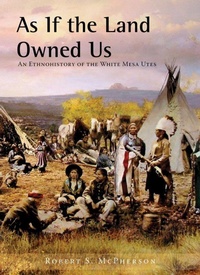
As If the Land Owned Us
An Ethnohistory of the White Mesa Utes
Published on 15. September 2011
Book
Paperback/Softback
448 pages
978-1-60781-145-9 (ISBN)
Description
The Ute people of White Mesa have a long, colorful, but neglected history in the Four Corners region. Although they ranged into the Great Basin, Southwest, and parts of the Rocky Mountains as hunters, gatherers, and warriors, southeastern Utah was home. There they adapted culturally and physically to the austere environment while participating in many of the well-known events of their times.
In As If the Land Owned Us, Robert McPherson has gathered the wisdom of White Mesa elders as they imparted knowledge about their land - place names, uses, teachings, and historic events tied to specific sites - providing a fresh insight into the lives of these little-known people. While there have been few published studies about the Southern Utes, this ethnohistory is the first to mix cultural and historic events. The book illustrates the life and times of the White Mesa Utes as they faced multiple changes to their lifeways. It is time for their history to be told in their terms.
In As If the Land Owned Us, Robert McPherson has gathered the wisdom of White Mesa elders as they imparted knowledge about their land - place names, uses, teachings, and historic events tied to specific sites - providing a fresh insight into the lives of these little-known people. While there have been few published studies about the Southern Utes, this ethnohistory is the first to mix cultural and historic events. The book illustrates the life and times of the White Mesa Utes as they faced multiple changes to their lifeways. It is time for their history to be told in their terms.
Reviews / Votes
"McPherson's ethnohistory of the White Mesa Ute people is exceptional. It is story and document, combining indigenous voices with non-Native accounts into a superbly crafted whole. It serves as a worthy model for any history-regional, ethnic, or otherwise-well fulfilling the author's aim to provide a 'bridge to contemporary generations' ?for a long forgotten people, their places, and times."-Catherine S. Fowler, University of Nevada, Reno"An essential source on the White Mesa Ute Indians. Setting the tone for each chapter, a moving introductory quotation from a Ute speaker illustrates attitudes and beliefs of the people, and the author offers several personal descriptions of people and places. A remarkable number of photographs, archival and contemporary, complement the narrative."-Colorado Book Review
More details
Language
English
Place of publication
Salt Lake City
United States
Product notice
Paperback (trade)
Unsewn / adhesive bound
Illustrations
100 photographs, 7 maps
Dimensions
Height: 277 mm
Width: 203 mm
Thickness: 23 mm
Weight
1225 gr
ISBN-13
978-1-60781-145-9 (9781607811459)
Copyright in bibliographic data and cover images is held by Nielsen Book Services Limited or by the publishers or by their respective licensors: all rights reserved.
Schweitzer Classification
Person
Robert S. McPherson is an associate professor at the College of Eastern Utah-San Juan Campus in Blanding, Utah, as well as an adjunct professor at the University of Utah. He is the author of a number of books on the history and cultures of the Four Corners region, including Comb Ridge and Its People: The Ethnohistory of a Rock, winner of the 2009 Utah Book Award for nonfiction.
Content
List of Maps
Acknowledgments
Introduction
1. White Mesa Ute Origins and PuwA-v: Creating the World, Empowering the Universe
2. "It Was as If the Land Owned Us": Ties to the Land, Resources for the People
3. Daily Life in an Austere Environment: Weenuche Beliefs and Life Cycle, 1880s
4. The Invasion Begins: Hispanic Entradas, American Trade, and the Mormon Mission, 1600-1855
5. "Enemies Like a Road Covered with Ice": Expanding Weenuche Dominance, 1855-1870
6. Decade of Decision, 1870-1880: Losing Land, Gaining Restrictions
7. Stemming the Flood, 1880-1882: Miners, Cowboys, and Settlers
8. Winning the Battles, Losing the War: Military Operations and Cowboy Incursions, 1882-1885
9. Agony with Little Ecstasy: Hunting, Travel, and Subsistence Curtailment, 1885-1895
10. The Replevied Present: San Juan County, the Southern Utes, and What Might Have Been, 1895-1900
11. "Only Bullets Talk Now": Turmoil and Dissent in a Shrinking World, 1900-1915
12. Posey and the Last White Uprising: Ending the Cycle of Violence, 1915-1923
13. Avikan: Remembering the Homeland, 1923-1941
14. Education, Economics, and Integration: Establishing the White Mesa Community, 1923-1960
15. People and Perception: Neighbors' Views Across a Chasm, 1860-1960
16. Circles, Trees, and Bears: Empowering the Weenuche Universe
17. Adoption, Adaptation, and Abandonment: Changing Weenuche Religious Practices, 1900-2010
18. Ironic Industries and Traditional Ties: Shifting Fortunes of the White Mesa Utes, 1950-2010
Epilogue
Notes
Bibliography
Index
Acknowledgments
Introduction
1. White Mesa Ute Origins and PuwA-v: Creating the World, Empowering the Universe
2. "It Was as If the Land Owned Us": Ties to the Land, Resources for the People
3. Daily Life in an Austere Environment: Weenuche Beliefs and Life Cycle, 1880s
4. The Invasion Begins: Hispanic Entradas, American Trade, and the Mormon Mission, 1600-1855
5. "Enemies Like a Road Covered with Ice": Expanding Weenuche Dominance, 1855-1870
6. Decade of Decision, 1870-1880: Losing Land, Gaining Restrictions
7. Stemming the Flood, 1880-1882: Miners, Cowboys, and Settlers
8. Winning the Battles, Losing the War: Military Operations and Cowboy Incursions, 1882-1885
9. Agony with Little Ecstasy: Hunting, Travel, and Subsistence Curtailment, 1885-1895
10. The Replevied Present: San Juan County, the Southern Utes, and What Might Have Been, 1895-1900
11. "Only Bullets Talk Now": Turmoil and Dissent in a Shrinking World, 1900-1915
12. Posey and the Last White Uprising: Ending the Cycle of Violence, 1915-1923
13. Avikan: Remembering the Homeland, 1923-1941
14. Education, Economics, and Integration: Establishing the White Mesa Community, 1923-1960
15. People and Perception: Neighbors' Views Across a Chasm, 1860-1960
16. Circles, Trees, and Bears: Empowering the Weenuche Universe
17. Adoption, Adaptation, and Abandonment: Changing Weenuche Religious Practices, 1900-2010
18. Ironic Industries and Traditional Ties: Shifting Fortunes of the White Mesa Utes, 1950-2010
Epilogue
Notes
Bibliography
Index