

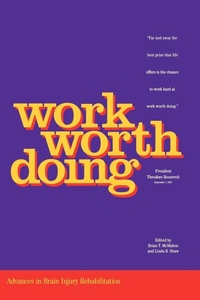
Work Worth Doing
Advances in Brain Injury Rehabilitation
1st Edition
Published on 1. January 1991
Book
Hardback
430 pages
978-1-878205-19-3 (ISBN)
Description
President Theodore Roosevelt once said, "Far and away the best prize that life offers is the chance to work hard at work worth doing." This quote is not only the source from which the title was borne, but also the philosophical approach toward TBI rehabilitation embraced by the 26 rehabilitation experts who wrote Work Worth Doing: Advances in Brain Injury Rehabilitation. This important, and possibly controversial, book of issues and methods addresses the full spectrum of vocational rehabilitation activities. Independent living, treatment generalization, criteria for evaluating TBI rehabilitation facilities, family involvement issues, and an entirely new perspective on the TBI rehabilitation industry are discussed.
More details
Language
English
Place of publication
London
United Kingdom
Publishing group
Taylor & Francis Ltd
Target group
College/higher education
Professional and scholarly
Dimensions
Height: 260 mm
Width: 183 mm
Thickness: 28 mm
Weight
1003 gr
ISBN-13
978-1-878205-19-3 (9781878205193)
Copyright in bibliographic data and cover images is held by Nielsen Book Services Limited or by the publishers or by their respective licensors: all rights reserved.
Schweitzer Classification
Other editions
Additional editions
E-Book
05/2021
1st Edition
Routledge
€73.99
Available for download
E-Book
05/2021
1st Edition
Routledge
€73.99
Available for download
Persons
Brian T. McMahon, Linda R. Shaw
Content
Section 1 - Management
Ethics in Business Practices, Brian T. McMahon, Ph.D., C.R.C.
The Outpatient Setting: The Preferred Context for Post-Acute Rehabilitation, Brian T. McMahon, Ph.D. and Linda R. Shaw, Ph.D., C.R.C.
Section 2 - Vocational Re-entry
Neuropsychological Evaluation: A Functional and Behavioral Approach, Jack G. Dial, Ph.D., Fong Chan, Ph.D., Roy Tunick, Ed.D., Steven G. Gray, Ph.D., and Michelle Marme, Ph.D.
Neuropsychological Evaluation, Rehabilitation, and Return-to-Work: A Case Study, Jack G. Dial, Ph.D., Fong Chan, Ph.D., Steven G. Gray, Ph.D., Roy Tunick, Ed.D., and Gwen Roldan, M.S.
An Ecological Approach to Vocational Evaluation, Fong Chan, Ph.D., Jack G. Dial, Ph.D., Robert Schleser, Ph.D., Brian T. McMahon, Ph.D., C.R.C., Linda R. Shaw, Ph.D., C.R.C., Michelle Marme, Ph.D., and Chow S. Lam, Ph.D.
Applied Behavior Analysis and Work Adjustment Training, Frank D. Lewis, Ph.D. and Craig F. Bitter, M.S.
Supported Employment and the Vocational Restoration Process, David P. Mahaffey, M.A., C.R.C. and Mary P. Ridgely, M.S.
New Avenues to Job Placement: The Advantages of Natural Supports, Robert T. Fraser, Ph.D., C.R.C.
Blueprint for Success in Vocational Restoration: The Work Re-Entry Program, Deborah L. Abrams, M.Ed. and William J. Haffey, Ph.D.
Section 3 - Community Re-entry
Preventing Post-Injury Alcohol-Related Problems: A Behavioral Approach, Mervin J. Langley, Ph.D.
The Life Coach Model of Community Re-Entry, Michael L. Jones, Ph.D., Randall W. Evans, Ph.D., Peter D. Patrick, Ph.D., and J. Jepson Wulff, Ph.D.
Community Skills Training, Lynn P. Cullity, O.T.R., Jodi D. Jackson, O.T.R., and Linda R. Shaw, Ph.D., C.R.C.
Programming for Skill Maintenance and Generalization, Charles J. Durgin, M.S., Lynn P. Cullity, O.T.R., and Patrick M.
Devine, M.A.
Sequencing Family Services in Response to Changing Needs, Linda R. Shaw, Ph.D., C.R.C.
Ethics in Business Practices, Brian T. McMahon, Ph.D., C.R.C.
The Outpatient Setting: The Preferred Context for Post-Acute Rehabilitation, Brian T. McMahon, Ph.D. and Linda R. Shaw, Ph.D., C.R.C.
Section 2 - Vocational Re-entry
Neuropsychological Evaluation: A Functional and Behavioral Approach, Jack G. Dial, Ph.D., Fong Chan, Ph.D., Roy Tunick, Ed.D., Steven G. Gray, Ph.D., and Michelle Marme, Ph.D.
Neuropsychological Evaluation, Rehabilitation, and Return-to-Work: A Case Study, Jack G. Dial, Ph.D., Fong Chan, Ph.D., Steven G. Gray, Ph.D., Roy Tunick, Ed.D., and Gwen Roldan, M.S.
An Ecological Approach to Vocational Evaluation, Fong Chan, Ph.D., Jack G. Dial, Ph.D., Robert Schleser, Ph.D., Brian T. McMahon, Ph.D., C.R.C., Linda R. Shaw, Ph.D., C.R.C., Michelle Marme, Ph.D., and Chow S. Lam, Ph.D.
Applied Behavior Analysis and Work Adjustment Training, Frank D. Lewis, Ph.D. and Craig F. Bitter, M.S.
Supported Employment and the Vocational Restoration Process, David P. Mahaffey, M.A., C.R.C. and Mary P. Ridgely, M.S.
New Avenues to Job Placement: The Advantages of Natural Supports, Robert T. Fraser, Ph.D., C.R.C.
Blueprint for Success in Vocational Restoration: The Work Re-Entry Program, Deborah L. Abrams, M.Ed. and William J. Haffey, Ph.D.
Section 3 - Community Re-entry
Preventing Post-Injury Alcohol-Related Problems: A Behavioral Approach, Mervin J. Langley, Ph.D.
The Life Coach Model of Community Re-Entry, Michael L. Jones, Ph.D., Randall W. Evans, Ph.D., Peter D. Patrick, Ph.D., and J. Jepson Wulff, Ph.D.
Community Skills Training, Lynn P. Cullity, O.T.R., Jodi D. Jackson, O.T.R., and Linda R. Shaw, Ph.D., C.R.C.
Programming for Skill Maintenance and Generalization, Charles J. Durgin, M.S., Lynn P. Cullity, O.T.R., and Patrick M.
Devine, M.A.
Sequencing Family Services in Response to Changing Needs, Linda R. Shaw, Ph.D., C.R.C.