

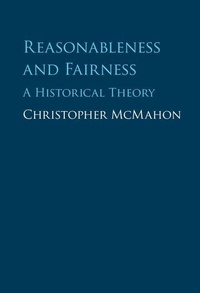
Reasonableness and Fairness
A Historical Theory
Published on 3. November 2016
Book
Hardback
264 pages
978-1-107-17717-8 (ISBN)
Description
We all know, or think we know, what it means to say that something is 'reasonable' or 'fair', but what exactly are these concepts and how have they evolved and changed over the course of history? In this book, Christopher McMahon explores reasonableness, fairness, and justice as central concepts of the morality of reciprocal concern. He argues that the basis of this morality evolves as history unfolds, so that forms of interaction that might have been morally acceptable in the past are judged unacceptable today. The first part of his study examines the notions of reasonableness and fairness as they are employed in ordinary practical thought, and the second part develops a constructivist theory to explain why and how this part of morality can undergo historical development without arriving at any final form. His book will interest scholars of ethics, political theory, and the history of ideas.
More details
Language
English
Place of publication
Cambridge
United Kingdom
Target group
College/higher education
Professional and scholarly
Illustrations
Worked examples or Exercises
Dimensions
Height: 235 mm
Width: 157 mm
Thickness: 19 mm
Weight
538 gr
ISBN-13
978-1-107-17717-8 (9781107177178)
Copyright in bibliographic data and cover images is held by Nielsen Book Services Limited or by the publishers or by their respective licensors: all rights reserved.
Schweitzer Classification
Other editions
Additional editions
E-Book
01/2017
Cambridge University Press
€23.49
Available for download
E-Book
11/2016
Cambridge University Press
€19.49
Available for download
Person
Christopher McMahon is Professor of Philosophy at the University of California, Santa Barbara. His previous books include Reasonable Disagreement: A Theory of Political Morality (Cambridge, 2009) and Collective Rationality and Collective Reasoning (Cambridge, 2001).
Content
Acknowledgements; Introduction; Part I. The Substance of Reciprocal Concern: 1. Fairness; 2. Reasonableness; 3. Political morality; Part II. The History of Reciprocal Concern: 4. Proper functioning and practical judgement; 5. A historical theory of reasons; 6. Naturalism and moral history; 7. The history of political morality; References; Index.