

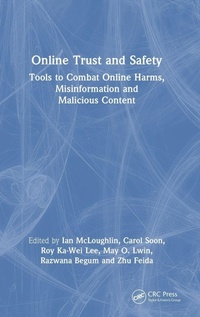
Online Trust and Safety
Tools to Combat Online Harms, Misinformation and Malicious Content
1st Edition
Published on 27. May 2026
Book
Hardback
292 pages
978-1-032-98677-7 (ISBN)
Description
The promise of the internet was open knowledge and connection; the reality includes manipulation, abuse and mistrust. This book confronts that gap with a practice-oriented guide to designing, analysing and governing safer digital ecosystems.
Authored by experts across academia, industry and government, it is organized around three pillars - (a) safety by design and provenance, (b) threat detection and analysis and (c) response and mitigation - to embed safeguards, surface emerging harms and execute effective incident response at scale. Chapters pair empirical studies with deployable techniques, from evaluation metrics and audits to governance and enforcement frameworks, situating technical advances within real-world constraints of cost, scale, privacy, equity and culture.
This resource offers researchers, policymakers, platform builders, educators and civil society a clear map of today's landscape as well as a pragmatic agenda for what can and should come next: transparent provenance, robust measurement and accountable interventions that earn user trust.
Authored by experts across academia, industry and government, it is organized around three pillars - (a) safety by design and provenance, (b) threat detection and analysis and (c) response and mitigation - to embed safeguards, surface emerging harms and execute effective incident response at scale. Chapters pair empirical studies with deployable techniques, from evaluation metrics and audits to governance and enforcement frameworks, situating technical advances within real-world constraints of cost, scale, privacy, equity and culture.
This resource offers researchers, policymakers, platform builders, educators and civil society a clear map of today's landscape as well as a pragmatic agenda for what can and should come next: transparent provenance, robust measurement and accountable interventions that earn user trust.
More details
Language
English
Place of publication
London
United Kingdom
Publishing group
Taylor & Francis Ltd
Target group
College/higher education
Professional and scholarly
Professional Practice & Development, Professional Reference, and Undergraduate Advanced
Product notice
Laminated cover
Illustrations
6 s/w Zeichnungen, 8 s/w Tabellen, 13 s/w Abbildungen, 7 s/w Photographien bzw. Rasterbilder
21 Tables, black and white; 6 Line drawings, black and white; 7 Halftones, black and white; 13 Illustrations, black and white
Dimensions
Height: 234 mm
Width: 156 mm
Thickness: 19 mm
Weight
610 gr
ISBN-13
978-1-032-98677-7 (9781032986777)
Copyright in bibliographic data and cover images is held by Nielsen Book Services Limited or by the publishers or by their respective licensors: all rights reserved.
Schweitzer Classification
Other editions
Additional editions
Ian Mcloughlin | Carol Soon | Roy Ka-Wei Lee
Online Trust and Safety
Tools to Combat Online Harms, Misinformation and Malicious Content
E-Book
05/2026
1st Edition
CRC Press
€68.49
Available for download
Ian Mcloughlin | Carol Soon | Roy Ka-Wei Lee
Online Trust and Safety
Tools to Combat Online Harms, Misinformation and Malicious Content
E-Book
05/2026
1st Edition
CRC Press
€68.49
Available for download
Ian Mcloughlin | Carol Soon | Roy Ka-Wei Lee
Online Trust and Safety
Tools to Combat Online Harms, Misinformation and Malicious Content
Book
05/2026
1st Edition
CRC Press
€65.00
Shipment within 10-20 days
Persons
Ian McLoughlin is a professor at the Singapore Institute of Technology (SIT). His research work is in novel Artificial Intelligence (AI) techniques for deployment in speech and audio systems. He has published over 300 peer-reviewed papers, contributed to research achieving industry impact in four countries and authored textbooks with Cambridge University Press and McGraw-Hill.
Carol Soon is the Deputy Head and an associate professor (Practice) in the Department of Communications and New Media, National University of Singapore. She is also Vice Chair of Singapore's Media Literacy Council and a member of the World Economic Forum's Global Future Council on Information Integrity. Her research interests are in false information, online safety, digital literacy and inclusion, media regulation, new media and activism and public engagement and deliberation.
Roy Ka-Wei Lee is an assistant professor, the Cheng Tsang Man Early Career Chair Professor and the Associate Head (Research) of the Information Systems Technology and Design (ISTD) Pillar at Singapore University of Technology and Design (SUTD). He leads the Social AI Studio, a dedicated research group developing cutting-edge social AI systems. Beyond academia, he is a smart nation fellow at GovTech, collaborating with public agencies to enhance the safe deployment of AI systems across government.
May Lwin is the Vice Provost (Faculty Affairs) and President's Chair Professor of Communication Studies at Wee Kim Wee School of Communication and Information (WKWSCI), Nanyang Technological University (NTU). She also serves as Joint Professor in the NTU LKC School of Medicine and is the director of Asian Health Behaviour Insights and Interventions (HABITS). A Fellow of the International Communication Association (ICA), she specialises in health communication and well-being of communities. Her research in online safety arena focuses on cybersafety issues regarding the young and vulnerable users, and the role of parents as well as educators in guiding the young.
Razwana Begum is the Head of the Global Security and Strategy Graduate Programme at the School of Humanities and Behavioural Sciences at the Singapore University of Social Sciences (SUSS). Her research interests include criminology, governance and public safety. She served as a Nominated Member of Singapore's 14th Parliament (2023-2025), where she focused on advancing issues related to public safety, women and children.
Zhu Feida teaches computer science and is the Associate Dean, Partnerships and Engagement, at the Singapore Management University. One of his research areas is in safety and security, such as privacy-preserving data sharing and analytics.
Carol Soon is the Deputy Head and an associate professor (Practice) in the Department of Communications and New Media, National University of Singapore. She is also Vice Chair of Singapore's Media Literacy Council and a member of the World Economic Forum's Global Future Council on Information Integrity. Her research interests are in false information, online safety, digital literacy and inclusion, media regulation, new media and activism and public engagement and deliberation.
Roy Ka-Wei Lee is an assistant professor, the Cheng Tsang Man Early Career Chair Professor and the Associate Head (Research) of the Information Systems Technology and Design (ISTD) Pillar at Singapore University of Technology and Design (SUTD). He leads the Social AI Studio, a dedicated research group developing cutting-edge social AI systems. Beyond academia, he is a smart nation fellow at GovTech, collaborating with public agencies to enhance the safe deployment of AI systems across government.
May Lwin is the Vice Provost (Faculty Affairs) and President's Chair Professor of Communication Studies at Wee Kim Wee School of Communication and Information (WKWSCI), Nanyang Technological University (NTU). She also serves as Joint Professor in the NTU LKC School of Medicine and is the director of Asian Health Behaviour Insights and Interventions (HABITS). A Fellow of the International Communication Association (ICA), she specialises in health communication and well-being of communities. Her research in online safety arena focuses on cybersafety issues regarding the young and vulnerable users, and the role of parents as well as educators in guiding the young.
Razwana Begum is the Head of the Global Security and Strategy Graduate Programme at the School of Humanities and Behavioural Sciences at the Singapore University of Social Sciences (SUSS). Her research interests include criminology, governance and public safety. She served as a Nominated Member of Singapore's 14th Parliament (2023-2025), where she focused on advancing issues related to public safety, women and children.
Zhu Feida teaches computer science and is the Associate Dean, Partnerships and Engagement, at the Singapore Management University. One of his research areas is in safety and security, such as privacy-preserving data sharing and analytics.
Content
1. Developing Human Resiliency to Cyber Misinformation through Critical Thinking. 2. Improving Content Integrity via Provenance by Design: An Overview of Current and Emerging Approaches. 3. The Dual Personas of Social Media Bots. 4. Jailbreaking Large Language Models: Vulnerabilities and Countermeasures. 5. A Practical and Empirical Approach to Safety Testing for LLM-Powered Apps. 6. Factuality of Large Language Models: An Adversarial Perspective. 7. Stamping Out Online Sexual Exploitation of Children: Ground Support for Victims, Community Efforts, and Industry Responses. 8. Enhancing Online Safety: Policy Toolkit for Mitigating Digital Threats. 9. Mitigating Harm, Defending Integrity: The Social Media Disinformation Landscape in the Philippines. 10. Online Harm Prevention on the Frontline. 11. Information Verification Behaviours of Singaporeans in Early vs. Late-Pandemic Stages. 12. The Use of Narratives in Cyber-Safety Education of Children and Adolescents. 13. News-Finds-Me Perception and Its Roles in Online Trust and Safety. 14. Navigating Trust in the Digital Age: Addressing Technology-Facilitated Sexual Violence. 15. The Psychology of Avatars: Unveiling the Hidden Risks in Virtual Playgrounds. 16. Rethinking Counternarratives: Toward Preventing Online Radicalization in Southeast Asia. 17. The Unexplored Role of Dramaturgy in Countering Violent Extremism (CVE) Online.