

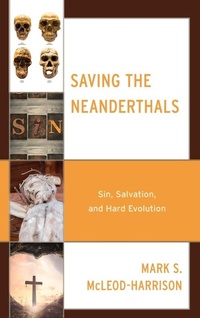
Saving the Neanderthals
Sin, Salvation, and Hard Evolution
Published on 29. October 2019
Book
Hardback
170 pages
978-1-9787-0654-5 (ISBN)
Description
What happens when the wrench of evolution is dropped into the hopper of Christian theology? Written by a philosopher, Saving the Neanderthals takes evolution as its foil and shows what might have to change in Christian theology in order to make theology compatible with evolution. If the Christian faith is shown consistent with what Mark S. McLeod-Harrison calls "hard evolution," then the softer versions will also be compatible. Indeed, that is exactly what the book argues, specifically for the Christian doctrines of sin and salvation. These doctrines typically rely on some fairly strong realist version of essentialism, which hard evolution denies; but McLeod-Harrison proposes an approach to sin and salvation that is compatible with the anti-essentialist claims of hard evolution.
Reviews / Votes
In Saving the Neanderthals, Christian philosopher Mark McLeod-Harrison brings the conceptual resources of philosophy to bear on the question of whether theologically orthodox faith (particularly the doctrines of sin and salvation) can be sustained in light of so-called 'hard-evolution'. Thus McLeod-Harrison deploys a range of philosophical concepts which are rarely employed in the faith-and-evolution literature. These include modal logic, natural kinds versus anti-essentialism, methodological naturalism versus metaphysical naturalism, human uniqueness versus biological persons, and the scope of the image of God viz. human ontological solidarity. McLeod-Harrison concludes that, in light of hard evolution, traditional doctrines of sin and salvation need to be modified, yet these modified versions still fall within the scope of Christian orthodoxy. Consequently, even if hard evolution is the way biological life arose on our planet, Christian faith has 'nothing to fear' from hard evolution. McLeod-Harrison models the Christian scholar facing challenging questions of our day head-on. He has provided a stimulating and significant addition to current thinking on the relationship between Christian faith and evolution, and, more broadly, an important contribution to the ancient enterprise of fides quarens intellectum. -- Chris Barrigar, author of Freedom All the Way Up: God and the Meaning of Life in a Scientific Age Rather than editing evolutionary science in order to make it seem less of a challenge to Christians than it really is, McLeod-Harrison is determined to see what Christian theology might look like if it opens itself fully and honestly to Darwin's great revolution. Readers may be surprised by what he finds. -- John F. Haught, Georgetown University What happens to the Christian doctrine of salvation if we reject biological essentialism - the notion that biological species are distinct and that therefore human beings can be understood as being special - as evolutionary theory compels us to do? In Saving the Neanderthals, Mark McLeod-Harrison carefully and thoughtfully helps us rethink the traditional loci of a doctrine of salvation: image of God, sin, love, and redemption. Using Neanderthals as a particular focus for investigation, he skillfully demonstrates that accepting central claims of evolutionary theory does not force us to reject central claims of Christian theology. -- Christian Early, James Madison University This thought-provoking book probes a number of important philosophical quandaries at stake when considering how key Christian doctrines relate to metaphysical naturalism that is implicit in standard biological theories of human evolution. This lucid work refuses to gloss over points of tension. At stake is how a Christian theology might respond to the paradoxical biological concept of the fluidity yet distinctiveness of species. For the author, that boils down to the theological significance of human specialness in tension with anti-essentialist views. That specialness is presupposed in the doctrines of sin and salvation. Original sin is not just incompatible with evolutionary theory, it also opens up philosophical quandaries. Regardless of whether the reader accepts all the arguments in this book, they will agree that Neanderthals are good creatures to think with, they invite deeper questions such as are they, like modern humans, also caught up in the Christian story of salvation? The author notes the evolutionary lottery that rendered modern humans as the one human species left standing, and in this sense, he challenges whether humans are really special after all. In a theoretical sense, Neanderthals might well have been the redeemers too. -- Celia Deane-Drummond, Oxford University McLeod-Harrison tackles an important question in this book, and it is not one of mere historic curiosity. Fundamentally he is asking, What does it mean to be a person created in the image of God? It is refreshing to see this question tackled with keen philosophical acumen. The issues are not primarily scientific, though of course they need to be informed by the relevant scientific discoveries. McLeod-Harrison stipulates what he calls "hard evolution" for the sake of argument, and examines whether some version of orthodox Christian faith is consistent with that. Particularly tricky for his account is the seeming denial of essentialism that is entailed by hard evolution. Even if we might be able to reliably group individuals today into what we call the species Homo sapiens, when we look back in time at our evolutionary history, that task becomes hugely problematic. Thus, McLeod-Harrison's question about whether Neanderthals could be saved, is an important one. Not all philosophers will agree with his analysis, but they should grapple with his arguments. -- Jim Stump, Vice President, BioLogos.orgMore details
Language
English
Place of publication
United States
Publishing group
Bloomsbury Publishing Plc
Target group
Professional and scholarly
Dimensions
Height: 235 mm
Width: 157 mm
Thickness: 14 mm
Weight
406 gr
ISBN-13
978-1-9787-0654-5 (9781978706545)
Copyright in bibliographic data and cover images is held by Nielsen Book Services Limited or by the publishers or by their respective licensors: all rights reserved.
Schweitzer Classification
Other editions
Additional editions
E-Book
10/2019
1st Edition
Lexington Books/Fortress Academic
€94.99
Available for download
E-Book
10/2019
1st Edition
Lexington Books/Fortress Academic
€94.99
Available for download
Person
Mark S. McLeod-Harrison is professor of philosophy at George Fox University.
Content
Chapter 1: Did Jesus Die for Neanderthals?
Chapter 2: The Issues
Chapter 3: Are Humans Special?
Chapter 4: Is There a Human Species?
Chapter 5: Theologizing Evolution's Challenges
Chapter 6: The Ubiquity of Sin and the Universality of Saintly Love
Chapter 7: Essences, Sin, and Our Neanderthal Sisters and Brothers
Chapter 8: Uniqueness and the Image of God
Chapter 9: Love, Altruism, and the Inevitability of Sin
Chapter 10: The Redemptive Work of the Biological Person, Jesus
Chapter 11: Saving the Neanderthals
Appendix: Is a Literal Adam and Eve Necessary?
Chapter 2: The Issues
Chapter 3: Are Humans Special?
Chapter 4: Is There a Human Species?
Chapter 5: Theologizing Evolution's Challenges
Chapter 6: The Ubiquity of Sin and the Universality of Saintly Love
Chapter 7: Essences, Sin, and Our Neanderthal Sisters and Brothers
Chapter 8: Uniqueness and the Image of God
Chapter 9: Love, Altruism, and the Inevitability of Sin
Chapter 10: The Redemptive Work of the Biological Person, Jesus
Chapter 11: Saving the Neanderthals
Appendix: Is a Literal Adam and Eve Necessary?