

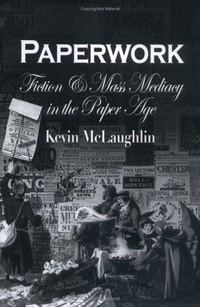
Paperwork
Fiction and Mass Mediacy in the Paper Age
Published on 22. September 2005
Book
Hardback
192 pages
978-0-8122-3888-4 (ISBN)
Description
"The Paper Age" is the phrase coined by Thomas Carlyle in 1837 to describe the monetary and literary inflation of the French Revolution-an age of mass-produced "Bank-paper" and "Book-paper." Carlyle's phrase is suggestive because it points to the particular substance-paper-that provides the basis for reflection on the mass media in much popular fiction appearing around the time of his historical essay. Rather than becoming a metaphor, however, paper in some of this fiction seems to display the more complex and elusive character of what Walter Benjamin evocatively calls "the decline of the aura." The critical perspective elaborated by Benjamin serves as the point of departure for the readings of paper proposed in Paperwork.
Kevin McLaughlin argues for a literary-critical approach to the impact of the mass media on literature through a series of detailed interpretations of paper in fiction by Poe, Stevenson, Melville, Dickens, and Hardy. In this fiction, he argues, paper dramatizes the "withdrawal," as Benjamin puts it, of the "here and now" of the traditional work of art into the dispersing or distracting movement of the mass media. Paperwork seeks to challenge traditional concepts of medium and message that continue to inform studies of print culture and the mass media especially in the wake of industrialized production in the early nineteenth century. It breaks new ground in the exploration of the difference between mass culture and literature and will appeal to cultural historians and literary critics alike.
Kevin McLaughlin argues for a literary-critical approach to the impact of the mass media on literature through a series of detailed interpretations of paper in fiction by Poe, Stevenson, Melville, Dickens, and Hardy. In this fiction, he argues, paper dramatizes the "withdrawal," as Benjamin puts it, of the "here and now" of the traditional work of art into the dispersing or distracting movement of the mass media. Paperwork seeks to challenge traditional concepts of medium and message that continue to inform studies of print culture and the mass media especially in the wake of industrialized production in the early nineteenth century. It breaks new ground in the exploration of the difference between mass culture and literature and will appeal to cultural historians and literary critics alike.
Reviews / Votes
"McLaughlin has done scholars in many fields a great service, and it is fitting that he should play a leading role in a potentially very fruitful Victorianist reckoning with Benjamin. This account of distraction will also demand and repay the attention of scholars interested in book history, new economic criticism, and transatlantic fiction in general." (Victorian Studies) "A finely honed and lively guide to the role of paper in literary production at this crucial point in the modern age." (Yearbook of English Studies)More details
Series
Language
English
Place of publication
Pennsylvania
United States
Target group
College/higher education
Professional and scholarly
Product notice
Paper over boards
Illustrations
8 illus.
Dimensions
Height: 237 mm
Width: 159 mm
Thickness: 20 mm
Weight
435 gr
ISBN-13
978-0-8122-3888-4 (9780812238884)
Copyright in bibliographic data and cover images is held by Nielsen Book Services Limited or by the publishers or by their respective licensors: all rights reserved.
Schweitzer Classification
Other editions
Additional editions
E-Book
06/2011
1st Edition
University of Pennsylvania Press
€65.29
Available for download
Person
Kevin McLaughlin is Professor of English and Comparative Literature at Brown University. He is cotranslator of Walter Benjamin's Arcades Project and author of Writing in Parts: Imitation and Exchange in Nineteenth-Century Literature.
Content
Frequently Cited Texts
Introduction: Apparitions of Paper
1. Distraction in America: Paper, Money, Poe
2. Off the Map: Stevenson's Polynesian Fiction
3. Transatlantic Connections: "Paper Language" in Melville
4. The Paper State: Collective Breakdown in Dickens's Bleak House
5. Pretending to Read: Hardy's The Mayor of Casterbridge
Afterword: The Novel Collective
Notes
Selected Bibliography
Index
Acknowledgments
Introduction: Apparitions of Paper
1. Distraction in America: Paper, Money, Poe
2. Off the Map: Stevenson's Polynesian Fiction
3. Transatlantic Connections: "Paper Language" in Melville
4. The Paper State: Collective Breakdown in Dickens's Bleak House
5. Pretending to Read: Hardy's The Mayor of Casterbridge
Afterword: The Novel Collective
Notes
Selected Bibliography
Index
Acknowledgments