

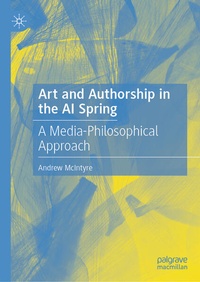
Art and Authorship in the AI Spring
Description
Following the release of ChatGPT, public fascination with the field of artificial intelligence (AI) has drastically intensified, stimulating an unprecedented rise in the financing, development and deployment of AI technologies across society. However, the current hype around AI also presents uncomfortable questions about the role of human agency in culture, particularly in practices of art and communications where the arrival of convincing AI-generated media has raised the prospect that human authors and artists may be sidelined or replaced. "Art and Authorship in the AI Spring" takes a step back from the modern situation to, instead, focus on the decade preceding the release of ChatGPT when our current understanding of AI was only beginning to take form. During this brief period of rapid technological development, many artists were already experimenting with emerging AI technologies as a means of probing traditional notions of authorship from the production of AI-generated paintings, poetry and films to more experimental practices utilizing deepfake techniques, biometric recognition systems and large language models. By critically analysing various instances of AI-generated art and media during this period, "Art and Authorship in the AI Spring" explores this central question of authorship through the unique and often overlooked media philosophy of Vilém Flusser that looks beyond aesthetics to instead consider the technical conditions of AI technology itself. In reconsidering this recent history of AI-generated media from this perspective, this book aims to shed new light on significant ongoing debates around the societal impacts of AI technologies today.
"We urgently need more interventions like McIntyre's that remind us of the short yet already strangely forgotten history of generative AI amid today's relentless hype. This book recovers the past decade of developments that too often vanish from public debate, to understand where we are and how we got here. It resists narrowing the ethical frame of generative AI to solely legal terms, instead opening up its wider societal and philosophical implications. We can all learn from McIntyre's creative conceptualisations, such as "weird media", to better understand how generative AI reshapes authorship, creativity and our cultural consumption and production."
- Tobias Blanke, Professor of Artificial Intelligence and Humanities, University of Amsterdam
Reviews / Votes
"As AI opens up new pathways for authorship, cultural production and artistic creation, we desperately need broader historical and theoretical trajectories to make sense of the ongoing changes. Art and Authorship in the AI Spring provides just this. Looking back at the decade preceding the emergence of ChatGPT and the AI hype, and activating a rich theoretical tradition centred around the work of Brazilian media philosopher Vilém Flusser, this acute and thoughtful book is the ideal compass for anyone interested in exploring from a novel angle the intersections between AI, art and communication." (Simone Natale, Associate Professor in Media Theory and History, University of Turin)
"Opening the black box of generative AI, but at the same time resisting mere technological determinism, McIntyre reveals its socio-technical agencies, both in terms of creative authorship and big tech companies authority. Focusing on the incubation phase of generative AI "before the hype" (when its structures were still intelligible in creative usage), this study - in media-phenomenological alliance with Flusser - addresses the "gestures" of AI in terms of authorship with precise analytics and ethical concern. With his final warning against "cultural extinction" as a collateral damage of displaced human authorship by AI, McIntyre carries media philosophy beyond the subsymbolical AI turn." (Wolfgang Ernst, former Chair of Media Theories at Humboldt University of Berlin)
"Both highly original and rigorously argued, this book outlines the way concepts of authorship and creativity are bound up with advanced technological systems. McIntyre develops an entirely new take both on the old humanist concept of authorship as well as the technical images produced by AI. It is a must read for anyone interested in understanding the power of technology to reshape culture and what it means to be human amongst artificially 'creative' systems." (Timothy Barker, Professor of Media Technology and Aesthetics, University of Glasgow)
"We urgently need more interventions like McIntyre's that remind us of the short yet already strangely forgotten history of generative AI amid today's relentless hype. This book recovers the past decade of developments that too often vanish from public debate, to understand where we are and how we got here. It resists narrowing the ethical frame of generative AI to solely legal terms, instead opening up its wider societal and philosophical implications. We can all learn from McIntyre's creative conceptualisations, such as "weird media", to better understand how generative AI reshapes authorship, creativity and our cultural consumption and production." (Tobias Blanke, Professor of Artificial Intelligence and Humanities, University of Amsterdam)
More details
Other editions
Additional editions
Person
Andrew McIntyre is a media theorist based in the UK. His work explores the social, cultural and political implications of AI-generated media and sits at the intersection of media philosophy, philosophy of technology and AI ethics. McIntyre holds a PhD in Film and Television Studies from the University of Glasgow and he has lectured and conducted research at the University of Amsterdam, University of Stirling and Humboldt University of Berlin.
Content
Chapter 1 : Before the Hype.- Chapter 2 : An Archaeology of the Author.- Chapter 3 : The Infinite Portrait.- Chapter 4 : Virtually Unrecognisable.- Chapter 5 : Weird Politics.- Chapter 6 : In the Eye of the Beholder.- Chapter 7 : Cries the Machine.- Chapter 8 : Extinction Culture.