

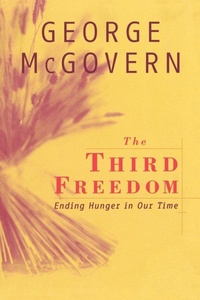
The Third Freedom
Ending Hunger in Our Time
Published on 29. December 2001
Book
Paperback/Softback
176 pages
978-0-7425-2125-4 (ISBN)
Description
In his 1941 State of the Union address, President Franklin D. Roosevelt described a future world founded on four essential freedoms - freedom of speech, freedom of religion, freedom from want, and freedom from fear. Sixty years later, nearly 20 percent of the earth's population are still seeking the third freedom, "which," Roosevelt said, "translated into world terms, means economic understanding which will secure to every nation a healthy peacetime life for its inhabitants - everywhere in the world."
In The Third Freedom, former three-term Democratic senator George McGovern describes his strategy to end world hunger in our time. When McGovern was the Democrats' nominee for president in 1972, 35 percent of the people in the world were hungry. By 1996, that figure was cut in half. Now, McGovern says, is the time to end world hunger entirely. "Ending it (hunger)," he says, "is a greater moral imperative now than ever before, because for the first time humanity has the instruments in hand to defeat this cruel enemy at a very reasonable cost."
McGovern raises two central questions: first, what would it cost for the nations of the world to end hunger and second, what would be the cost if hunger is allowed to persist at its present levels? McGovern concludes, "I can think of no investment that would profit the international community more than erasing hunger from the face of the earth." We have the ability to end hunger, McGovern says, now it's just a matter of finding the leadership.
In The Third Freedom, former three-term Democratic senator George McGovern describes his strategy to end world hunger in our time. When McGovern was the Democrats' nominee for president in 1972, 35 percent of the people in the world were hungry. By 1996, that figure was cut in half. Now, McGovern says, is the time to end world hunger entirely. "Ending it (hunger)," he says, "is a greater moral imperative now than ever before, because for the first time humanity has the instruments in hand to defeat this cruel enemy at a very reasonable cost."
McGovern raises two central questions: first, what would it cost for the nations of the world to end hunger and second, what would be the cost if hunger is allowed to persist at its present levels? McGovern concludes, "I can think of no investment that would profit the international community more than erasing hunger from the face of the earth." We have the ability to end hunger, McGovern says, now it's just a matter of finding the leadership.
More details
Language
English
Place of publication
United States
Publishing group
Bloomsbury Publishing Plc
Product notice
Paperback (trade)
Dimensions
Height: 229 mm
Width: 152 mm
Thickness: 10 mm
Weight
262 gr
ISBN-13
978-0-7425-2125-4 (9780742521254)
Copyright in bibliographic data and cover images is held by Nielsen Book Services Limited or by the publishers or by their respective licensors: all rights reserved.
Schweitzer Classification
Person
George McGovern was U.S. Senator from South Dakota from 1963 to 1981, and the Democratic candidate for president in 1972. He was the first director of the U.S. Food for Peace Program. McGovern is now U.S. Ambassador to the UN Agencies on Food and Agriculture in Rome.
Content
Chapter 1 A Strategy to Defeat World Hunger
Chapter 2 Food for Peace
Chapter 3 Hunger: U.S.A.
Chapter 4 Women and Girls
Chapter 5 The Vicious Circle: Hunger, Conflict, More Hunger
Chapter 6 Water
Chapter 7 Ending World Hunger in Our Time
Chapter 2 Food for Peace
Chapter 3 Hunger: U.S.A.
Chapter 4 Women and Girls
Chapter 5 The Vicious Circle: Hunger, Conflict, More Hunger
Chapter 6 Water
Chapter 7 Ending World Hunger in Our Time