

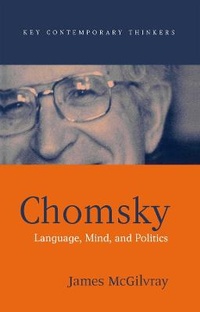
Chomsky
Language, Mind and Politics
Published on 23. August 1999
Book
Hardback
288 pages
978-0-7456-1887-6 (ISBN)
Description
Noam Chomsky is well known as a linguist and as a political thinker. He is less well known as a philosopher. This is unfortunate, because his philosophical work connects his political views and his work as a scientist of language. His rationalist philosophical views tie common-sense understandings of human action and decision (including political thought and action) to that human mental capacity we call language. The key to Chomsky's overall intellectual project lies in what he has to say about a biologically based human nature. To explain his view of human nature, McGilvray begins by distinguishing common-sense understanding (which includes the domains of economic, social, political and linguistic behaviour) from scientific knowledge of the mind. He then outlines the picture of the mind that underlies the distinction between common sense and science. This picture of the mind is shown to develop from Chomsky's attempt to address some basic observations concerning how language is acquired and used - the "poverty of stimulus" and the "creative aspects of language use".
Like some seventeenth-, eighteenth- and nineteenth-century thinkers, Chomsky seeks to account for these observations by producing a rationalist account of human nature. McGilvray then explores the connection between this account of human nature and Chomsky's linguistic and political work. Chomsky's revitalized rationalism has profound implications for both the science of the human mind ('cognitive science') and for an understanding of human action. No responsible individual can afford to ignore it. This book will be of interest to second-year undergraduates and above in linguistics, philosophy, politics and political theory, sociology and social theory.
Like some seventeenth-, eighteenth- and nineteenth-century thinkers, Chomsky seeks to account for these observations by producing a rationalist account of human nature. McGilvray then explores the connection between this account of human nature and Chomsky's linguistic and political work. Chomsky's revitalized rationalism has profound implications for both the science of the human mind ('cognitive science') and for an understanding of human action. No responsible individual can afford to ignore it. This book will be of interest to second-year undergraduates and above in linguistics, philosophy, politics and political theory, sociology and social theory.
More details
Series
Language
English
Place of publication
Oxford
United Kingdom
Target group
College/higher education
Professional and scholarly
Illustrations
8 figures, references, bibliography
Dimensions
Height: 229 mm
Width: 152 mm
Weight
870 gr
ISBN-13
978-0-7456-1887-6 (9780745618876)
Copyright in bibliographic data and cover images is held by Nielsen Book Services Limited or by the publishers or by their respective licensors: all rights reserved.
Schweitzer Classification
Other editions
Content
Abbreviations. Introduction. 1. Common Sense and Science. 2. Mapping the Mind. 3. Poverty, Creativity, and Making the World. 4. Languages and the Science of Language. 5. How to Make an Expression. 6. Meanings and Their Use. 7. Anarchosyndicalism and the Responsible Intellectual. 8. Human Nature and Ideal Social Organization. Notes. References. Index.