

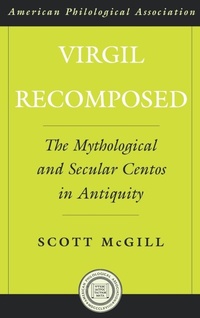
Virgil Recomposed
The Mythological and Secular Centos in Antiquity
Published on 18. August 2005
Book
Hardback
260 pages
978-0-19-517564-6 (ISBN)
Description
The Virgilian centos anticipate the avant-garde and smash the image of a staid, sober, and centered classical world. This book examines the twelve mythological and secular Virgilian centos that survive from antiquity. The centos, in which authors take non-consecutive lines or segments of lines from the Eclogues, Georgics, and Aeneid and reconnect them to produce new poems, have received limited attention. No other book-length study exists of all the centos, which date from ca. 200 to ca. 530.
The centos are literary games, and they have a playful shock value that feels very modern. Yet the texts also demand to be taken seriously for what they disclose about late antique literary culture, Virgil's reception, and several important topics in Latin literature and literary studies generally. As radically intertextual works, the centos are particularly valuable sites for pursuing inquiry into allusion. Scrutinizing the peculiarities of the texts' allusive engagements with Virgil requires clarification of the roles of the author and the reader in allusion, the criteria for determining what constitutes an allusion, and the different functions allusion can have. By investigating the centos from these different perspectives and asking what they reveal about a wide range of weighty subjects, this book comes into dialogue with major topics and studies in Latin literature.
The centos are literary games, and they have a playful shock value that feels very modern. Yet the texts also demand to be taken seriously for what they disclose about late antique literary culture, Virgil's reception, and several important topics in Latin literature and literary studies generally. As radically intertextual works, the centos are particularly valuable sites for pursuing inquiry into allusion. Scrutinizing the peculiarities of the texts' allusive engagements with Virgil requires clarification of the roles of the author and the reader in allusion, the criteria for determining what constitutes an allusion, and the different functions allusion can have. By investigating the centos from these different perspectives and asking what they reveal about a wide range of weighty subjects, this book comes into dialogue with major topics and studies in Latin literature.
Reviews / Votes
a valuable study * Llewwelyn Morgan, Times Literary Supplement *More details
Series
Language
English
Place of publication
New York
United States
Target group
Professional and scholarly
Dimensions
Height: 235 mm
Width: 157 mm
Thickness: 20 mm
Weight
577 gr
ISBN-13
978-0-19-517564-6 (9780195175646)
Copyright in bibliographic data and cover images is held by Nielsen Book Services Limited or by the publishers or by their respective licensors: all rights reserved.
Schweitzer Classification
Other editions
Additional editions
E-Book
07/2005
1st Edition
OUP eBook
€136.99
Available for download
E-Book
07/2005
1st Edition
OUP eBook
€136.99
Available for download