

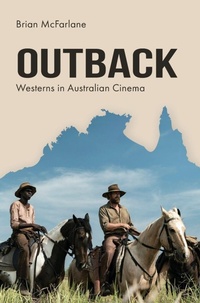
Outback
Westerns in Australian Cinema
Published on 26. November 2024
Book
Hardback
186 pages
978-1-83595-013-5 (ISBN)
Description
Focusing on the incidence of the 'Westerns' film genre in the 120-odd years of Australian cinema history, exploring how the American genre has been adapted to the changing Australian social, political and cultural contexts of their production, including the shifting emphases in the representation of the Indigenous population.
The idea for the book came to the author while he was writing two recent articles. One was an essay for Screen Education on the western in Australian cinema of the 21st century; the other piece was the review of a book entitled Film and the Historian, for the online journal Inside Story . Between the two, he saw the interesting prospect of a book-length study of the role of the western genre in Australia's changing political and cultural history over the last century - and the ways in which film can, without didacticism, provide evidence of such change. Key matters include the changing attitudes to and representation of Indigenous peoples and of women's roles in Australian Westerns.
When one considers that the longest narrative film then seen in Australia, and quite possibly the world was Charles Tait's The Story of the Kelly Gang (1906), it is clear that Australia has some serious history in the genre, and Kelly has ridden again in Justin Kurzel's 2020 adaptation of Peter Carey's The True History of the Kelly Gang.
The idea for the book came to the author while he was writing two recent articles. One was an essay for Screen Education on the western in Australian cinema of the 21st century; the other piece was the review of a book entitled Film and the Historian, for the online journal Inside Story . Between the two, he saw the interesting prospect of a book-length study of the role of the western genre in Australia's changing political and cultural history over the last century - and the ways in which film can, without didacticism, provide evidence of such change. Key matters include the changing attitudes to and representation of Indigenous peoples and of women's roles in Australian Westerns.
When one considers that the longest narrative film then seen in Australia, and quite possibly the world was Charles Tait's The Story of the Kelly Gang (1906), it is clear that Australia has some serious history in the genre, and Kelly has ridden again in Justin Kurzel's 2020 adaptation of Peter Carey's The True History of the Kelly Gang.
More details
Language
English
Place of publication
United Kingdom
Publishing group
Intellect
Target group
Professional and scholarly
Illustrations
17 Illustrations, black and white
Dimensions
Height: 250 mm
Width: 175 mm
Thickness: 15 mm
Weight
534 gr
ISBN-13
978-1-83595-013-5 (9781835950135)
Copyright in bibliographic data and cover images is held by Nielsen Book Services Limited or by the publishers or by their respective licensors: all rights reserved.
Schweitzer Classification
Other editions
Additional editions
E-Book
09/2024
Intellect Books
€87.99
Available for download
Person
Brian McFarlane is the editor or co-editor of more than thirty books and hundreds of articles and reviews, He is the editor of The Encyclopedia of British Film and co-editor of The Oxford Companion to Australian Film. He is Adjunct Professor in the Department of Media and Communications at Swinburne University of Technology, Melbourne, Australia.
Content
Acknowledgements
Chapter One: Australian Westerns?
Chapter Two: What constitutes a 'Western'?
Chapter Three: Outlaws at large: the bushranging phenomenon
Chapter Four: 1940s-1960s: Australians and others tackle the genre
Chapter Five: The 'revival': Snowy River and others
Chapter Six: The Western in the new century
Conclusion
Select Bibliography
Index
Chapter One: Australian Westerns?
Chapter Two: What constitutes a 'Western'?
Chapter Three: Outlaws at large: the bushranging phenomenon
Chapter Four: 1940s-1960s: Australians and others tackle the genre
Chapter Five: The 'revival': Snowy River and others
Chapter Six: The Western in the new century
Conclusion
Select Bibliography
Index