

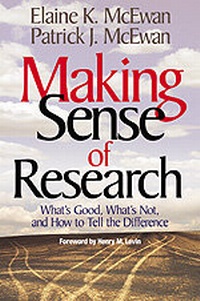
Making Sense of Research
What's Good, What's Not, and How To Tell the Difference
1st Edition
Published on 14. May 2003
Book
Paperback/Softback
200 pages
978-0-7619-7708-7 (ISBN)
Description
How can educators make sense of the complexities of research?
Making Sense of Research brings together the best of two worlds-the "real" world where education is practiced daily and the "ivory tower" world where research is ongoing. The authors have written this book for practitioners at all levels, from teachers making site-specific decisions such as allocating time, to administrators making schoolwide and policy decisions such as reducing class size. They outline and explain how quality research can inform, enlighten, and provide direction to educators that will save time and money, as well as make schools more effective and increase opportunities for students.
Educators are increasingly accountable for the outcome of their efforts. This vital resource will assist them in assessing the validity of research claims by leading the reader through a revealing examination of five critical questions:
Does it work? (the causal question)
How does it work? (the process question)
Is it worthwhile? (the cost question)
Will it work for me? (the usability question)
Is it working for me? (the evaluation question)
Making Sense of Research will change the way you read and think about research, and thereby help you enhance school improvement, sustain your vision of quality education, attain your mission, and ultimately increase student achievement.
Making Sense of Research brings together the best of two worlds-the "real" world where education is practiced daily and the "ivory tower" world where research is ongoing. The authors have written this book for practitioners at all levels, from teachers making site-specific decisions such as allocating time, to administrators making schoolwide and policy decisions such as reducing class size. They outline and explain how quality research can inform, enlighten, and provide direction to educators that will save time and money, as well as make schools more effective and increase opportunities for students.
Educators are increasingly accountable for the outcome of their efforts. This vital resource will assist them in assessing the validity of research claims by leading the reader through a revealing examination of five critical questions:
Does it work? (the causal question)
How does it work? (the process question)
Is it worthwhile? (the cost question)
Will it work for me? (the usability question)
Is it working for me? (the evaluation question)
Making Sense of Research will change the way you read and think about research, and thereby help you enhance school improvement, sustain your vision of quality education, attain your mission, and ultimately increase student achievement.
Reviews / Votes
Each chapter launches with a discussion of the different forms of inquiry that can be used to answer [a] question at hand, and in plain language how each type (design or paradigm) works. Part of that process involves frank assessment of the strengths and limitations of each format--and thus the credibility of the evidence produced. -- June edition of www.unlockresearch.comMore details
Language
English
Place of publication
Thousand Oaks
United States
Target group
Professional and scholarly
Dimensions
Height: 254 mm
Width: 178 mm
Weight
382 gr
ISBN-13
978-0-7619-7708-7 (9780761977087)
Copyright in bibliographic data and cover images is held by Nielsen Book Services Limited or by the publishers or by their respective licensors: all rights reserved.
Schweitzer Classification
Other editions
Additional editions
Elaine K. Mcewan-Adkins | Patrick J. McEwan
Making Sense of Research
What's Good, What's Not, and How To Tell the Difference
Book
05/2003
1st Edition
Corwin Press Inc
€85.61
Article exhausted; check different version
Persons
Elaine K. McEwan is an educational consultant with The McEwan-Adkins Group, offering professional development for educators to assist them in meeting the challenges of literacy learning in Grades Pre K-6. A former teacher, librarian, principal, and assistant superintendent for instruction in several suburban Chicago school districts, Elaine is the award-winning and best-selling author of more than three dozen books for educators. Her Corwin Press titles include Raising Reading Achievement in Middle and High Schools: Five Simple-to-Follow Strategies for Principals, Second Edition (2006), Seven Strategies of Highly Effective Readers: Using Cognitive Research to Boost K-8 Achievement (2004), Ten Traits of Highly Effective Principals: From Good to Great Performance (2003), Making Sense of Research: What's Good, What's Not, and How to Tell the Difference (2003), Seven Steps to Effective Instructional Leadership, Second Edition (2003), Teach Them ALL to Read: Catching the Kids Who Fall through the Cracks (2002), and Ten Traits of Highly Effective Teachers: How to Hire, Mentor, and Coach Successful Teachers (2001).
McEwan was honored by the Illinois Principals Association as an outstanding instructional leader, by the Illinois State Board of Education with an Award of Excellence in the Those Who Excel Program, and by the National Association of Elementary School Principals as the National Distinguished Principal from Illinois for 1991. She received her undergraduate degree in education from Wheaton College and advanced degrees in library science (MA) and educational administration (EdD) from Northern Illinois University.
Patrick J. McEwan is a Professor of Economics at Wellesley College and the Director of Latin American Studies at Wellesley College. His research interests include the impact and cost evaluation of education and social policy in Latin America, especially Chile and Honduras. His work has been published in the American Economic Review, the Journal of Public Economics, Educational Evaluation and Policy Analysis, and other journals of economics and education policy. For more information on his research, visit www.patrickmcewan.net.
McEwan was honored by the Illinois Principals Association as an outstanding instructional leader, by the Illinois State Board of Education with an Award of Excellence in the Those Who Excel Program, and by the National Association of Elementary School Principals as the National Distinguished Principal from Illinois for 1991. She received her undergraduate degree in education from Wheaton College and advanced degrees in library science (MA) and educational administration (EdD) from Northern Illinois University.
Patrick J. McEwan is a Professor of Economics at Wellesley College and the Director of Latin American Studies at Wellesley College. His research interests include the impact and cost evaluation of education and social policy in Latin America, especially Chile and Honduras. His work has been published in the American Economic Review, the Journal of Public Economics, Educational Evaluation and Policy Analysis, and other journals of economics and education policy. For more information on his research, visit www.patrickmcewan.net.
Content
Foreword - Henry M. Levin
Preface
The Goals of This Book
Who This Book Is For
What This Book Is Not
Overview of the Contents
A Few Words of Explanation
About the Authors
1. Asking the Right Questions
What Is Our Approach to Making Sense of Research?
Five Questions About Research
Four Case Studies of Education Research
Further Reading
2. Behind the Scenes in the World of Education Research
The World of Education Research
Who Does Education Research?
Who Pays for It?
Where Is It Published?
Can You Trust Education Research?
What Does the Future Hold for Education Research?
Does Education Research Really Matter?
Further Reading
3. The Causal Questions: Does It Work? (Part I)
The Causality Conundrum
Simple (Minded) Methods of Establishing Causality
What Can Go Wrong With Experiments?
Why Are Experiments So Unpopular With Education Teachers
Further Reading
4 The Causal Question: Does It Work? (Part II)
Quasi-Experiments and Non-Experiments
The Researcher's Bag of Tricks
Quasi-Experimental Approaches
Non-Experimental Approaches
Further Reading
5. The Process Question: How Does It Work?
What Is Qualitative Research?
The Qualities of Qualitative Research
The Power of Qualitative Research
Qualitative Research Methods
From Whence Comes the Quality in Qualitative Research?
Further Reading
6. The Cost Question: Is It Worthwhile?
The Concept of Costs
The Ingredients Method of Cost Analysis
Two Important Cost Questions
Further Reading
7. The Usability Question: Will It Work for Me?
Will it Work in My Setting?
Some Rules of Thumb for Making Generalizations
Research Reviews and Meta-Analysis
Special Considerations for Qualitative and Cost Studies
Making Trade-Offs
Further Reading
8. The Evaluation Question: Is It Working for Me?
What Is User-Driven Research?
User-Driven Research at Lincoln Middle School
Asking the Right Questions
Refocusing on Outcomes
Defining the Problems
Exemplars of User-Driven Research
Further Reading
Resource: Bibliographies for Case Studies
Class Size Reduction
Phonics Instruction
Private-School Vouchers
Whole-School Reform
References
Index
Preface
The Goals of This Book
Who This Book Is For
What This Book Is Not
Overview of the Contents
A Few Words of Explanation
About the Authors
1. Asking the Right Questions
What Is Our Approach to Making Sense of Research?
Five Questions About Research
Four Case Studies of Education Research
Further Reading
2. Behind the Scenes in the World of Education Research
The World of Education Research
Who Does Education Research?
Who Pays for It?
Where Is It Published?
Can You Trust Education Research?
What Does the Future Hold for Education Research?
Does Education Research Really Matter?
Further Reading
3. The Causal Questions: Does It Work? (Part I)
The Causality Conundrum
Simple (Minded) Methods of Establishing Causality
What Can Go Wrong With Experiments?
Why Are Experiments So Unpopular With Education Teachers
Further Reading
4 The Causal Question: Does It Work? (Part II)
Quasi-Experiments and Non-Experiments
The Researcher's Bag of Tricks
Quasi-Experimental Approaches
Non-Experimental Approaches
Further Reading
5. The Process Question: How Does It Work?
What Is Qualitative Research?
The Qualities of Qualitative Research
The Power of Qualitative Research
Qualitative Research Methods
From Whence Comes the Quality in Qualitative Research?
Further Reading
6. The Cost Question: Is It Worthwhile?
The Concept of Costs
The Ingredients Method of Cost Analysis
Two Important Cost Questions
Further Reading
7. The Usability Question: Will It Work for Me?
Will it Work in My Setting?
Some Rules of Thumb for Making Generalizations
Research Reviews and Meta-Analysis
Special Considerations for Qualitative and Cost Studies
Making Trade-Offs
Further Reading
8. The Evaluation Question: Is It Working for Me?
What Is User-Driven Research?
User-Driven Research at Lincoln Middle School
Asking the Right Questions
Refocusing on Outcomes
Defining the Problems
Exemplars of User-Driven Research
Further Reading
Resource: Bibliographies for Case Studies
Class Size Reduction
Phonics Instruction
Private-School Vouchers
Whole-School Reform
References
Index