

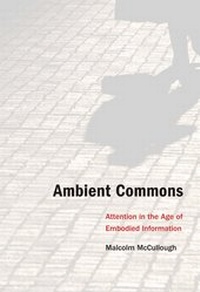
Ambient Commons
Attention in the Age of Embodied Information
Published on 15. March 2013
Book
Hardback
368 pages
978-0-262-01880-7 (ISBN)
Description
The world is filling with ever more kinds of media, in ever more contexts
and formats. Glowing rectangles have become part of the scene; screens, large and
small, appear everywhere. Physical locations are increasingly tagged and digitally
augmented. Amid this flood, your attention practices matter more than ever. You
might not be able to tune this world out. So it is worth remembering that underneath
all these augmentations and data flows, fixed forms persist, and that to notice them
can improve other sensibilities. In Ambient Commons, Malcolm
McCullough explores the workings of attention through a rediscovery of
surroundings.
McCullough describes what he calls the Ambient: an
increasing tendency to perceive information superabundance whole, where individual
signals matter less and at least some mediation assumes inhabitable form. He
explores how the fixed forms of architecture and the city play a cognitive role in
the flow of ambient information. As a persistently inhabited world, can the Ambient
be understood as a shared cultural resource, to be socially curated, voluntarily
limited, and self-governed as if a commons? Ambient Commons
invites you to look past current obsessions with smart phones to rethink attention
itself, to care for more situated, often inescapable forms of information.
and formats. Glowing rectangles have become part of the scene; screens, large and
small, appear everywhere. Physical locations are increasingly tagged and digitally
augmented. Amid this flood, your attention practices matter more than ever. You
might not be able to tune this world out. So it is worth remembering that underneath
all these augmentations and data flows, fixed forms persist, and that to notice them
can improve other sensibilities. In Ambient Commons, Malcolm
McCullough explores the workings of attention through a rediscovery of
surroundings.
McCullough describes what he calls the Ambient: an
increasing tendency to perceive information superabundance whole, where individual
signals matter less and at least some mediation assumes inhabitable form. He
explores how the fixed forms of architecture and the city play a cognitive role in
the flow of ambient information. As a persistently inhabited world, can the Ambient
be understood as a shared cultural resource, to be socially curated, voluntarily
limited, and self-governed as if a commons? Ambient Commons
invites you to look past current obsessions with smart phones to rethink attention
itself, to care for more situated, often inescapable forms of information.
More details
Language
English
Place of publication
Cambridge, Mass.
United States
Publishing group
MIT Press Ltd
Target group
Professional and scholarly
US School Grade: College Graduate Student and over
Illustrations
58 s/w Abbildungen
58 b&w illus.
Dimensions
Height: 203 mm
Width: 127 mm
Thickness: 0 mm
Weight
454 gr
ISBN-13
978-0-262-01880-7 (9780262018807)
Copyright in bibliographic data and cover images is held by Nielsen Book Services Limited or by the publishers or by their respective licensors: all rights reserved.
Schweitzer Classification
Other editions
Additional editions
Book
08/2015
MIT Press
€27.40
Article exhausted; check different version
E-Book
03/2013
MIT Press
€29.49
Available for download
Person
Malcolm McCullough is Associate Professor of Architecture at Taubman College, the University
of Michigan. He is the author of Abstracting Craft: The Practiced Digital Hand
and Digital Ground: Architecture, Pervasive Computing, and Environmental
Knowing, both published by the MIT Press.
of Michigan. He is the author of Abstracting Craft: The Practiced Digital Hand
and Digital Ground: Architecture, Pervasive Computing, and Environmental
Knowing, both published by the MIT Press.