

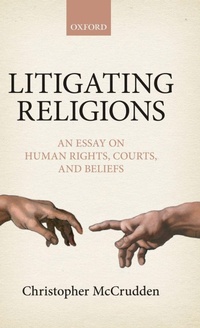
Litigating Religions
An Essay on Human Rights, Courts, and Beliefs
Published on 25. January 2018
Book
Hardback
214 pages
978-0-19-875904-1 (ISBN)
Description
Religions are a problem for human rights, and human rights are a problem for religions. And both are problems for courts. This book presents an interpretation of how religion and human rights interrelate in the legal context, and how this relationship might be reconceived to make this relationship somewhat less fraught.
Litigating Religions, an essay adapted by Christopher McCrudden from the Alberico Gentili Lectures given at the University of Macerata, Italy, examines how the resurgent role of religion in public life gives rise to tensions with key aspects of human rights, in particular freedom of religion and anti-discrimination law, and how these tensions cannot be considered as simply transitional.
The context for the discussion is the increasingly troubled area of human rights litigation involving religious arguments, such as wearing religious dress at work, conscientious objections by marriage registrars, admission of children to religious schools, prohibitions on same-sex marriage, and access to abortion. Christopher McCrudden argues that, if we wish to establish a better dialogue between the contending views, we must address a set of recurring problems identifiable in such litigation. To address these problems requires changes both in human rights theory and in religious understandings.
Litigating Religions, an essay adapted by Christopher McCrudden from the Alberico Gentili Lectures given at the University of Macerata, Italy, examines how the resurgent role of religion in public life gives rise to tensions with key aspects of human rights, in particular freedom of religion and anti-discrimination law, and how these tensions cannot be considered as simply transitional.
The context for the discussion is the increasingly troubled area of human rights litigation involving religious arguments, such as wearing religious dress at work, conscientious objections by marriage registrars, admission of children to religious schools, prohibitions on same-sex marriage, and access to abortion. Christopher McCrudden argues that, if we wish to establish a better dialogue between the contending views, we must address a set of recurring problems identifiable in such litigation. To address these problems requires changes both in human rights theory and in religious understandings.
More details
Language
English
Place of publication
Oxford
United Kingdom
Target group
Professional and scholarly
Dimensions
Height: 222 mm
Width: 145 mm
Thickness: 15 mm
Weight
407 gr
ISBN-13
978-0-19-875904-1 (9780198759041)
Copyright in bibliographic data and cover images is held by Nielsen Book Services Limited or by the publishers or by their respective licensors: all rights reserved.
Schweitzer Classification
Other editions
Additional editions
E-Book
01/2018
1st Edition
OUP eBook
€43.49
Available for download
E-Book
01/2018
1st Edition
OUP eBook
€37.99
Available for download
Person
Christopher McCrudden is Professor of Human Rights and Equality Law at Queen's University, Belfast; William W Cook Global Professor of Law at the University of Michigan Law School; and a practising barrister at Blackstone Chambers in London. A Fellow of the British Academy, he is the author of numerous titles, including: Buying Social Justice (OUP, 2007); Courts and Consociations: Human Rights versus Power-Sharing (OUP, 2013); and editor of Understanding Human Dignity (OUP, 2013).
Content
Part 1: Context
1: Concepts and Cases
2: Ideology
3: Institutions
Part 2: Problems
4: The Teleological Problem
5: The Epistemological Problem
6: The Ontological Problem
Part 3: Ways Forward
7: Rethinking the Fundamentals of Human Rights Theory
8: How Should Courts Approach Religious Litigation?
9: How Should Religions Approach Human Rights?
1: Concepts and Cases
2: Ideology
3: Institutions
Part 2: Problems
4: The Teleological Problem
5: The Epistemological Problem
6: The Ontological Problem
Part 3: Ways Forward
7: Rethinking the Fundamentals of Human Rights Theory
8: How Should Courts Approach Religious Litigation?
9: How Should Religions Approach Human Rights?