

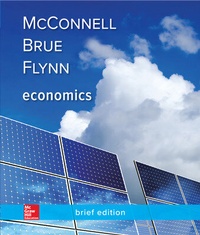
Economics, Brief Edition
3rd Edition
Published on 17. September 2018
Book
Hardback
576 pages
978-0-07-802187-9 (ISBN)
Description
McConnell, Brue and Flynn's Economics: Brief Edition, 3e comes from the same author team as the market-leading Principles of Economics textbook. Economics: Brief Edition tailors the core concepts from proven leader Economics, 21st edition to create a concise introduction to the course that is distinct in purpose, style, and coverage. Like the 21st edition, Economics: Brief Edition, 3e continues to be innovative while teaching students in a clear, unbiased way. Content and pedagogy have 3 main goals: help the beginning student master the principles essential for understanding the economizing problem, specific economic issues, and the policy alternatives; help the student understand and apply the economic perspective and reason accurately and objectively about economic matters; and promote a lasting student interest in economics and the economy.
Connect Economics- McConnell Brief 3e also brings a robust set of digital tools to engage today's students. From SmartBook to videos and interactive graphs, students have the tools to learn economics principles and apply how it relates to their everyday lives.
Connect Economics- McConnell Brief 3e also brings a robust set of digital tools to engage today's students. From SmartBook to videos and interactive graphs, students have the tools to learn economics principles and apply how it relates to their everyday lives.
More details
Edition
3rd edition
Language
English
Place of publication
New York
United States
Publishing group
McGraw-Hill Education - Europe
Target group
College/higher education
Dimensions
Height: 262 mm
Width: 218 mm
Thickness: 25 mm
Weight
1218 gr
ISBN-13
978-0-07-802187-9 (9780078021879)
Copyright in bibliographic data and cover images is held by Nielsen Book Services Limited or by the publishers or by their respective licensors: all rights reserved.
Schweitzer Classification
Persons
Cambell R. McConnell earned his Ph.D. at the University of Iowa after receiving degrees from Cornell College and the University of Illinois. He taught at the University of Nebraska-Lincoln from 1953 until his retirement in 1990. He was also coauthor of Contemporary Labor Economics and Essentials of Economics. He was a recipient of both the University of Nebraska Distinguished Teaching Award and the James A. Lake Academic Freedom Award and served as president of the Midwest Economics Association. Professor McConnell was awarded an honorary Doctor of Laws degree from Cornell College in 1973 and received its Distinguished Achievement Award in 1994. He was also a jazz expert and aficionado until his passing in 2019.
Stanley L. Brue did his undergraduate work at Augustana College (South Dakota) and received its Distinguished Achievement Award in 1991. He received his Ph.D. from the University of Nebraska-Lincoln. He is retired from a long career at Pacific Lutheran University, where he was honored as a recipient of the Burlington Northern Faculty Achievement Award. Professor Brue has also received the national Leavey Award for excellence in economics education. He has served as national president and chair of the Board of Trustees of Omicron Delta Epsilon International Economics Honorary. He is coauthor of Economic Scenes, fifth edition (Prentice-Hall); Contemporary Labor Economics, twelfth edition; Essentials of Economics, fourth edition and The Evolution of Economic Thought, eighth edition (Cengage Learning). For relaxation, he enjoys international travel, attending sporting events, and going on fishing trips.
Sean M. Flynn did his undergraduate work at the University of Southern California before completing his Ph.D. at U.C. Berkeley, where he served as the Head Graduate Student Instructor for the Department of Economics after receiving the Outstanding Graduate Student Instructor Award. He teaches at Scripps College (of the Claremont Colleges) and is the author of Economics for Dummies, third edition (Wiley); Essentials of Economics, fourth edition; and The Cure That Works: How to Have the World's Best Healthcare-at a Quarter of the Price (Regnery). His research interests include behavioral finance, behavioral economics, and health care economics. An accomplished martial artist, Sean has coached five of his students to national championships and is the author of Understanding Shodokan Aikido. Other hobbies include running, traveling, and cooking.
Stanley L. Brue did his undergraduate work at Augustana College (South Dakota) and received its Distinguished Achievement Award in 1991. He received his Ph.D. from the University of Nebraska-Lincoln. He is retired from a long career at Pacific Lutheran University, where he was honored as a recipient of the Burlington Northern Faculty Achievement Award. Professor Brue has also received the national Leavey Award for excellence in economics education. He has served as national president and chair of the Board of Trustees of Omicron Delta Epsilon International Economics Honorary. He is coauthor of Economic Scenes, fifth edition (Prentice-Hall); Contemporary Labor Economics, twelfth edition; Essentials of Economics, fourth edition and The Evolution of Economic Thought, eighth edition (Cengage Learning). For relaxation, he enjoys international travel, attending sporting events, and going on fishing trips.
Sean M. Flynn did his undergraduate work at the University of Southern California before completing his Ph.D. at U.C. Berkeley, where he served as the Head Graduate Student Instructor for the Department of Economics after receiving the Outstanding Graduate Student Instructor Award. He teaches at Scripps College (of the Claremont Colleges) and is the author of Economics for Dummies, third edition (Wiley); Essentials of Economics, fourth edition; and The Cure That Works: How to Have the World's Best Healthcare-at a Quarter of the Price (Regnery). His research interests include behavioral finance, behavioral economics, and health care economics. An accomplished martial artist, Sean has coached five of his students to national championships and is the author of Understanding Shodokan Aikido. Other hobbies include running, traveling, and cooking.
Content
Part One: Introduction
Chapter 1 Limits, Alternatives, and Choices
Chapter 2 The Market System and the Circular Flow
Part Two: Price, Quantity, and Efficiency
Chapter 3 Demand, Supply, and Market Equilibrium
Appendix 3: Additional Examples of Supply and Demand
Chapter 4 Elasticity of Demand and Supply
Chapter 5 Market Failures: Public Goods and Externalities
Part Three: Product Markets
Chapter 6 Businesses and Their Costs
Chapter 7 Pure Competition
Chapter 8 Pure Monopoly
Chapter 9 Monopolistic Competition and Oligopoly
Part Four: Resource Markets and Government
Chapter 10 Wage Determination
Chapter 11 Income Inequality and Poverty
Chapter 12 Public Finance: Expenditures and Taxes
Part Five: GDP, Growth, and Instability
Chapter 13 GDP and Economic Growth
Chapter 14 Business Cycles, Unemployment, and Inflation
Chapter 15 Aggregate Demand and Aggregate Supply
Chapter 16 Fiscal Policy, Deficits, and Debt
Part Six: Money, Banking, and Monetary Policy
Chapter 17 Money, Banking, and Financial Institutions
Chapter 18 Interest Rates and Monetary Policy
Part Seven: Long-Run Considerations and International Economics
Chapter 19 Long-Run Aggregate Supply and Aggregate Demand
Chapter 20 International Trade and Exchange Rates
Chapter 21 Behavioral Economics
Chapter 1 Limits, Alternatives, and Choices
Chapter 2 The Market System and the Circular Flow
Part Two: Price, Quantity, and Efficiency
Chapter 3 Demand, Supply, and Market Equilibrium
Appendix 3: Additional Examples of Supply and Demand
Chapter 4 Elasticity of Demand and Supply
Chapter 5 Market Failures: Public Goods and Externalities
Part Three: Product Markets
Chapter 6 Businesses and Their Costs
Chapter 7 Pure Competition
Chapter 8 Pure Monopoly
Chapter 9 Monopolistic Competition and Oligopoly
Part Four: Resource Markets and Government
Chapter 10 Wage Determination
Chapter 11 Income Inequality and Poverty
Chapter 12 Public Finance: Expenditures and Taxes
Part Five: GDP, Growth, and Instability
Chapter 13 GDP and Economic Growth
Chapter 14 Business Cycles, Unemployment, and Inflation
Chapter 15 Aggregate Demand and Aggregate Supply
Chapter 16 Fiscal Policy, Deficits, and Debt
Part Six: Money, Banking, and Monetary Policy
Chapter 17 Money, Banking, and Financial Institutions
Chapter 18 Interest Rates and Monetary Policy
Part Seven: Long-Run Considerations and International Economics
Chapter 19 Long-Run Aggregate Supply and Aggregate Demand
Chapter 20 International Trade and Exchange Rates
Chapter 21 Behavioral Economics