

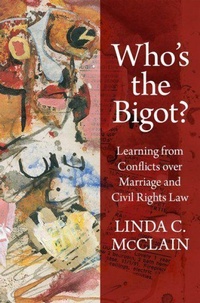
Who's the Bigot?
Learning from Conflicts over Marriage and Civil Rights Law
Published on 22. April 2020
Book
Hardback
304 pages
978-0-19-087720-0 (ISBN)
Description
Historically, critics of interracial, interfaith, and most recently same-sex marriage have invoked conscience and religious liberty to defend their objections, and often they have been accused of bigotry. Although denouncing and preventing bigotry is a shared political value with a long history, people disagree over who is a bigot and what makes a belief, attitude, or action bigoted. This is evident from the rejoinder that calling out bigotry is intolerant political correctness, even bigotry itself.
In Who's the Bigot?, the eminent legal scholar Linda C. McClain traces the rhetoric of bigotry and conscience across a range of debates relating to marriage and antidiscrimination law. Is "bigotry" simply the term society gives to repudiated beliefs that now are beyond the pale? She argues that the differing views people hold about bigotry reflect competing understandings of what it means to be "on the wrong side of history" and the ways present forms of discrimination resemble or differ from past forms. Furthermore, McClain shows that bigotry has both a backward- and forward-looking dimension. We not only learn the meaning of bigotry by looking to the past, but we also use examples of bigotry, on which there is now consensus, as the basis for making new judgments about what does or does not constitute bigotry and coming to new understandings of both injustice and justice.
By examining charges of bigotry and defenses based on conscience and religious belief in these debates, Who's the Bigot? makes a novel and timely contribution to our understanding of the relationship between religious liberty and discrimination in American life.
In Who's the Bigot?, the eminent legal scholar Linda C. McClain traces the rhetoric of bigotry and conscience across a range of debates relating to marriage and antidiscrimination law. Is "bigotry" simply the term society gives to repudiated beliefs that now are beyond the pale? She argues that the differing views people hold about bigotry reflect competing understandings of what it means to be "on the wrong side of history" and the ways present forms of discrimination resemble or differ from past forms. Furthermore, McClain shows that bigotry has both a backward- and forward-looking dimension. We not only learn the meaning of bigotry by looking to the past, but we also use examples of bigotry, on which there is now consensus, as the basis for making new judgments about what does or does not constitute bigotry and coming to new understandings of both injustice and justice.
By examining charges of bigotry and defenses based on conscience and religious belief in these debates, Who's the Bigot? makes a novel and timely contribution to our understanding of the relationship between religious liberty and discrimination in American life.
Reviews / Votes
Who's the Bigot? illuminates how "the rhetoric of bigotry" enables inaction in the face of systemic and structural discrimination. McClain's powerful insight thus has much to offer in any examination of social inclusion, whether it be based on sexual orientation, gender identity, gender, race, ethnicity or any other ism. * Professor Tanya Kateri Hernandez, Author of Racial Innocence: Unmasking Latino Anti-Black Bias and the Struggle for Equality * The book offers meaningful lessons about the rhetoric of bigotry and its puzzles for civil rights struggles, especially in this uniquely polarized period in United States history. Overall, McClain's book makes an original contribution to our understanding of bigotry, especially in struggles at the intersection of family law and civil rights... McClain's important work provides a framework for understanding how rhetoric involving bigotry is being harnessed by both sides of the ongoing legal battles over broad religious exemptions and LGBTQ child welfare... McClain's insightful book builds a persuasive case for why the legal inquiry in struggles over marriage and civil rights should not narrowly focus on whether religious sincerity or appeals to conscience deserve moral condemnation. * Jordan Blair Woods, University of Arkansas School of Law, Michigan Law Review * Linda McClain helps us understand our present moment of crisis-prone incivility via a single word: the bigot. Deftly assessing past changes in the American legal recognition of interfaith, interracial and same-sex marriage, as well as desegration and integration, she shows that calling out bigotry has sometimes promoted civility, and yet has also undermined it. This feminist defense of diversity and equality helps to debunk purported moral equivalences, and charts an important way forward for law, religion and public life. * Katharine Young, Professor of Law, Boston College Law School and author of Constituting Economic and Social Rights (OUP, 2012). * Linda McClain's book is a meticulously researched and compellingly presented study of moral and political language. She illuminates the different ways in which the term "bigot" has been used in American constitutional law, from the battles over slavery in the nineteenth century to the skirmishes over same sex marriage in the twenty-first. * Cathleen Kaveny, Balkinization blog * McClain provides readers a way to understand the meaning, the boundary, and even the accommodation of bigotry. The book would be of interest not just to legal scholars but also to those studying law from a perspective of political theory, sociology, or history. The scope and depth of McClain's book is impressive and she has a lot to teach her readers. I highly recommend this book to anyone who wants to learn more about society's conflicts over marriage and civil rights law. * Sonu Bedi, author of Private Racism, and Professor in Law and Political Science, Dartmouth College * This timely, wide-ranging, and historically detailed work invites us to think more deeply about bigotry - what it is, how it has functioned in various debates over marriage, and how those debates in turn shed light on the reality and rhetoric of bigotry. McClain's book is an invaluable contribution to our perspective on these matters. * John Corvino, author of Debating Religious Liberty and Discrimination and What's Wrong With Homosexuality?, Dean, Irvin D. Reid Honors College and Professor of Philosophy, Wayne State University * An important and clear-minded book by a leading scholar of law and public policy that explores our evolving understanding of bigotry in the context of debates over gay rights and religious liberty. Deeply illuminating. * Stephen Macedo, Laurance S. Rockefeller Professor of Politics and the University Center for Human Values, Princeton University * A must read for those who are interested in seeing the modern social psychological understanding of racism applied to American religion. * Thomas F. Pettigrew, Research Professor of Social Psychology, University of California, Santa Cruz * Through historical excavation and close readings of primary texts, Linda McClain examines the meaning and use of bigotry over time. By situating us in the thick of past conflicts over equality, McClain shows that views we now repudiate as bigoted were once within the realm of reasonable debate. Her book should be a warning for proponents of equality law today: Labeling one's opponents as bigots may obscure, rather than illuminate, connections between past and present struggles. Instead, by unearthing the similarities in justifications for inequality over time, McClain leaves us better able to appreciate the relationship between struggles for racial equality and struggles for LGBT equality. * Douglas NeJaime, Anne Urowsky Professor of Law, Yale Law School * At a time when public discourse is so charged, and the label "bigot" carries enormous emotional and psychological weight, Linda McClain helpfully unpacks the legal provenance of this fraught term. Drawing on a diverse range of contexts - from interracial marriage to the present debate over conscience exemptions - McClain considers what it means, as a matter of law and culture, to characterize someone (and their actions) as bigoted. This is required reading for anyone who wants to understand our polarized society and how we got here. * Melissa Murray, Frederick I. and Grace Stokes Professor of Law, NYU School of Law *More details
Language
English
Place of publication
New York
United States
Target group
College/higher education
Product notice
sewn/stitched
Cloth over boards
Dimensions
Height: 239 mm
Width: 157 mm
Thickness: 30 mm
Weight
544 gr
ISBN-13
978-0-19-087720-0 (9780190877200)
Copyright in bibliographic data and cover images is held by Nielsen Book Services Limited or by the publishers or by their respective licensors: all rights reserved.
Schweitzer Classification
Other editions
Additional editions
E-Book
02/2020
OUP eBook
€20.99
Available for download
E-Book
02/2020
OUP eBook
€20.99
Available for download
Person
Linda C. McClain is the Robert Kent Professor at Boston University School of Law. She also teaches in BU's Kilachand Honors College. An internationally known scholar, she has written about marriage, family law, civil rights law, gender equality and law, feminist legal theory, and law and religion. She has held fellowships at the University Center for Human Values, Princeton University, and the Safra Center at Harvard University. Her books include The Place of Families: Fostering Capacity, Equality, and Responsibility, Ordered Liberty: Rights, Responsibilities, and Virtues (with James E. Fleming), Gender Equality: Dimensions of Women's Equal Citizenship (co-edited with Joanna Grossman and cited in the credits for On the Basis of Sex), and What Is Parenthood? Contemporary Debates About the Family. A graduate of Oberlin College, she has an M.A. from University of Chicago Divinity School, a J.D. from Georgetown University Law Center, and an LL.M. from NYU School of Law.
Content
Chapter 1. Who's the Bigot? Puzzles about Bigotry Chapter 2. From "The Bigot in Our Midst" to "Good People" with Hidden Biases: The Scientific Study of Prejudice Chapter 3. Interfaith Marriage as a Protest Against Bigotry?: Debates in the 1950s and 1960s Chapter 4. "You are Waging a Fight of Morality and Conscience:" Competing Theologies of Segregation and Integration 144 Chapter 5. "Our Spirit Is Not Narrow Bigotry": Debating the Civil Rights Act of 1964 and "Legislating Morality" Chapter 6. Prejudice, Moral Progress, and Not Being "On the Wrong Side of History": The Legacy of Loving for the Right to Marry Chapter 7. "Sincere Believers," "Bigots," or "Superstitious Fools"?: Motives and Morality in the Supreme Court's Gay Rights Cases Chapter 8. "This Isn't 1964 Anymore"-Or Is It? Competing Appeals to the Civil Rights Past in Present Controversies over "Religious Liberty versus LGBT Rights" Chapter 9. Conclusion: Learning Bigotry's Lessons