

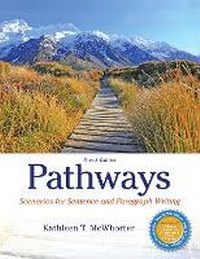
Pathways
Scenarios for Sentence and Paragraph Writing
4th Edition
Published on 20. January 2015
Book
Paperback/Softback
624 pages
978-0-321-97416-7 (ISBN)
Description
NOTE: You are purchasing a standalone product; MyWritingLab (TM) does not come packaged with this content. If you would like to purchase both the physical text and MyWritingLab search for:
0321990951 / 9780321990952 Pathways: Scenarios for Sentence and Paragraph Writing Plus MyWritingLab with Pearson eText - Access Card
Package contains:
0133944131 / 9780133944136 MyWritingLab with Pearson eText - Access Card
013394414X / 9780133944143 9780133944136 MyWritingLab with Pearson eText - Inside Star Sticker
0321974166 / 9780321974167 Pathways: Scenarios for Sentence and Paragraph Writing, 4e
For courses in Developmental Writing.
A lively, integrated approach that emphasizes the connection of the reading and writing processes
Pathways: Scenarios for Paragraph and Sentence Writing, Fourth Edition teaches fundamental sentence and paragraph writing skills by engaging student interest, maintaining a focus on expressing ideas rather than on following rules.
Students learn grammar in the context of the "whole paper." Seven of the 17 chapters deal with grammar topics; in these chapters, students examine student essays, read and respond to ideas, and write and revise paragraphs. In Parts II through IV, students apply what they have learned about sentence-level correctness to their own writing as they explore logical paragraph development and organization of ideas. The last two chapters introduce essay writing, enabling students to accelerate from paragraphs to essays, with the goal of achieving stronger, more fully developed writing skills.
Also Available with MyWritingLab (TM)
This title is also available with MyWritingLab - an online homework, tutorial, and assessment program designed to work with this text to engage students and improve results. Within its structured environment, students practice what they learn, test their understanding, and pursue a personalized study plan that helps them better absorb course material and understand difficult concepts.
0321990951 / 9780321990952 Pathways: Scenarios for Sentence and Paragraph Writing Plus MyWritingLab with Pearson eText - Access Card
Package contains:
0133944131 / 9780133944136 MyWritingLab with Pearson eText - Access Card
013394414X / 9780133944143 9780133944136 MyWritingLab with Pearson eText - Inside Star Sticker
0321974166 / 9780321974167 Pathways: Scenarios for Sentence and Paragraph Writing, 4e
For courses in Developmental Writing.
A lively, integrated approach that emphasizes the connection of the reading and writing processes
Pathways: Scenarios for Paragraph and Sentence Writing, Fourth Edition teaches fundamental sentence and paragraph writing skills by engaging student interest, maintaining a focus on expressing ideas rather than on following rules.
Students learn grammar in the context of the "whole paper." Seven of the 17 chapters deal with grammar topics; in these chapters, students examine student essays, read and respond to ideas, and write and revise paragraphs. In Parts II through IV, students apply what they have learned about sentence-level correctness to their own writing as they explore logical paragraph development and organization of ideas. The last two chapters introduce essay writing, enabling students to accelerate from paragraphs to essays, with the goal of achieving stronger, more fully developed writing skills.
Also Available with MyWritingLab (TM)
This title is also available with MyWritingLab - an online homework, tutorial, and assessment program designed to work with this text to engage students and improve results. Within its structured environment, students practice what they learn, test their understanding, and pursue a personalized study plan that helps them better absorb course material and understand difficult concepts.
More details
Edition
4th edition
Language
English
Place of publication
United States
Publishing group
Pearson Education (US)
Target group
College/higher education
Dimensions
Height: 274 mm
Width: 216 mm
Thickness: 25 mm
Weight
1134 gr
ISBN-13
978-0-321-97416-7 (9780321974167)
Copyright in bibliographic data and cover images is held by Nielsen Book Services Limited or by the publishers or by their respective licensors: all rights reserved.
Schweitzer Classification
Other editions
Previous edition
Book
3rd Edition
Pearson
€114.08
The article will not be published
Content
NOTE: Both Brief and Comprehensive Tables of Contents are listed below.
BRIEF CONTENTS
Part I: Getting Started?
1. An Introduction to Writing?
2. The Reading-Writing Connection
Part II: Sentence Basics and Development?
4. Complete Sentences Versus Fragments?
5. Run-On Sentences and Comma Splices?
6. Combining and Expanding Your Ideas?
7. Using Adjectives and Adverbs to Describe?
8. Using Modifiers to Add Detail?
Writers' Workshops: Using Language Effectively?
Part III: Common Sentence Problems and How to Avoid Them?
9. Revising Confusing and Inconsistent Sentences?
10. Using Verbs Correctly?
Writers' Workshops: Digital Literacy in the Wired Classroom?
Part IV: Paragraph Basics, Development, and Revision?
11. Planning and Organizing?
12. Drafting and Revising?
13. Developing, Arranging, and Connecting Details?
14. Using Methods of Organization?
Writers' Workshops: Using Visuals in Your Writing?
15. Revising Paragraphs?
Part V: Essay Basics, Development, and Common Problems?
16. Essay Basics and Development?
17. Avoiding Common Problems in Essays?
Part VI: A Thematic Reader?
Part VII: Reviewing the Basics
COMPREHENSIVE CONTENTS
Part I:?GETTING STARTED
Chapter 1. An Introduction to Writing?
Writing Understanding What Writing Is and Is Not?
Beginning Tips for Generating Ideas?
Beginning Tips for Organizing Your Ideas?
BRIEF CONTENTS
Part I: Getting Started?
1. An Introduction to Writing?
2. The Reading-Writing Connection
Part II: Sentence Basics and Development?
4. Complete Sentences Versus Fragments?
5. Run-On Sentences and Comma Splices?
6. Combining and Expanding Your Ideas?
7. Using Adjectives and Adverbs to Describe?
8. Using Modifiers to Add Detail?
Writers' Workshops: Using Language Effectively?
Part III: Common Sentence Problems and How to Avoid Them?
9. Revising Confusing and Inconsistent Sentences?
10. Using Verbs Correctly?
Writers' Workshops: Digital Literacy in the Wired Classroom?
Part IV: Paragraph Basics, Development, and Revision?
11. Planning and Organizing?
12. Drafting and Revising?
13. Developing, Arranging, and Connecting Details?
14. Using Methods of Organization?
Writers' Workshops: Using Visuals in Your Writing?
15. Revising Paragraphs?
Part V: Essay Basics, Development, and Common Problems?
16. Essay Basics and Development?
17. Avoiding Common Problems in Essays?
Part VI: A Thematic Reader?
Part VII: Reviewing the Basics
COMPREHENSIVE CONTENTS
Part I:?GETTING STARTED
Chapter 1. An Introduction to Writing?
Writing Understanding What Writing Is and Is Not?
Beginning Tips for Generating Ideas?
Beginning Tips for Organizing Your Ideas?