

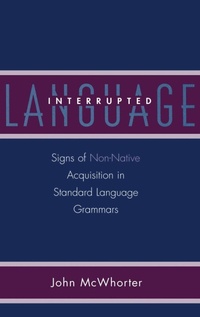
Language Interrupted
Signs of Non-Native Acquisition in Standard Language Grammars
Published on 21. June 2007
Book
Hardback
304 pages
978-0-19-530980-5 (ISBN)
Description
Foreigners often say that English language is "easy." A language like Spanish is challenging in its variety of verb endings (the verb speak is conjugated hablo, hablas, hablamos), and gender for nouns, whereas English is more straight forward (I speak, you speak, we speak). But linguists generally swat down claims that certain languages are "easier" than others, since it is assumed all languages are complex to the same degree. For example, they
will point to English's use of the word "do" -- Do you know French? This usage is counter-intuitive and difficult for non-native speakers. Linguist John McWhorter agrees that all languages are complex, but questions
whether or not they are all equally complex. The topic of complexity has become a hot issue in recent years, particularly in creole studies, historical linguistics, and language contact. As McWhorter describes, when languages came into contact over the years (when French speakers ruled the English for a few centuries, or the vikings invaded England), a large number of speakers are forced to learn a new language quickly, and this came up with a simplified version, a pidgin. When this ultimately
turns into a "real" language, a creole, the result is still simpler and less complex than a "non-interrupted" language that has been around for a long time. McWhorter makes the case that this kind of
simplification happens in degrees, and criticizes linguists who are reluctant to say that, for example, English is simply simpler than Spanish for socio-historical reasons. He analyzes how various languages that seem simple but are not creoles, actually are simpler than they would be if they had not been broken down by large numbers of adult learners. In addition to English, he looks at Mandarin Chinese, Persian, Malay, and some Arabic varieties. His work will interest not just experts in
creole studies and historical linguistics, but the wider community interested in language complexity.
will point to English's use of the word "do" -- Do you know French? This usage is counter-intuitive and difficult for non-native speakers. Linguist John McWhorter agrees that all languages are complex, but questions
whether or not they are all equally complex. The topic of complexity has become a hot issue in recent years, particularly in creole studies, historical linguistics, and language contact. As McWhorter describes, when languages came into contact over the years (when French speakers ruled the English for a few centuries, or the vikings invaded England), a large number of speakers are forced to learn a new language quickly, and this came up with a simplified version, a pidgin. When this ultimately
turns into a "real" language, a creole, the result is still simpler and less complex than a "non-interrupted" language that has been around for a long time. McWhorter makes the case that this kind of
simplification happens in degrees, and criticizes linguists who are reluctant to say that, for example, English is simply simpler than Spanish for socio-historical reasons. He analyzes how various languages that seem simple but are not creoles, actually are simpler than they would be if they had not been broken down by large numbers of adult learners. In addition to English, he looks at Mandarin Chinese, Persian, Malay, and some Arabic varieties. His work will interest not just experts in
creole studies and historical linguistics, but the wider community interested in language complexity.
Reviews / Votes
The main virture of this book is that it is written in a clear way and is very readable in spite of the fact that McWhorter discusses a large amount of data from a variety of sources. Chapters 4-8, the test cases for the main claim of the book, are organized in a similar fashion and contain tables where data from languages are presented in a way that helps the reader to follow the analysis. This is important as the cases discussed come from different language families, so it is unlikely that the reader will be familiar with all of them. McWhorter's writing is engaging; he succeeds in looking at specific, local cases from a broad perspective and draws parallels between them. The presentation of the data is lucid and everything is connected to the central line of argumentation of the book in a direct way. * Linguist List *More details
Language
English
Place of publication
New York
United States
Target group
College/higher education
Professional and scholarly
Illustrations
11 illus.
Dimensions
Height: 240 mm
Width: 161 mm
Thickness: 22 mm
Weight
663 gr
ISBN-13
978-0-19-530980-5 (9780195309805)
Copyright in bibliographic data and cover images is held by Nielsen Book Services Limited or by the publishers or by their respective licensors: all rights reserved.
Schweitzer Classification
Other editions
Additional editions
E-Book
06/2007
1st Edition
OUP eBook
€47.99
Available for download
E-Book
06/2007
1st Edition
OUP eBook
€37.99
Available for download
Person
Content
1: Navajo as Default
2: Defining Grammatical Complexity
3: Epistemological Caveats
4: English: The "Irriataion" of Nuance
5: "Altaicization" or Simplification?
6: Persian: "The Most Atypical Iranian Language"
7: Colloquial Arabic: A Mysterious "Drift"
8: Malay: "A More Approachable Structure:
9: A New Typlogy of Language Contact
2: Defining Grammatical Complexity
3: Epistemological Caveats
4: English: The "Irriataion" of Nuance
5: "Altaicization" or Simplification?
6: Persian: "The Most Atypical Iranian Language"
7: Colloquial Arabic: A Mysterious "Drift"
8: Malay: "A More Approachable Structure:
9: A New Typlogy of Language Contact