

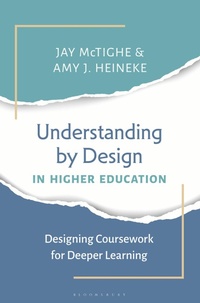
Understanding by Design in Higher Education
Designing Coursework for Deeper Learning
Will be published approx. on 3. September 2026
Book
Hardback
160 pages
979-8-7651-5183-9 (ISBN)
Description
Understanding by Design (R) (UbD) is an internationally renowned curriculum development framework that has been used by educators across the world for more than three decades. The key ideas of the UbD framework are contained in its title: 1) prioritize the development of in-depth understandings to facilitate transfer for real-world applications; and 2) apply a three-stage design process for creating curricula toward those ends.
Though most widely used in K-12 schools, UbD can be applied to guide postsecondary faculty in designing courses to deepen students' understanding and promote transfer in professional settings. Given the reality that most higher education faculty have little to no preparation in designing curriculum, the practical three-stage backward design framework can support them in applying their disciplinary expertise to develop coursework for deeper learning and transfer.
The goal of this book is to support faculty in thoughtfully designing coursework that prioritizes students' understanding, incorporates authentic and engaging assessments, and encourages active learning for understanding and transfer beyond the college classroom. Rather than recycling old syllabi or simply covering the chapters of a textbook, faculty will learn to harness their rich academic and professional expertise to design meaningful, authentic, and engaging curriculum.
Though most widely used in K-12 schools, UbD can be applied to guide postsecondary faculty in designing courses to deepen students' understanding and promote transfer in professional settings. Given the reality that most higher education faculty have little to no preparation in designing curriculum, the practical three-stage backward design framework can support them in applying their disciplinary expertise to develop coursework for deeper learning and transfer.
The goal of this book is to support faculty in thoughtfully designing coursework that prioritizes students' understanding, incorporates authentic and engaging assessments, and encourages active learning for understanding and transfer beyond the college classroom. Rather than recycling old syllabi or simply covering the chapters of a textbook, faculty will learn to harness their rich academic and professional expertise to design meaningful, authentic, and engaging curriculum.
Reviews / Votes
Faculty in higher education have been borrowing and adapting the Understanding by Design approach for some time. Now there is finally a seminal guidebook for the task, specifically targeting higher education. The authors do more than clearly explain the process step by step. They illustrate how it can be adapted to any field of study and used for various purposes. As the world of higher education rapidly evolves, this book should be in the personal library of every serious educator. A lot of my own success in the field can be directly attributed to this approach to both course and program development. I highly recommend this book. -- Dr. Nancy K Sundheim * Associate Professor, Emeritus, Director Emeritus, Manufacturing Engineering Technology, St. Cloud State University * Understanding by Design in Higher Education is a must-use manual for anyone undertaking course-and program-level design in postsecondary contexts. Written in clear and accessible language, this book addresses cutting-edge topics such as AI and responsive design, and provides ample practical examples to help faculty meet the needs of diverse learners across disciplines. This will be a go-to resource for my own department as we undergo curricular revision in the coming years. -- Kate Paesani * Associate Professor, Department of French & Italian; Director, Center for Advanced Research on Language Acquisition (CARLA), University of Minnesota * McTighe and Heineke have written the UbD book that higher education has been waiting for. It is thorough and practical at the course level, but it was the program-level blueprint that stopped me - I could immediately see how to apply it to the curriculum challenges we are facing right now. -- Dr. Caroline Fell Kurban * Advisor to the Rector, MEF University * Generative AI has exposed a hard truth about higher education: when information is everywhere, teaching cannot simply be about delivering more of the same. The question now is whether universities will be true to their mission as learning organizations-or cling to outdated models where learning was too often beside the point. Jay McTighe and Amy Heineke offer a powerful answer. Through the Understanding by Design framework, they show how to focus teaching on what truly matters: enduring understandings, meaningful evidence of learning, and the ability to use knowledge-with plasticity-in novel situations. Clear, bold, and practical, this book offers conceptual guidance and concrete application for universities ready to design learning for a new era. They have given us the blueprint to redesign learning in higher education. Now is the time to build. -- William Gaudelli * Inaugural Dean, College of Lifetime Learning, Georgia Institute of Technology * What a timely and thoughtful expansion of the already robust Understanding by Design framework to make it immediately applicable for use in undergraduate, graduate, and professional programs. Wiggins and Heinecke offer new perspectives aligned with needs of higher education faculty and add fresh material related to adult learning principles, accreditation expectations, and applications of artificial intelligence. We can't wait to apply the new insights and tools! -- Nancy P. Moreno, PhD * Ph.D.,Thomas R. Powers Distinguished Chair of Educational Outreach, professor and chair, Huffington Department of Education, Innovation & Technology, Baylor College of Medicine * For more than two decades, Understanding by Design has been my bible for curriculum writing, lesson planning, IEP development, assessment design, and course development. Their framework didn't just refine my teaching; it fundamentally transformed how I think. Backward design gave me a language and a structure for what excellent teaching and deep learning looks like, sounds like, and feels like across disciplines and contexts. When faculty learn to begin with the end in mind, when they clarify what authentic understanding and transfer really mean in their fields, they unlock an entirely new world for learners. They create the conditions for human thinking, metacognition, and meaningful teaching and learning to flourish.Jay McTighe has an extraordinary gift for taking complex ideas and making them accessible, actionable, and inspiring. His new book, Understanding by Design in Higher Education, offers exactly the blueprint that today's faculty need. It connects the enduring principles of backward design to the realities of contemporary higher education and provides practical, discipline-specific examples that faculty can use immediately. This text doesn't just tell educators what backward design is; it shows them how to do the important, thoughtful work of designing for understanding, transfer, and authentic learning. His co-author, Dr. Amy Heineke, brings deep expertise in teacher education and multilingual learning, enriching this work with practical insights that strengthen its relevance for today's diverse higher-education classrooms. -- Maureen Martin * MA, MS, BS, Assistant Director of Faculty Development, part-time faculty, Teacher Education, Howard Community College *
More details
Language
English
Place of publication
New York
United States
Publishing group
Bloomsbury Publishing Plc
Target group
College/higher education
Professional and scholarly
Dimensions
Height: 254 mm
Width: 178 mm
Thickness: 25 mm
Weight
454 gr
ISBN-13
979-8-7651-5183-9 (9798765151839)
Copyright in bibliographic data and cover images is held by Nielsen Book Services Limited or by the publishers or by their respective licensors: all rights reserved.
Schweitzer Classification
Persons
Jay McTighe is a veteran educator and author of 18 books with translations into 14 languages, including the award-winning and best-selling Understanding by Design (R) series with Grant Wiggins. Jay has also written more than 60 articles and book chapters and has spoken at state, national, and international conferences in 48 states within the United States, in seven Canadian provinces, and internationally in 39 countries on six continents.
Amy Heineke is a professor in the School of Education at Loyola University Chicago, where she prepares educators to design curriculum and instruction that nurtures students' disciplinary learning and language development. Dr. Heineke has written nine books and 70 peer-reviewed articles and chapters, drawing from her research on educator preparation, curriculum design, and instructional supports for multilingual learners.
Amy Heineke is a professor in the School of Education at Loyola University Chicago, where she prepares educators to design curriculum and instruction that nurtures students' disciplinary learning and language development. Dr. Heineke has written nine books and 70 peer-reviewed articles and chapters, drawing from her research on educator preparation, curriculum design, and instructional supports for multilingual learners.
Content
Introduction
Chapter 1: The Big Ideas of Understanding by Design
Chapter 2: Defining Learning Goals
Chapter 3: Determining Evidence of Learning
Chapter 4: Developing the Learning Plan
Chapter 5: Responding to All Learners
Chapter 6: Using Understanding by Design to Enhance Programs
Appendices
Chapter 1: The Big Ideas of Understanding by Design
Chapter 2: Defining Learning Goals
Chapter 3: Determining Evidence of Learning
Chapter 4: Developing the Learning Plan
Chapter 5: Responding to All Learners
Chapter 6: Using Understanding by Design to Enhance Programs
Appendices