

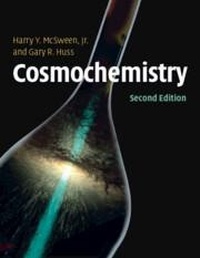
Cosmochemistry
2nd Edition
Will be published approx. on 3. March 2022
Book
Hardback
452 pages
978-1-108-83983-9 (ISBN)
Description
Cosmochemistry is a rapidly evolving field of planetary science and the second edition of this classic text reflects the exciting discoveries made over the past decade from new spacecraft missions. Topics covered include the synthesis of elements in stars, behaviour of elements and isotopes in the early solar nebula and planetary bodies, and compositions of extra-terrestrial materials. Radioisotope chronology of the early Solar System is also discussed, as well as geochemical exploration of planets by spacecraft, and cosmochemical constraints on the formation of solar systems. Thoroughly updated throughout, this new edition features significantly expanded coverage of chemical fractionation and isotopic analyses; focus boxes covering basic definitions and essential background material on mineralogy, organic chemistry and quantitative topics; and a comprehensive glossary. An appendix of analytical techniques and end-of-chapter review questions, with solutions available at www.cambridge.org/cosmochemistry2e, also contribute to making this the ideal teaching resource for courses on the Solar System's composition as well as a valuable reference for early career researchers.
Reviews / Votes
'Cosmochemistry deserves a wide distribution as a text for undergraduate and research students. Indeed, the book is worthy of the American Astronomical Society's Chambliss Astronomical Writing Award given for textbooks at either the upper-division or graduate level.' David L. Lambert, The Observatory 'The authors ... have done an admirable job of providing context for the ongoing research in this field, and the current and anticipated results from the exploration of the solar system by spacecraft, including returned samples from asteroids, the Moon, and Mars.' Christopher Herd, American Mineralogist 'It would be effectively impossible for any textbook to capture the current state of cosmochemistry, given the pace of discovery. The authors ... acknowledge that their book is a snapshot. However, they have done an admirable job of providing context for the ongoing research in this field, and the current and anticipated results from the exploration of the solar system by spacecraft, including returned samples from asteroids, the Moon, and Mars.' Christopher Herd, American MineralogistMore details
Edition
2nd Revised edition
Language
English
Place of publication
Cambridge
United Kingdom
Target group
Professional and scholarly
Edition type
Revised edition
Illustrations
Worked examples or Exercises
Dimensions
Height: 260 mm
Width: 208 mm
Thickness: 29 mm
Weight
1214 gr
ISBN-13
978-1-108-83983-9 (9781108839839)
Copyright in bibliographic data and cover images is held by Nielsen Book Services Limited or by the publishers or by their respective licensors: all rights reserved.
Schweitzer Classification
Other editions
Additional editions
Harry McSween, Jr | Gary Huss
Cosmochemistry
E-Book
02/2022
2nd Edition
Cambridge University Press
€63.49
Available for download
Jr Harry McSween
Cosmochemistry
E-Book
10/2021
Cambridge University Press
€63.49
Available for download
Previous edition
Harry Y. McSween, Jr | Gary R. Huss
Cosmochemistry
Book
04/2010
Cambridge University Press
€86.65
Article exhausted; check for reprint
Persons
Harry McSween is Chancellor Professor Emeritus at the University of Tennessee. His research on meteorites and Mars has resulted in hundreds of scientific papers. He has authored/co-authored six books on planetary science, including the textbook Planetary Geoscience (Cambridge, 2019) and was co-investigator on four NASA spacecraft missions. He has received awards from the US National Academy of Sciences, Meteoritical Society, and American Geophysical Union, and is the namesake for an asteroid.
Content
1. Introduction to Cosmochemistry; 2. Nuclides and Elements - The Building Blocks of Matter; 3. Origin of the Elements; 4. Solar System and Cosmic Abundances - Elements and Isotopes; 5. Presolar Grains - A Record of Stellar Nucleosynthesis and Processes in Interstellar Space; 6. Meteorites and Interplanetary Dust - A Record of Nebular and Planetary Processes; 7. Element Fractionations by Cosmochemical and Geochemical Processes; 8. Stable-Isotope Fractionations by Cosmochemical and Geochemical Processes; 9. Radioisotopes as Chronometers; 10. Chronology of the Early Solar System; 11. The Most Volatile Elements and Compounds - Ices, Noble Gases, and Organic Matter; 12. Planetesimals - Leftover Planetary Building Blocks; 13. Chemistry of Planetesimals and Their Samples; 14. Geochemical Exploration - The Moon and Mars as Case Studies; 15. Cosmochemical Models for the Formation and Evolution of Solar Systems; Appendix: Analytical Techniques Commonly Used in Cosmochemistry; References; Index.