

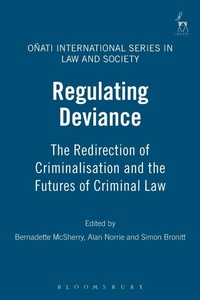
Regulating Deviance
The Redirection of Criminalisation and the Futures of Criminal Law
Published on 12. December 2008
Book
Paperback/Softback
310 pages
978-1-84113-890-9 (ISBN)
Description
The criminal attacks that occurred in the United States on 11 September 2001 have profoundly altered and reshaped the priorities of criminal justice systems around the world. Domestic criminal law has become a vehicle for criminalising 'new' terrorist offences and other transnational forms of criminality. 'Preventative' detention regimes have come to the fore, balancing the scales in favour of security rather than individual liberty. These moves complement already existing shifts in criminal justice policies and ideologies brought about by adjusting to globalisation, economic neo-liberalism and the shift away from the post-war liberal welfare settlement. This collection of essays by leading scholars in the fields of criminal law and procedure, criminology, legal history, law and psychology and the sociology of law, focuses on the future directions for the criminal law in the light of current concerns with state security and regulating 'deviant' behaviour.
Reviews / Votes
...the book is a distinct and valuable contribution to both substantive criminal law theory and to the burgeoning field of security studies... Jonathan Simon Criminal Law and Philosophy Volume 6, 2012 This work would be of interest to scholars in the United States in the cross cultural study of law and the development of law. It would also be of interest to those who are interested in the development of criminal law, the theory of criminal law, criminology and the sociology of law...the work leaves the reader with plenty of food for thought and significant ideas as to the roots of criminal law and changes in the nature of criminal law. J. Michael Olivero Law and Politics Book Review Vol 19, No 9, September 2009 For far too long academic arguments surrounding criminalisation have been stuck in a narrow debate about the interpretation of the 'harm principle'. This book is a welcome attempt to broaden that debate. This book contains many excellent and thoughtful contributions. This is a book to be strongly recommended by those interested in issues surrounding criminalisation and the role of the state in times of perceived turbulence. It does not seek to be a book of answers, but it is buzzing with insights and ideas. Jonathan Herring Kings Law Journal Volume 21. Issue 1More details
Series
Language
English
Place of publication
Oxford
United Kingdom
Publishing group
Bloomsbury Publishing PLC
Target group
Professional and scholarly
Dimensions
Height: 234 mm
Width: 156 mm
Thickness: 18 mm
Weight
503 gr
ISBN-13
978-1-84113-890-9 (9781841138909)
Copyright in bibliographic data and cover images is held by Nielsen Book Services Limited or by the publishers or by their respective licensors: all rights reserved.
Schweitzer Classification
Other editions
Additional editions
Bernadette McSherry | Alan Norrie | Simon Bronitt
Regulating Deviance
The Redirection of Criminalisation and the Futures of Criminal Law
Book
12/2008
Hart Publishing
€133.60
Shipment within 15-20 days
Bernadette McSherry | Alan Norrie | Simon Bronitt
Regulating Deviance
The Redirection of Criminalisation and the Futures of Criminal Law
E-Book
12/2008
1st Edition
Hart Publishing
€44.49
Available for download
Persons
Bernadette McSherry is Professor of Law, Monash University and Australian Research Council Federation Fellow. Alan Norrie is the Edmund-Davies Professor of Criminal Law and Criminal Justice, King's College London. Simon Bronitt is Professor of Law and Director, National Europe Centre, the Australian National University.
Content
Part I: Introduction
1. Regulating Deviance: The Redirection of Criminalisation and the Futures of Criminal Law
Bernadette McSherry, Alan Norrie and Simon Bronitt
Part II: Shifts in Criminal Justice Policies
2. Citizenship, Authoritarianism and the Changing Shape of the Criminal Law
Alan Norrie
3. Fixing the Future? The Pre-emptive Turn in Criminal Justice
Lucia Zedner
4. 'Victim-Driven' Criminalisation? Some Recent Trends in the Expansion of the Criminal Law
Leslie Sebba
Part III: The Quest for Security
5. Criminal Law, Human Rights and Preventative Justice
Andrew Ashworth
6. The Theory of Vulnerable Autonomy and the Legitimacy of Civil Preventative Orders
Peter Ramsay
7. Expanding the Boundaries of Inchoate Crimes: The Growing Reliance on Preparatory Offences
Bernadette McSherry
8. Social Science and Criminal Law Reform: Beyond Mere Opinion Polling and Penal Populism
Mark Nolan
Part IV: The Scope and Justification of Sexual Offences
9. Criminal Law and Private Spaces: Regulating Homosexual Acts in Singapore
Kumaralingam Amirthalingam
10. Moral Uncertainties of Rape and Murder: Problems at the Core of Criminal Law Theory
Ngaire Naffine
Part V: Codification and The Liberal Promise
11. Criminal Codes in the 21st Century: The Paradox of the Liberal Promise
Simon Bronitt and Miriam Gani
12. Faultlines Between Guilt and Punishment in Australia's Model Criminal Code
Ian Leader-Elliott
1. Regulating Deviance: The Redirection of Criminalisation and the Futures of Criminal Law
Bernadette McSherry, Alan Norrie and Simon Bronitt
Part II: Shifts in Criminal Justice Policies
2. Citizenship, Authoritarianism and the Changing Shape of the Criminal Law
Alan Norrie
3. Fixing the Future? The Pre-emptive Turn in Criminal Justice
Lucia Zedner
4. 'Victim-Driven' Criminalisation? Some Recent Trends in the Expansion of the Criminal Law
Leslie Sebba
Part III: The Quest for Security
5. Criminal Law, Human Rights and Preventative Justice
Andrew Ashworth
6. The Theory of Vulnerable Autonomy and the Legitimacy of Civil Preventative Orders
Peter Ramsay
7. Expanding the Boundaries of Inchoate Crimes: The Growing Reliance on Preparatory Offences
Bernadette McSherry
8. Social Science and Criminal Law Reform: Beyond Mere Opinion Polling and Penal Populism
Mark Nolan
Part IV: The Scope and Justification of Sexual Offences
9. Criminal Law and Private Spaces: Regulating Homosexual Acts in Singapore
Kumaralingam Amirthalingam
10. Moral Uncertainties of Rape and Murder: Problems at the Core of Criminal Law Theory
Ngaire Naffine
Part V: Codification and The Liberal Promise
11. Criminal Codes in the 21st Century: The Paradox of the Liberal Promise
Simon Bronitt and Miriam Gani
12. Faultlines Between Guilt and Punishment in Australia's Model Criminal Code
Ian Leader-Elliott