

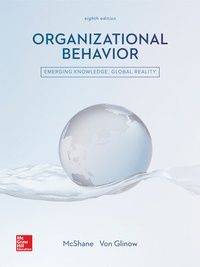
Organizational Behavior
8th Edition
Published on 16. April 2017
Book
Hardback
624 pages
978-1-259-56279-2 (ISBN)
Description
Organizational Behavior, 8e by McShane / Von Glinow helps everyone make sense of Organizational Behavior, and provides the conceptual tools to work more effectively in the workplace. This author duo continue the trailblazing innovations that made the previous editions of Organizational Behavior recognized and adopted by the new generation organizational behavior instructor.
The McShane and Von Glinow product is acclaimed for:
Readability, presentation of current knowledge
Linking OB concepts and theories with reality
Strong International / Global orientation
Contemporary Theory Foundation (without the jargon)
Active Learning and Critical Thinking Support
Textbook's philosophy OB knowledge is for everyone, not just traditional managers. Organizational Behavior, 8e is written in the context of these emerging workplace realities. This edition explains how emotions are the foundation of employee motivation, attitudes, and decisions; how social networks generate power and shape communication patterns; how self-concept influences individual behavior, team cohesion, and leadership; and how adopting a global mindset has become an important employee characteristic in this increasingly interconnected world. This book also presents the reality that organizational behavior is not just for managers; it is relevant and valuable to anyone who works in and around organizations.
The McShane and Von Glinow product is acclaimed for:
Readability, presentation of current knowledge
Linking OB concepts and theories with reality
Strong International / Global orientation
Contemporary Theory Foundation (without the jargon)
Active Learning and Critical Thinking Support
Textbook's philosophy OB knowledge is for everyone, not just traditional managers. Organizational Behavior, 8e is written in the context of these emerging workplace realities. This edition explains how emotions are the foundation of employee motivation, attitudes, and decisions; how social networks generate power and shape communication patterns; how self-concept influences individual behavior, team cohesion, and leadership; and how adopting a global mindset has become an important employee characteristic in this increasingly interconnected world. This book also presents the reality that organizational behavior is not just for managers; it is relevant and valuable to anyone who works in and around organizations.
More details
Edition
8th edition
Language
English
Place of publication
OH
United States
Target group
College/higher education
US School Grade: From College Freshman to College Graduate Student
Edition type
Unabridged edition
Product notice
sewn/stitched
Cloth over boards
Illustrations
110 Illustrations
Dimensions
Height: 285 mm
Width: 225 mm
Thickness: 24 mm
Weight
1399 gr
ISBN-13
978-1-259-56279-2 (9781259562792)
Copyright in bibliographic data and cover images is held by Nielsen Book Services Limited or by the publishers or by their respective licensors: all rights reserved.
Schweitzer Classification
Other editions
Previous edition
Mary Von Glinow | Steven McShane
Organizational Behavior
Book
10/2014
7th Edition
McGraw-Hill Professional
€290.91
Article exhausted; check for reprint
Persons
Steven L. McShane is Conjoint Professor at Newcastle Business School, University of Newcastle (Australia). He previously held the positions of Adjunct Professor at Gustavson School of Business, University of Victoria (Canada), Professor at Simon Fraser Universitys Faculty of Business Administration (Canada), and Winthrop Professor of Management at the University of Western Australia Graduate School of Management and Business School. He currently teaches organizational behavior in the IMBA program at the Antai College of Economics and Management atShanghai Jiao Tong University in Shanghai, China. Steve has received awards for his teaching quality and innovation, and receives high ratings from students in Perth, Shanghai, Singapore, Manila, and other cities where he has taught. He is alsoa popular visiting speaker, having given dozens of invited talks and seminars to faculty and students in the United States, China, Canada, Malaysia, India, and other countries.Steve earned his PhD from Michigan State University, where he specialized in organizational behavior and labor relations. He also holds a Masters of Industrial Relations from the University of Toronto and an undergraduate degree from Queens University in Canada. Steve is a past president of the Administrative Sciences Association of Canada (the Canadian equivalent of the Academy of Management) and served as Director of Graduate Programs in Simon Fraser Universitys business faculty. He has conducted executive programs with Nokia, Ti?V-Si?D, Wesfarmers Group, Main Roads WA, McGraw-Hill, ALCOA World Alumina Australia, and many other organizations. Along with coauthoring Organizational Behavior, Ninth Edition, Steve is lead coauthor of Canadian Organizational Behaviour, Tenth Edition (2018), Organisational Behaviour: Asia Pacific, Sixth Edition (2019), and M: Organizational Behavior, Fourth Edition (2019). He is also coauthor of editions or translations of his organizational behavior books in other countries. Steve has published several dozen articles and conference papers on workplace values, training transfer, organizational learning, exitvoiceloyalty, employee socialization, wrongful dismissal, media biasin business magazines, and other diverse topics. Steve enjoys spending his leisure time hiking, swimming, body board surfing, canoeing, skiing, and traveling with his wife and two daughters.
Dr. Von Glinow is a Knight Ridder Eminent Scholar Chair in International Management at Florida International University and is senior editor for the Journal of International Business Studies (JIBS). She served as 2010 to 2012 president of the Academy of International Business (AIB) and the 19941995 president of the Academy of Management (AOM). Previously on the Marshall School faculty of the University of Southern California, she has an MBA and a PhD in management science from Ohio State University, and is a Fellow of the Academy of Management, Mary Ann Von Glinow Courtesy of Donna McClement the Academy of International Business, and the Pan-Pacific Business Association.
She sits on 13 editorial review boards and numerous international panels and teaches in executive programs in Latin America, Asia, and the United States.
Dr. Von Glinow has authored over 100 journal articles and 13 books, most of
which have been translated into Chinese, Hindi, and Spanish. Her book on organizational learning capability won a Gold Book Award from the Ministry of Economic Affairs in Taiwan in 2002. She is the 2005 recipient of the Academy of
Managements Distinguished Service Award, one of the highest honors bestowed by
the Academy.
Mary Ann has consulted widely and is on the board of directors of several organizations, including the advisory board to Volvo-Geely in China. She is actively involved in several animal welfare organizations and received the 1996 Humanitarian Award of the Year from Miamis Adopt-a-Pet.
Dr. Von Glinow is a Knight Ridder Eminent Scholar Chair in International Management at Florida International University and is senior editor for the Journal of International Business Studies (JIBS). She served as 2010 to 2012 president of the Academy of International Business (AIB) and the 19941995 president of the Academy of Management (AOM). Previously on the Marshall School faculty of the University of Southern California, she has an MBA and a PhD in management science from Ohio State University, and is a Fellow of the Academy of Management, Mary Ann Von Glinow Courtesy of Donna McClement the Academy of International Business, and the Pan-Pacific Business Association.
She sits on 13 editorial review boards and numerous international panels and teaches in executive programs in Latin America, Asia, and the United States.
Dr. Von Glinow has authored over 100 journal articles and 13 books, most of
which have been translated into Chinese, Hindi, and Spanish. Her book on organizational learning capability won a Gold Book Award from the Ministry of Economic Affairs in Taiwan in 2002. She is the 2005 recipient of the Academy of
Managements Distinguished Service Award, one of the highest honors bestowed by
the Academy.
Mary Ann has consulted widely and is on the board of directors of several organizations, including the advisory board to Volvo-Geely in China. She is actively involved in several animal welfare organizations and received the 1996 Humanitarian Award of the Year from Miamis Adopt-a-Pet.
Content
Part 1: Introduction
Chapter 1: Introduction to the Field of Organizational Behavior
Part 2: Individual Behavior and Processes
Chapter 2: Individual Behavior, Personality, and Values
Chapter 3: Perceiving Ourselves and Others in Organizations
Chapter 4: Workplace Emotions, Attitudes, and Stress
Chapter 5: Foundations of Employee Motivation
Chapter 6: Applied Performance Practices
Chapter 7: Decision Making and Creativity
Part 3: Team Processes
Chapter 8: Team Dynamics
Chapter 9: Communicating in Teams and Organizations
Chapter 10: Power and Influence in the Workplace
Chapter 11: Conflict and Negotiation in the Workplace
Chapter 12: Leadership in Organizational Settings
Part 4: Organizational Processes
Chapter 13: Designing Organizational Structures
Chapter 14: Organizational Culture
Chapter 15: Organizational Change
Chapter 1: Introduction to the Field of Organizational Behavior
Part 2: Individual Behavior and Processes
Chapter 2: Individual Behavior, Personality, and Values
Chapter 3: Perceiving Ourselves and Others in Organizations
Chapter 4: Workplace Emotions, Attitudes, and Stress
Chapter 5: Foundations of Employee Motivation
Chapter 6: Applied Performance Practices
Chapter 7: Decision Making and Creativity
Part 3: Team Processes
Chapter 8: Team Dynamics
Chapter 9: Communicating in Teams and Organizations
Chapter 10: Power and Influence in the Workplace
Chapter 11: Conflict and Negotiation in the Workplace
Chapter 12: Leadership in Organizational Settings
Part 4: Organizational Processes
Chapter 13: Designing Organizational Structures
Chapter 14: Organizational Culture
Chapter 15: Organizational Change