

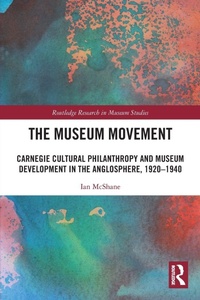
The Museum Movement
Carnegie Cultural Philanthropy and Museum Development in the Anglosphere, 1920-1940
1st Edition
Will be published approx. on 20. July 2026
Book
Paperback/Softback
150 pages
978-0-367-62370-8 (ISBN)
Description
The Museum Movement provides the first systematic overview of the 'museum movement' of the early twentieth century, which encouraged museums to play a greater role in education and civic uplift.
Highlighting the key role played by the Carnegie Corporation in guiding museum development in the late colonial period, this book shows that the movement was strongly influenced by the racial politics of the period and that its focus on local histories and civic engagement sought to boost the historical legitimacy and continued vitality of small towns and their dominant white populations. Demonstrating that the 'museum movement' placed new emphasis on the importance of professionalisation, interpretation, and audience engagement, McShane shows how, by the late 1930s, the movement had helped lay the foundations of museology. This book also constructs a genealogy of the 'new' museology, the next wave of museum reform that emerged in the 1970s, by reflecting critically on the 'newness' of some of its ideas. Indicating that 'new' thinking about audience, display media, and the economics of culture has a longer history, this book also provides historical perspectives on current interests in informal and social learning, the formation of museum publics, and institutional convergence.
The Museum Movement explores the intersections and crosscurrents of modernism and settler-colonialism and will thus appeal to academics and students with an interest in museum studies, heritage, history, colonial studies, and race.
Highlighting the key role played by the Carnegie Corporation in guiding museum development in the late colonial period, this book shows that the movement was strongly influenced by the racial politics of the period and that its focus on local histories and civic engagement sought to boost the historical legitimacy and continued vitality of small towns and their dominant white populations. Demonstrating that the 'museum movement' placed new emphasis on the importance of professionalisation, interpretation, and audience engagement, McShane shows how, by the late 1930s, the movement had helped lay the foundations of museology. This book also constructs a genealogy of the 'new' museology, the next wave of museum reform that emerged in the 1970s, by reflecting critically on the 'newness' of some of its ideas. Indicating that 'new' thinking about audience, display media, and the economics of culture has a longer history, this book also provides historical perspectives on current interests in informal and social learning, the formation of museum publics, and institutional convergence.
The Museum Movement explores the intersections and crosscurrents of modernism and settler-colonialism and will thus appeal to academics and students with an interest in museum studies, heritage, history, colonial studies, and race.
Reviews / Votes
"McShane's book is one of the first comprehensive studies of the museum movement of the early twentieth century which traces the cultural philanthropy of the Carnegie Corporation of New York (CCNY). It is a major contribution to our understanding of museum professionals and professionalisation in the interwar period which clearly owes much to private rather than public funding...Histories of the museum sector, professional bodies and everyday practice, are few and far between. For researchers of this foundational period of museum history, therefore, this text is essential reading, showing CCNY's support of museum education, exhibition display and training, and the establishment of membership bodies, such as the Art Gallery and Museums Association of Australia and New Zealand in 1939. The Corporation cultivated new areas of museum work and expertise, science-based social reform, civic uplift, managerialism, professional development and public museum education programs, alongside its better-known work funding the building of public libraries. In a detailed, carefully researched and authoritatively written text, the author shows how the work of the CCNY shaped, and was shaped by, the intellectual currents of the time: pragmatism, progressivism and modernisation, constructivist theories of learning, and notions of race and culture."Conal McCarthy, Professor of Museum and Heritage Studies, Te Herenga Waka Victoria University of Wellington in History Australia (23:1, 2026)
More details
Series
Language
English
Place of publication
London
United Kingdom
Publishing group
Taylor & Francis Ltd
Target group
College/higher education
Postgraduate
Illustrations
18 s/w Photographien bzw. Rasterbilder, 18 s/w Abbildungen
18 Halftones, black and white; 18 Illustrations, black and white
Dimensions
Height: 234 mm
Width: 156 mm
ISBN-13
978-0-367-62370-8 (9780367623708)
Copyright in bibliographic data and cover images is held by Nielsen Book Services Limited or by the publishers or by their respective licensors: all rights reserved.
Schweitzer Classification
Other editions
Additional editions
Ian McShane
The Museum Movement
Carnegie Cultural Philanthropy and Museum Development in the Anglosphere, 1920-1940
E-Book
03/2025
1st Edition
Routledge
€60.49
Available for download
Ian McShane
The Museum Movement
Carnegie Cultural Philanthropy and Museum Development in the Anglosphere, 1920-1940
E-Book
03/2025
1st Edition
Routledge
€60.49
Available for download
Ian McShane
The Museum Movement
Carnegie Cultural Philanthropy and Museum Development in the Anglosphere, 1920-1940
Book
03/2025
1st Edition
Routledge
€205.80
Shipment within 15-20 days
Person
Ian McShane is an honorary associate professor in the Centre for Urban Research, RMIT University, Melbourne, Australia. His research interests focus on the informal and formal education sectors, including museums, libraries, and schools, and he has published widely on cultural, educational, and urban policy. Prior to academia, Ian worked as a museum curator, arts administrator, and education consultant.
Content
1. Introduction; 2. The Museum Movement: Background and Influences;3. Survey, Analysis, Plan: The Carnegie Corporation of New York's Cultural Programs; 4. Museum Development and the British Empire Museum Surveys;5. Expert and Efficient: Curators and Managers in the New Museum; 6. Visiting Museums: Education, Behaviour, and New Leisure; 7. Conclusion: Museology Old and New?