

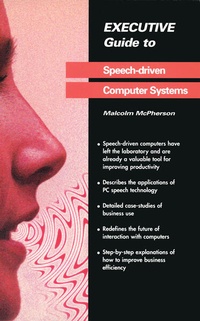
Executive Guide to Speech-Driven Computer Systems
1st Edition
Published on 15. September 1995
Book
Paperback/Softback
XIII, 113 pages
978-3-540-19911-3 (ISBN)
Description
A new generation of speech-driven personal computer systems promises to transform the business use of Information Technology. This is not merely a matter of discarding the keyboard, but of rethinking business processes to take advantage of the increased productivity that speech-driven systems can bring.
Malcolm McPherson is one of the pioneers of this fast-moving field, and has been personally involved in the development of systems that have met business needs across many industrial sectors.
Malcolm McPherson is one of the pioneers of this fast-moving field, and has been personally involved in the development of systems that have met business needs across many industrial sectors.
More details
Series
Edition
1st Edition
Language
English
Place of publication
London
United Kingdom
Publishing group
Springer Berlin
Target group
Professional and scholarly
Professional/practitioner
Illustrations
40 s/w Abbildungen
XIII, 113 p. 40 illus.
Dimensions
Height: 235 mm
Width: 155 mm
Thickness: 8 mm
Weight
207 gr
ISBN-13
978-3-540-19911-3 (9783540199113)
DOI
10.1007/978-1-4471-0385-1
Schweitzer Classification
Other editions
Additional editions
Malcolm McPherson
Executive Guide to Speech-Driven Computer Systems
E-Book
12/2012
Springer
€53.49
Available for download
Content
1 Introduction.- The Speech-Activation Market.- The Two-Finger Factor.- The Legal Factor.- The Pentium Factor.- The RSI Factor.- The Efficiency Factor.- The Hands-Free Factor.- The On-the-Move Factor.- Conclusion.- Introduction: Series Editor's Notes.- 2 The Future Office.- A Day at the Office in the Future.- The Future Office: Series Editor's Notes.- 3 How Speech Activation Works.- Simplistic Explanation.- Continuous Versus Discontinuous.- Speaker-Dependent Versus Speaker-Independent.- Small Vocabulary Versus Large Vocabulary.- Dalek Speak Versus Phrase Speak.- Conclusion.- How Speech Activation Works: Series Editor's Notes.- 4 Example Speech Packages.- Example Speech Packages: Series Editor's Notes.- 5 Case Studies.- Case Study 1: Director of International Interior Design Contractors Using CADSpeak for Windows.- Case Study 2: Senior Partner from Small London Solicitors Using DragonDictate Classic.- Case Study 3: RSI Sufferer Using Shakespeare DOS SpeechWriter.- Case Study 4: Partially Sighted Trust Manager from Large London Solicitors Using OfficeSpeak Lite.- Case Study 5: IT Coordinator from Major UK Bank Using the IBM PDS.- Case Studies: Series Editor's Notes.- 6 Products on the Market Now.- Very Large Vocabulary.- Large Vocabulary.- Medium Vocabulary.- Small Vocabulary.- Tiny Vocabulary.- Products on the Market Now: Series Editor's Notes.- 7 Research and Development in Speech.- Major Design Questions Facing Speech Recognition Engineers.- Microphone Technology.- Sound Card Technology.- Database Searching and Template Matching.- Speech Recognition Using Neural Networks.- The Use of Artificial Intelligence in Speech Systems.- Research and Development in Speech: Series Editor's Notes.- 8 Environmental Changes.- Medical Aspects of Speech Recognition.-Workplace Reorganization.- Environmental Changes: Series Editor's Notes.- 9 Conclusions.- Appendix: Messages for Executives.- Why Is Speech Technology Important?.- Why Is Speech Technology Important for Busy Executives Today?.- How Will Speech Technology Affect the Executive and the Organization?.- How Can Speech Technology Offer Competitive Advantage?.- What Are the Next Steps?.