

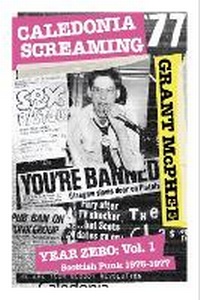
Caledonian Screaming
Limited Edition
Published on 12. November 2025
Book
Paperback/Softback
512 pages
978-1-7385149-9-1 (ISBN)
Description
Scotland, 1976. The 9th copy of the Ramones' debut album to arrive in the UK made its way to Glasgow. Scotland loved the Ramones from the off. A month after they had played at the Roundhouse, negative headlines about the band were splashed across the front page of a leading Glasgow newspaper. The first punk scare story. This only made the kids love them more. A few days after this, the Stranglers played in rural Hawick, followed shortly after by the Sex Pistols appearing in Dundee. Punk had entered Scotland.
The country had a long tradition of involvement with pioneering counter-culture, notably co-founding the International Times and London's underground hotspot, Middle-Earth. The kids in 1975 and '76 read the same weekly music press, imported all the same NYC punk classics and were as primed for 1977 punk as anywhere else in the UK. But something stopped this movement abruptly in its tracks: the Anarchy Tour.
While the rest of the country was just as scandalised in December 1976, the furore associated with punk soon mostly subsided. However, this was not the case in Scotland. Glasgow in particular had a year-long Calvinistic zeal towards 'banning' anything approximating 'punk'; combined with draconian licensing laws and an almost complete lack of infrastructure, the movement was strangled abruptly after its promising birth.
For many, this is where Scotland's involvement with punk finished, to suddenly spring back into life in January 1978 with the arrival of Fast Product and Simple Minds. It is almost as though 1977 never happened in Scotland. But it did and this is the untold story of that year.
Hundreds of bands formed in bedrooms, mostly outside of the big cities - small towns in Fife, the Borders and satellite areas of Glasgow. Using DIY ingenuity, these teenagers would improvise with what little means they had - organising their own gigs by subterfuge, writing their own very localised fanzines, building makeshift recording studios, releasing self produced cassette singles, fighting the authorities and trying to make themselves heard to a London press who had little to no interest in what was happening North of the Border.
It's a misnomer that the majority of what was happening in Scotland was merely a poor imitation of what London was doing a year previously; many of the bands were investigating areas that would be pivotal to post-punk and 'indie'. It was a country that appeared to be developing, like Caledonian marsupials, an alternative evolution of what was to come after punk. This music was almost all unheard at the time outside of bedrooms and local village halls, and the majority of these bands would never make it into the pages of the established press or history books.
1977, rather than a lost year, is one of Scotland's most important. It's what directly led to it being recognised as punching unusually high above its weight in regards to DIY and 'Indie' music. And this is its almost untold story, featuring interviews from over 200 Scottish punk musicians and London contemporaries (including members of Subway Sect, Generation X, The Adverts, Talking Heads, Chelsea, Alternative TV, Sex Pistols, The Lurkers and Cortinas) as well as promoters, label owners, fanzine and music press writers.
Learning three chords was easy, finding somewhere to play was the real challenge.
The country had a long tradition of involvement with pioneering counter-culture, notably co-founding the International Times and London's underground hotspot, Middle-Earth. The kids in 1975 and '76 read the same weekly music press, imported all the same NYC punk classics and were as primed for 1977 punk as anywhere else in the UK. But something stopped this movement abruptly in its tracks: the Anarchy Tour.
While the rest of the country was just as scandalised in December 1976, the furore associated with punk soon mostly subsided. However, this was not the case in Scotland. Glasgow in particular had a year-long Calvinistic zeal towards 'banning' anything approximating 'punk'; combined with draconian licensing laws and an almost complete lack of infrastructure, the movement was strangled abruptly after its promising birth.
For many, this is where Scotland's involvement with punk finished, to suddenly spring back into life in January 1978 with the arrival of Fast Product and Simple Minds. It is almost as though 1977 never happened in Scotland. But it did and this is the untold story of that year.
Hundreds of bands formed in bedrooms, mostly outside of the big cities - small towns in Fife, the Borders and satellite areas of Glasgow. Using DIY ingenuity, these teenagers would improvise with what little means they had - organising their own gigs by subterfuge, writing their own very localised fanzines, building makeshift recording studios, releasing self produced cassette singles, fighting the authorities and trying to make themselves heard to a London press who had little to no interest in what was happening North of the Border.
It's a misnomer that the majority of what was happening in Scotland was merely a poor imitation of what London was doing a year previously; many of the bands were investigating areas that would be pivotal to post-punk and 'indie'. It was a country that appeared to be developing, like Caledonian marsupials, an alternative evolution of what was to come after punk. This music was almost all unheard at the time outside of bedrooms and local village halls, and the majority of these bands would never make it into the pages of the established press or history books.
1977, rather than a lost year, is one of Scotland's most important. It's what directly led to it being recognised as punching unusually high above its weight in regards to DIY and 'Indie' music. And this is its almost untold story, featuring interviews from over 200 Scottish punk musicians and London contemporaries (including members of Subway Sect, Generation X, The Adverts, Talking Heads, Chelsea, Alternative TV, Sex Pistols, The Lurkers and Cortinas) as well as promoters, label owners, fanzine and music press writers.
Learning three chords was easy, finding somewhere to play was the real challenge.
More details
Language
English
Place of publication
United Kingdom
Publishing group
Into Creative
Illustrations
Black and white
Dimensions
Height: 234 mm
Width: 156 mm
Thickness: 36 mm
ISBN-13
978-1-7385149-9-1 (9781738514991)
Copyright in bibliographic data and cover images is held by Nielsen Book Services Limited or by the publishers or by their respective licensors: all rights reserved.
Schweitzer Classification
Person
GRANT McPHEE is a filmmaker and music writer from Scotland His feature-length documentary, Big Gold Dream was adapted into book form as Hungry Beat with co-writer, Douglas MacIntyre.
His documentary, Teenage Superstars was awarded 'Pick of the Day' by the Guardian, The Times and Telegraph and was one of Rolling Stone's 'Ten Essential Music Documentaries'. Grant also wrote Postcards From Scotland: Independent Scottish Music 1983-1995, in 2024.
His documentary, Teenage Superstars was awarded 'Pick of the Day' by the Guardian, The Times and Telegraph and was one of Rolling Stone's 'Ten Essential Music Documentaries'. Grant also wrote Postcards From Scotland: Independent Scottish Music 1983-1995, in 2024.