

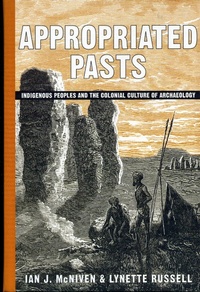
Appropriated Pasts
Indigenous Peoples and the Colonial Culture of Archaeology
Published on 15. September 2005
Book
Hardback
328 pages
978-0-7591-0906-3 (ISBN)
Description
Archaeology has been complicit in the appropriation of indigenous peoples' pasts worldwide. While tales of blatant archaeological colonialism abound from the era of empire, the process also took more subtle and insidious forms.
Reviews / Votes
The authors have given solid support to their goal of producing a manuscript that calls attention not only to the ways that archaeology has been used to subordinate, objectify, and appropriate the heritage and past of indigenous populations in Australia but they have found the means of supporting that goal through lucid writing and documentation. The text will be a useful tool to social scientists studying the issues inherent in Indigenous studies and reflexive examinations of archaeology as a political enterprise, as well as to those archaeologists in North America or in Australia struggling with the idea of a shared stewardship. As such, I see the volume as being a major textbook within classes examining Indigenous Archaeology and Critical Archaeology courses of study. -- Joe Watkins A good read, informative and thought-provoking. Summing Up: Recommended. Most levels/libraries. * CHOICE * The authors effectively utilize Australian archaeology and its relationship with indigenous people in order to present their argument, but with themes directed at wider audiences with varying interests, including archaeologists and anthropologists, historians and social scientists. * Museum Anthropology * For the historian wanting to learn about the history of a highly relevant discipline, Appropriated Pasts is a very good starting point. In exposing the national impacts of archaeology's history, we come face to face with many of the lingering cultural assumptions that inform our visual and textual reference languages. This book presents numerous profound insights into a scientific practice that has shaped our views of Aboriginal peoples. -- Ann McGrath, Australian National University * Australian Historical Studies * This voume is well suited as a textbook in archaeology, Native Studies, and other disciplines. It will clearly be read and widely cited for years to come on several continents. * Canadian Journal of Archaeology * I found this book enjoyable and stimulating. It is a thoughtful summation of the sins of our archaeological ancestors. * Aboriginal History * The book contains an important mapping of 'western' thoughts that influenced certain archaeologies and some fascinating case studies that help especially outsiders better understand Australia's many pasts. * South African Archaeological Bulletin * Incisive and thought-provoking. A volume that touches all facets of archaeology because of the seriousness of the issues it raises. -- Claire Smith, Flinders University and President of the World Archaeological CongressMore details
Series
Language
English
Place of publication
California
United States
Product notice
Laminated cover
Dimensions
Height: 235 mm
Width: 154 mm
Thickness: 18 mm
Weight
635 gr
ISBN-13
978-0-7591-0906-3 (9780759109063)
Copyright in bibliographic data and cover images is held by Nielsen Book Services Limited or by the publishers or by their respective licensors: all rights reserved.
Schweitzer Classification
Other editions
Additional editions
Ian J. McNiven | Lynette Russell
Appropriated Pasts
Indigenous Peoples and the Colonial Culture of Archaeology
E-Book
09/2005
1st Edition
AltaMira Press
€51.99
Available for download
Persons
Ian J. McNiven is Senior Lecturer and co-director of the Programme for Australian Indigenous Archaeology within the School of Geography and Environmental Science, Monash University.
Content
Chapter 1 Colonial Culture of Archaeology Chapter 2 Progressivism: The Invention of Prehistory Chapter 3 Antiquation: Aboriginal Peoples as Living Fossils Chapter 4 Migrationism: The Archaeology of Dispossession Chapter 5 Diffusionism: The Archaeology of Alienation Chapter 6 Subjectation: Appropration Through Science Chapter 7 Shared Nations: The New Appropriation Chapter 8 Partnerships: Pathways to a Decolonised Practice Chapter 9 References Chapter 10 Index