

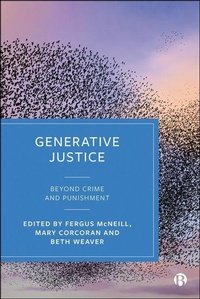
Generative Justice
Beyond Crime and Punishment
1st Edition
Will be published approx. on 29. January 2026
Book
Hardback
272 pages
978-1-5292-4590-5 (ISBN)
Description
This edited collection explores the concept of Generative Justice and how it might help us reimagine conventional responses to crime and state punishment. With case studies from the Global North and South, it offers insights into how, within different cultural contexts, justice-involved people find solidarity, belonging and purpose.
The book showcases exciting and innovative projects and communities in which unlikely solidarities have been forged among diverse people, through creative practices, education, food, horticulture, and through shared experiences of reentry, recovery and desistance. By exploring the common features and qualities of these generative places, the book sets out an agenda for future research and activism.
The book showcases exciting and innovative projects and communities in which unlikely solidarities have been forged among diverse people, through creative practices, education, food, horticulture, and through shared experiences of reentry, recovery and desistance. By exploring the common features and qualities of these generative places, the book sets out an agenda for future research and activism.
Reviews / Votes
'Generative justice (GJ) is a new term, and this innovative book demonstrates its practical and theoretical potential. Justice is not some lofty and remote conception nor does it belong only to the formal systems of the state. The book itself models the ways in which different perspectives on crime can be pooled in GJ to point towards novel pathways to desistance and reconciliation.' Rob Canton, De Montfort University 'This is a wonderful collection and an absolute must read for all concerned with defining and doing justice in contemporary worlds that takes us beyond normative concepts of crime and punishment. The authors take us on a journey constituted by the 'concept-praxis' of Generative Justice through creative, collaborative, engaged, sensory, activist and transformational research with criminal justice impacted people and communities.' Maggie O'Neill, University College Cork 'In an era when political winds have shifted away from recognizing the full humanity of criminalized people, this collection offers a new vision of justice-one that is relational, communal, humane and in fact generative. Generative Justice makes room to ask new questions of our responses to both crime and criminalization, and its chapters provide numerous examples of novel and promising approaches to justice that meet the needs of a new day. This is an important intervention that is at once ambitious, theoretically sophisticated, feasible and humane.' Reuben Jonathan Miller, MacArthur Fellow and author of Halfway Home: Race, Punishment and the Afterlife of Mass IncarcerationMore details
Edition
First Edition
Language
English
Place of publication
Bristol
United Kingdom
Target group
Professional and scholarly
Illustrations
3 s/w Abbildungen, 1 s/w Tabelle
Not illustrated
Dimensions
Height: 238 mm
Width: 158 mm
Thickness: 20 mm
Weight
520 gr
ISBN-13
978-1-5292-4590-5 (9781529245905)
Copyright in bibliographic data and cover images is held by Nielsen Book Services Limited or by the publishers or by their respective licensors: all rights reserved.
Schweitzer Classification
Other editions
Additional editions
Book
approx. 01/2027
1st Edition
Bristol University Press
€43.00
Not yet published
E-Book
01/2026
1st Edition
Bristol University Press
€40.99
Available for download
Persons
Fergus McNeill is Professor of Criminology and Social Work at the University of Glasgow.
Mary Corcoran is Professor of Criminology at Keele University.
Beth Weaver is Professor of Criminal and Social Justice at the University of Strathclyde.
Mary Corcoran is Professor of Criminology at Keele University.
Beth Weaver is Professor of Criminal and Social Justice at the University of Strathclyde.
Content
1. Introducing Generative Justice - Fergus McNeill, Mary Corcoran and Beth Weaver
2. Generative Justice: The Cooperative Way - Beth Weaver
3. Generative Justice at LandWorks: Sam's Story - Julie Parsons and Samuel Auchterlonie
4. Kitchen Table Justice: Reflections on What Abolition and Food Justice Can Teach Us About Generative Justice - Kelsey Timler and Cathee Porter
5. Global South Generative Justice? A Study of Education and Reintegration in 'Prisons Without Police' in Brazil - Sergio Grossi
6. Bearing Witness to State Power: Peer Support in Prison as an Expression of Generative Justice - William McGowan and Christian Perrin
7. Generative Justice and Systems Change: Five Lessons Learned in Reentry - Ruth Armstrong, Karen Hamer, Dempsey Lewis and Cedric Martin
8. Opening Minds, Hearts, and Visions: Generative Justice among Choir Volunteers and Incarcerated Individuals - Mary L. Cohen and Richard Winemiller
9. Generative Justice in Hindsight: On Knowing, Doing and Sharing through Participatory Arts- Based Research - Emma Murray, Lucia Arias, Gillian Buck, Kemi Ryan and Natasha Ryan
10. A Perspective From Practice: Making Together, Between Limitations and Possibilities - Alison Urie
11. The Generative Culture of Recovery: The Intersection of Coloniality, Utopian Visioning and Generative Justice - David Patton
12. The Re/Integrative Potential of Generative Spaces: A Case Study of 'The Place' - Alejandro Rubio Arnal
13. Possibilities for Generative Justice in the Penal Voluntary Sector - Kaitlyn Quinn
Afterword - Michelle Brown and Shadd Maruna
2. Generative Justice: The Cooperative Way - Beth Weaver
3. Generative Justice at LandWorks: Sam's Story - Julie Parsons and Samuel Auchterlonie
4. Kitchen Table Justice: Reflections on What Abolition and Food Justice Can Teach Us About Generative Justice - Kelsey Timler and Cathee Porter
5. Global South Generative Justice? A Study of Education and Reintegration in 'Prisons Without Police' in Brazil - Sergio Grossi
6. Bearing Witness to State Power: Peer Support in Prison as an Expression of Generative Justice - William McGowan and Christian Perrin
7. Generative Justice and Systems Change: Five Lessons Learned in Reentry - Ruth Armstrong, Karen Hamer, Dempsey Lewis and Cedric Martin
8. Opening Minds, Hearts, and Visions: Generative Justice among Choir Volunteers and Incarcerated Individuals - Mary L. Cohen and Richard Winemiller
9. Generative Justice in Hindsight: On Knowing, Doing and Sharing through Participatory Arts- Based Research - Emma Murray, Lucia Arias, Gillian Buck, Kemi Ryan and Natasha Ryan
10. A Perspective From Practice: Making Together, Between Limitations and Possibilities - Alison Urie
11. The Generative Culture of Recovery: The Intersection of Coloniality, Utopian Visioning and Generative Justice - David Patton
12. The Re/Integrative Potential of Generative Spaces: A Case Study of 'The Place' - Alejandro Rubio Arnal
13. Possibilities for Generative Justice in the Penal Voluntary Sector - Kaitlyn Quinn
Afterword - Michelle Brown and Shadd Maruna