

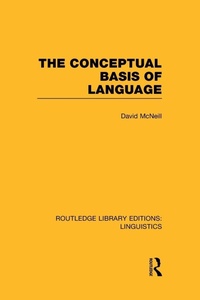
The Conceptual Basis of Language (RLE Linguistics A: General Linguistics)
General Linguistics)
1st Edition
Published on 21. December 2015
Book
Paperback/Softback
324 pages
978-1-138-98895-8 (ISBN)
Description
In this volume, the author deals explicitly and literally with the speech-thought relationship. Departing boldly from contemporary linguistic and psycholinguistic thinking, the author offers us one of the truly serious efforts since Vygotsky to deal with this question. A unifying theme is the organization of action, and speech is seen as growing out of sensory-motor representations that are simultaneously part of meaning and part of action.
More details
Series
Language
English
Place of publication
London
United Kingdom
Publishing group
Taylor & Francis Ltd
Target group
College/higher education
Professional and scholarly
Dimensions
Height: 234 mm
Width: 156 mm
Thickness: 18 mm
Weight
497 gr
ISBN-13
978-1-138-98895-8 (9781138988958)
Copyright in bibliographic data and cover images is held by Nielsen Book Services Limited or by the publishers or by their respective licensors: all rights reserved.
Schweitzer Classification
Other editions
Additional editions
E-Book
01/2014
1st Edition
Routledge
€64.49
Available for download
E-Book
01/2014
1st Edition
Routledge
€64.49
Available for download
David McNeill
The Conceptual Basis of Language (RLE Linguistics A: General Linguistics)
General Linguistics)
Book
11/2013
1st Edition
Routledge
€242.40
Shipment within 15-20 days
Person
David McNeill
Content
Preface. Part 1: Introduction 1. Introduction 2. Previous Work 2.1. Speech Comprehension 2.2. Speech Production Part 2: Theory 3. Sign Structures 3.1. The Theory of Signs 3.2. Summary 4. Basis of Syntagmata 4.1. Syntagmata From the Point of View of Speech Output Control 4.2. The AB Model 4.3. Syntagmata From the Point of View of Sign Relationships 4.4. Articulation Growth (Growth of System B) 4.5. Cognitive Growth (Growth of System A) 4.6. Summary 5. Sensory-Motor Ideas 5.1. Sensory-Motor Ideas Based on Events 5.2. Other Sensory-Motor Ideas 5.3. Specification of Events With Cases 5.4. Other Basic Ideas 5.5. Summary 6. Conceptual Structure 6.1. Basic Representation 6.2. Extending the Representation 6.3. Derivation of New Results 6.4. Summary 7. Some Symbolic Signs 7.1. Form of Representation 7.2. The Passive 7.3. The Restrictive Relative Clause 7.4. The Pseudocleft 7.5. Summary Part 3: Data 8. Analyses of Conceptual Structure 8.1. Methods 8.2. Findings 8.3. Summary 9. Spontaneous Speech 9.1. Types of Speech Dysfluencies 9.2. The Effects of Complexity 9.3. Phonemic Clauses 9.4. Syntactic Devices 9.5. Summary 10. Ontogenesis 10.1. Semiotic Extension 10.2. orientation of Language 10.3. Acquisition of Syntactic Devices 10.5. Summary 11. Gestures 11.1. previous Research on Gestures 11.2. Empirical Study of Gestures 11.3. gestures Accompanying Speech Dysfluencies 11.4. Gesture Peak 11.5. Forms of Gestures 11.6. Complexity 11.7. Summary Part 4: Conclusion 12. Processes, Goals and Grammatical Systems 12.1. Process and Use 12.2. Processes and Grammatical Systems. References. Author Index. Subject Index