

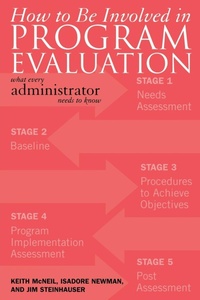
How to be Involved in Program Evaluation
What Every Adminstrator Needs to Know
Published on 16. June 2005
Book
Paperback/Softback
320 pages
978-1-57886-251-1 (ISBN)
Description
The purpose of this book is to improve the direction and utility of the evaluation by program directors in charge, and the implementation of the evaluation by the evaluator. The authors contend that both of these goals can best be met by understanding each individual role.
How to be Involved in Program Evaluation:
?Provides a framework for understanding evaluation and the value of working within an evaluation model
?Provides an overview of the General Evaluation Model (GEM)
?Reviews the components of GEM from the viewpoint of the Evaluator and the Program Director-to emphasize the joint effort of the two persons
?Presents aspects of evaluation as a profession, including standards developed by professional organizations, desired traits of the Evaluator, and advantages and disadvantages of the Evaluator coming from outside the organization as compared to inside the organization
?Discusses the need for data collection instruments, and presents various examples, along with the advantages and disadvantages of the various evaluation instruments
?Discusses the crucial role of reporting evaluation results
?Discusses how the General Evaluation Model can be used to evaluate an entire school
This book will be a valuable reference to program directors and evaluators.
How to be Involved in Program Evaluation:
?Provides a framework for understanding evaluation and the value of working within an evaluation model
?Provides an overview of the General Evaluation Model (GEM)
?Reviews the components of GEM from the viewpoint of the Evaluator and the Program Director-to emphasize the joint effort of the two persons
?Presents aspects of evaluation as a profession, including standards developed by professional organizations, desired traits of the Evaluator, and advantages and disadvantages of the Evaluator coming from outside the organization as compared to inside the organization
?Discusses the need for data collection instruments, and presents various examples, along with the advantages and disadvantages of the various evaluation instruments
?Discusses the crucial role of reporting evaluation results
?Discusses how the General Evaluation Model can be used to evaluate an entire school
This book will be a valuable reference to program directors and evaluators.
Reviews / Votes
The authors of How to be Involved in Program Evaluation make clear the purpose of evaluation, the need for evaluation and the role of the program director in initiating positive evaluation. They have developed a general evaluation model that can be used for assessing an individual progam or a whole school package. There is also a useful glossary providing concise definitions of program evaluation terms and a comprehensive compilation of reference materials. * School Administrator * This text discusses the various steps in school program evaluation from the vantage points of both the evaluator and the program director. Written by two educational psychologists and a school evaluator, it provides an overview of the General Evaluation Model along with real-world examples of its implantation (both successful and unsuccessful). * Reference and Research Book News *More details
Language
English
Place of publication
United States
Publishing group
Bloomsbury Publishing Plc
Dimensions
Height: 229 mm
Width: 152 mm
Thickness: 17 mm
Weight
460 gr
ISBN-13
978-1-57886-251-1 (9781578862511)
Copyright in bibliographic data and cover images is held by Nielsen Book Services Limited or by the publishers or by their respective licensors: all rights reserved.
Schweitzer Classification
Other editions
Additional editions
Keith McNeil | Isadore Newman | Jim Steinhauser
How to be Involved in Program Evaluation
What Every Adminstrator Needs to Know
E-Book
06/2005
1st Edition
R & L Education
€78.49
Available for download
Persons
Keith McNeil has been teaching at New Mexico State University since 1989.
Isadore Newman has been a professor at the University of Akron since 1971.
Since 2003, Jim Steinhauser has been an evaluator for the El Paso Independent School District, focusing on the evaluation of the State Compensatory Education program and the evaluation of the Mathematics/Science Partnership between El Paso ISD and the University of Texas at El Paso.
Isadore Newman has been a professor at the University of Akron since 1971.
Since 2003, Jim Steinhauser has been an evaluator for the El Paso Independent School District, focusing on the evaluation of the State Compensatory Education program and the evaluation of the Mathematics/Science Partnership between El Paso ISD and the University of Texas at El Paso.
Content
Part 1 Preface
Chapter 2 1 What Is Evaluation?
Chapter 3 2 Overview of GEM
Chapter 4 3 Needs Assessment
Chapter 5 4 Baseline
Chapter 6 5 Procedures to Achieve Objectives
Chapter 7 6 Program Implementation Assessment
Chapter 8 7 Post Assessment
Chapter 9 8 Review of GEM From the Viewpoint of the Evaluator and the Program Director
Chapter 10 9 Evaluation as a Profession
Chapter 11 10 Evaluation Instruments
Chapter 12 11 Reporting
Chapter 13 12 Application of GEM to Evaluating Schools
Part 14 Appendixes
Part 15 A Acronyms
Part 16 B Personal Evaluation History of the Authors
Part 17 C Summary of the Program Evaluation Standards
Part 18 D Evaluation Forms and Instruments
Part 19 E Evaluation Plans
Part 20 F Evaluation Reports
Part 21 G Evaluation Resources
Part 22 H Evaluation Contracts Obtained Over a 12-Year Period, Identified by Number of Years, How Obtained, Funding Agency, and Brief Name
Part 23 Glossary
Part 24 References
Part 25 Index
Part 26 About the Authors
Chapter 2 1 What Is Evaluation?
Chapter 3 2 Overview of GEM
Chapter 4 3 Needs Assessment
Chapter 5 4 Baseline
Chapter 6 5 Procedures to Achieve Objectives
Chapter 7 6 Program Implementation Assessment
Chapter 8 7 Post Assessment
Chapter 9 8 Review of GEM From the Viewpoint of the Evaluator and the Program Director
Chapter 10 9 Evaluation as a Profession
Chapter 11 10 Evaluation Instruments
Chapter 12 11 Reporting
Chapter 13 12 Application of GEM to Evaluating Schools
Part 14 Appendixes
Part 15 A Acronyms
Part 16 B Personal Evaluation History of the Authors
Part 17 C Summary of the Program Evaluation Standards
Part 18 D Evaluation Forms and Instruments
Part 19 E Evaluation Plans
Part 20 F Evaluation Reports
Part 21 G Evaluation Resources
Part 22 H Evaluation Contracts Obtained Over a 12-Year Period, Identified by Number of Years, How Obtained, Funding Agency, and Brief Name
Part 23 Glossary
Part 24 References
Part 25 Index
Part 26 About the Authors