

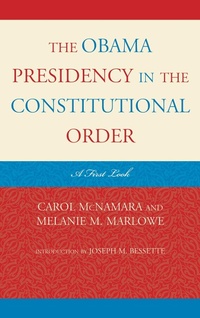
The Obama Presidency in the Constitutional Order
A First Look
Published on 16. April 2011
Book
Hardback
270 pages
978-1-4422-0530-7 (ISBN)
Description
The Obama administration is shaping up to be one of the most consequential in recent American history. In this book, a diverse group of presidential scholars step back from the partisan debate to consider the first two years of the Obama presidency through the lens of the U.S. constitution's theory, structure, and powers. They ask how Barack Obama understands and exercises the President's formal constitutional and informal powers and responsibilities of the president, from foreign policy and public policy to his political leadership of the Democratic party and the nation as a whole. This timely first look at the Obama presidency establishes a constitutional yardstick of interest to scholars of the presidency, constitutional thought, and American political thought.
Reviews / Votes
The Obama Presidency in the Constitutional Order improves our understanding of the institution of the presidency, builds upon constitutional theory/rhetorical presidency literature, and places the early days of the Obama administration within these frameworks. * American Review of Politics * The opposition between the founding and Progressive conceptions of the Constitution underlies this insightful ten-essay evaluation. The unifying thread relates how President Obama, with a Progressive preference for domestic over foreign policy and a "living constitution" philosophy, employs executive, judicial, and legislative power to attain greater economic equality... Obama emerges as a strong chief legislator, an agenda setter, and even a detailed mechanic in low-profile Jeffersonian "collusion" with his party, yet he is criticized among supporters for insufficiently promoting the "black agenda." The founding "constitutional space" to govern insulated from popular pressures collides with the Progressive popular leader. James Ceaser notes instances of demagogic rhetoric by Obama that would be proscribed by founding conceptions. In the most panoramic essay, Marc Landy describes Obama as more LBJ than FDR; he approaches domestic policy with a sense of urgency, but foreign policy with ambivalence. Summing Up: Recommended. Undergraduate, graduate, and research collections. -- T. M. Jackson, Marywood University * CHOICE * An impressive collection of scholarly analyses of President Barack Obama's exercise of his constitutional and political powers. This books lays to rest the myth that Obama's presidency is fulfilling the pledge for fundamental change from the George W. Bush era. The authors present striking evidence of continuity with his predecessor's leadership. -- Mark J. Rozell, George Mason University, author; The New Politics of the Old South: An Introduction to Southern Politics, Sixth Edition There is a necessary tension between the constitutional character of the presidential office and the occupant's connection to public opinion. No recent presidency better illustrates this tension than that of Barack Obama, the subject of this timely collection of essays. -- Joseph Bessette, Tuohy Professor of Government and Ethics at Claremont McKenna College This book rises above the standard set by most "first look" or "first appraisal" volumes. It steps back from the typical list of policy arenas to examine the Obama presidency in the constitutional order, focusing both on the "Big C" Constitution as well as more fundamental regime questions. The coverage of essential issues-executive powers, interbranch relations-is well-handled, as are deeper questions such as the president's connection to progressivism in its many forms. As such, the book ably places President Obama and his administration in broader constitutional, historical, and philosophical context, all while remaining exceptionally relevant to contemporary concerns. Most of all, the book demonstrates the many ways in which the Constitution both empowers and constrains chief executives, regardless of party or ambition. Highly recommended. -- David Crockett, Trinity UniversityMore details
Language
English
Place of publication
United States
Publishing group
Bloomsbury Publishing Plc
Target group
Professional and scholarly
Product notice
Laminated cover
Dimensions
Height: 239 mm
Width: 163 mm
Thickness: 15 mm
Weight
367 gr
ISBN-13
978-1-4422-0530-7 (9781442205307)
Copyright in bibliographic data and cover images is held by Nielsen Book Services Limited or by the publishers or by their respective licensors: all rights reserved.
Schweitzer Classification
Other editions
Additional editions
E-Book
03/2011
1st Edition
Rowman & Littlefield Publishers
€45.49
Available for download
Persons
Carol McNamara is senior lecturer in the Political Science Department at Utah State University. Melanie Marlowe is a lecturer of political science at Miami University.
Content
Foreword
Chapter 1: The Obama Campaign Revolution: Presidential Electioneering in the Digital Age
Chapter 2: Professor Obama and the Constitution
Chapter 3: President Obama and Executive Independence
Chapter 4: President Obama and Congress: Deference, Disinterest, or Collusion?
Chapter 5: The Spirit is Partially Willing: The Legal Realism and Half-Hearted Minimalism of President Obama
Chapter 6: President Obama, the Intelligence Community, and the War on Terror: "Change We Can Believe In?"
Chapter 7: The End of Small Politics? Barack Obama and the Progressive Movement
Chapter 8: Presidential Masks: Barack Obama and FDR
Chapter 9: Barack Obama's Post-Racial Presidency: a New Joshua for a New Civil Rights Era
Chapter 10: The Changing Face of Barack Obama's Leadership
Chapter 1: The Obama Campaign Revolution: Presidential Electioneering in the Digital Age
Chapter 2: Professor Obama and the Constitution
Chapter 3: President Obama and Executive Independence
Chapter 4: President Obama and Congress: Deference, Disinterest, or Collusion?
Chapter 5: The Spirit is Partially Willing: The Legal Realism and Half-Hearted Minimalism of President Obama
Chapter 6: President Obama, the Intelligence Community, and the War on Terror: "Change We Can Believe In?"
Chapter 7: The End of Small Politics? Barack Obama and the Progressive Movement
Chapter 8: Presidential Masks: Barack Obama and FDR
Chapter 9: Barack Obama's Post-Racial Presidency: a New Joshua for a New Civil Rights Era
Chapter 10: The Changing Face of Barack Obama's Leadership