

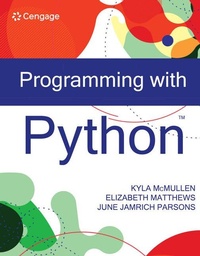
Programming with Python
Published on 25. March 2022
Book
Paperback/Softback
592 pages
978-0-357-63745-6 (ISBN)
Description
Ideal for anyone who has never programmed, McMullen/Matthews/Parsons' PROGRAMMING WITH PYTHON uses a beginner's approach that combines conceptual content with rich examples and hands-on learning activities. Straightforward and student friendly, it emphasizes fundamental computer concepts from a Python programming perspective using a clear presentation with little technical jargon. Modules introduce important computer science concepts, procedural programming and object-oriented programming in short segments, while real-world examples, streamlined code and descriptive figures help you better understand today's computing concepts. As you strengthen your computer science knowledge, you will also sharpen critical-thinking and problem-solving skills -- and build confidence.
More details
Language
English
Place of publication
Boston, MA
United States
Publishing group
Cengage Learning, Inc
Target group
College/higher education
Product notice
Paperback (trade)
Unsewn / adhesive bound
Dimensions
Height: 274 mm
Width: 216 mm
Thickness: 23 mm
Weight
1179 gr
ISBN-13
978-0-357-63745-6 (9780357637456)
Copyright in bibliographic data and cover images is held by Nielsen Book Services Limited or by the publishers or by their respective licensors: all rights reserved.
Schweitzer Classification
Persons
Kyla McMullen is a tenure-track faculty member in the University of Florida's Computer & Information Sciences & Engineering Department. Her research interests are in the perception, application and development of 3D audio technologies. In this line of research, sounds are digitally filtered so that when they are played over headphones, the listener perceives the sound as being emitted from a specific location in their own physical space, much like surround sound over headphones. Dr. McMullen is using this research to create realistic virtual environments, enhance data sonification, augment assistive technologies for people with visual impairments and decrease the cognitive load in multimodal systems. She recently received the National Science Foundation's CAREER Award to further support this research. She earned a B.S. in computer science from the University of Maryland, Baltimore County (UMBC), and M.S. and Ph.D. degrees in computer science and engineering from the University of Michigan. Elizabeth "Liz" A. Matthews is an assistant professor of computer science at Washington and Lee University in Lexington, Virginia. She received a B.S. in computer science from Western Washington University, an M.S. in computer science from Clemson University and a Ph.D. in human-centered computing from the University of Florida. June Jamrich Parsons is an educator, digital book pioneer, co-author of Texty and McGuffey award-winning textbooks and a TAA fellow. She co-developed the first commercially successful multimedia, interactive digital textbook that established the standard for platforms now being developed by numerous educational publishers. In addition to authoring textbooks for Course Technology and Cengage, Dr. Parsons' career includes extensive classroom teaching and product design for eCourseware. She also served as a creative strategist for MediaTechnics Corp. and director of content for Veative Virtual Reality Labs. A member of the Association for Computing Machinery, she holds a Ph.D. in instructional technology and Certified Computing Professional certification. June Jamrich Parsons is an educator, digital book pioneer, co-author of Texty and McGuffey award-winning textbooks and a TAA fellow. She co-developed the first commercially successful multimedia, interactive digital textbook that established the standard for platforms now being developed by numerous educational publishers. In addition to authoring textbooks for Course Technology and Cengage, Dr. Parsons' career includes extensive classroom teaching and product design for eCourseware. She also served as a creative strategist for MediaTechnics Corp. and director of content for Veative Virtual Reality Labs. A member of the Association for Computing Machinery, she holds a Ph.D. in instructional technology and Certified Computing Professional certification.
Content
1. Computational Thinking.
2. Programming Tools.
3. Literals, Variables, and Constants.
4. Numeric Data Types and Expressions.
5. Character and String Data Types.
6. Decision Control Structures.
7. Repetition Control Structures.
8. Lists.
9. Functions.
10. Exceptions.
11. File Operations.
12. Recursion.
13. Modules.
14. Classes and Objects.
15. Methods.
16. Encapsulation.
17. Inheritance.
18. Polymorphism.
19. Linked List Data Structures.
20. Stacks, Queues, and Tables.
21. Trees and Graphs.
22. Algorithm Complexity and Big-O Notation.
23. Search Algorithms.
24. Sorting Algorithms.
25. Processor Architecture.
26. Data Representation.
27. Programming Paradigms.
28. User Interfaces.
29. Software Development Methodologies.
30. Pseudocode, Flowcharts, and Decision Tables.
31. Unified Modeling Language.
2. Programming Tools.
3. Literals, Variables, and Constants.
4. Numeric Data Types and Expressions.
5. Character and String Data Types.
6. Decision Control Structures.
7. Repetition Control Structures.
8. Lists.
9. Functions.
10. Exceptions.
11. File Operations.
12. Recursion.
13. Modules.
14. Classes and Objects.
15. Methods.
16. Encapsulation.
17. Inheritance.
18. Polymorphism.
19. Linked List Data Structures.
20. Stacks, Queues, and Tables.
21. Trees and Graphs.
22. Algorithm Complexity and Big-O Notation.
23. Search Algorithms.
24. Sorting Algorithms.
25. Processor Architecture.
26. Data Representation.
27. Programming Paradigms.
28. User Interfaces.
29. Software Development Methodologies.
30. Pseudocode, Flowcharts, and Decision Tables.
31. Unified Modeling Language.