

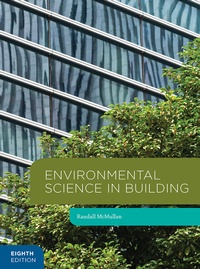
Environmental Science in Building
Description
This popular textbook covers how the built environment and the management of energy relate to the quality of human living-conditions and the environmental performance of buildings. It is the key introductory text for understanding the principles and theories of the environmental science behind construction, and the only text on the market to provide the basic scientific principles of such a broad range of topics. The text covers a range of areas in the field, including climate change, energy management, and sustainability in construction, with an important focus on contemporary environmental topics such as carbon, lifetime performance and rating schemes. The author is known for his extremely clear, finely crafted text, and the book offers a wealth of excellent worked examples.
This text is designed to be useful, at all levels, to students and practitioners of architecture, construction studies, building services, surveying, and environmental science.
More details
Other editions
Additional editions
Previous edition
Person
Randall McMullan is a construction physicist, lecturer and government adviser whose experience spans industry and education. He is the author of various books and publications in the fields of construction, science, applied computing, education and training.
Content
PART I: CORE TOPICS The Environment.- Energy Use in Buildings Thermal Effects in Buildings.- Air Control in Buildings.- Principles of Lighting.- Artificial Lighting.- Natural Lighting.- Aspects of Sound.- Noise and Sound Insulation.- Room Acoustics.- Electricity Supplies.- Water Supplies.- Waste Water.- Green Buildings.- PART II: RESOURCES SECTION Resource 1: Science Information.- Resource 2: Principles of Heat.- Resource 3: Principles of Light and Sound.- Resource 4: Principles of Electricity.- Resource 5: Principles of Water Technology.- Resource 6: References.