

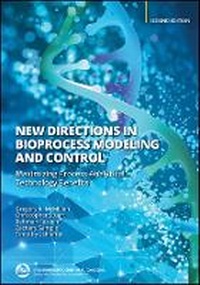
New Directions in Bioprocess Modeling and Control
Maximizing Process Analytical Technology Benefits
2nd Edition
Published on 30. August 2022
Book
Paperback/Softback
468 pages
978-1-64331-104-3 (ISBN)
Description
New Directions in Bioprocess Modeling and Control: Maximizing Process Analytical Technology Benefits, 2nd Edition
This book provides practical, comprehensive knowledge on how to use the advances in analytical measurements and basic and advanced control to improve batch profiles and endpoint consistency. The consequential integration of measurements, models, and controls into a digital twin with recently developed blocks to provide profiles and predict endpoints enables:
- Developing dynamic models from trend charts that are used for experiment design, diagnosing the sources of limitations and inconsistences, and developing and testing solutions 500 times real time without interfering with existing plant operation.
- Comprehensive views of basic process control with the possibilities of model predictive control to control and optimize batch profiles by non-intrusive development and confirmation.
- The ability to determine how to maximize the performance of bioreactors, which are often the bottleneck and the key to product quality and consistency, without tests or trials in the actual plant.
The resulting improvements in batch cycle time and consistency can be designed, tested, quantified, and confirmed; and operators can be trained independently of actual plant operation. The benefit from the elimination of a bad batch-particularly for new biologics-is potentially worth ten or more million dollars.
This book provides practical, comprehensive knowledge on how to use the advances in analytical measurements and basic and advanced control to improve batch profiles and endpoint consistency. The consequential integration of measurements, models, and controls into a digital twin with recently developed blocks to provide profiles and predict endpoints enables:
- Developing dynamic models from trend charts that are used for experiment design, diagnosing the sources of limitations and inconsistences, and developing and testing solutions 500 times real time without interfering with existing plant operation.
- Comprehensive views of basic process control with the possibilities of model predictive control to control and optimize batch profiles by non-intrusive development and confirmation.
- The ability to determine how to maximize the performance of bioreactors, which are often the bottleneck and the key to product quality and consistency, without tests or trials in the actual plant.
The resulting improvements in batch cycle time and consistency can be designed, tested, quantified, and confirmed; and operators can be trained independently of actual plant operation. The benefit from the elimination of a bad batch-particularly for new biologics-is potentially worth ten or more million dollars.
More details
Edition
2nd Revised edition
Language
English
Place of publication
North Carolina
United States
Target group
Professional and scholarly
Edition type
Revised edition
Weight
1024 gr
ISBN-13
978-1-64331-104-3 (9781643311043)
Copyright in bibliographic data and cover images is held by Nielsen Book Services Limited or by the publishers or by their respective licensors: all rights reserved.
Schweitzer Classification
Other editions
Additional editions
Gregory K. McMillan | Christopher Stuart | Rehman Fazeem
New Directions in Bioprocess Modeling and Control
Maximizing Process Analytical Technology Benefits
E-Book
01/2021
2nd Edition
Wiley
€130.99
Available for download
Persons
Gregory K. McMillan, CAP, has more than 50 years of experience in industrial process automation, with an emphasis on the synergy of dynamic modeling and process control. He retired as a Senior Fellow from Solutia and a senior principal software engineer from Emerson Process Systems and Solutions. He was also an adjunct professor in the Washington University Saint Louis Chemical Engineering department from 2001 to 2004. McMillan is the author of numerous ISA books and columns on process control, and he has been the monthly Control Talk columnist for Control magazine since 2002. He started and guided the ISA Standards and Practices committee on ISA-TR5.9-2023, PID Algorithms and Performance Technical Report, and he wrote "Annex A - Valve Response and Control Loop Performance, Sources, Consequences, Fixes, and Specifications" in ISA-TR75.25.02-2000 (R2023), Control Valve Response Measurement from Step Inputs. McMillan's achievements include the ISA Kermit Fischer Environmental Award for pH control in 1991, appointment to ISA Fellow in 1991, the Control magazine Engineer of the Year Award for the Process Industry in 1994, induction into the Control magazine Process Automation Hall of Fame in 2001, selection as one of InTech magazine's 50 Most Influential Innovators in 2003, the ISA Life Achievement Award in 2010, and the ISA Mentoring Excellence award in 2020. He has a BS in engineering physics from Kansas University and an MS in control theory from Missouri University of Science and Technology, both with emphasis on industrial processes.
Christopher Stuart is a senior software engineer for Emerson's Process Simulation Development group. He holds a bachelor of science degree in chemical engineering with a biochemical emphasis from Missouri University of Science and Technology. Stuart's research interests are in efficient algorithms for thermodynamic calculations and dynamic simulations.
Rehman Fazeem is an advanced chemical engineer at Honeywell's UOP, formally known as Universal Oil Products, in the UOP Process Technology (UPT) division. His areas of expertise are process design, simulation, equipment design, process control, automation, chemical reaction technology, and catalyst deactivation. Fazeem has more than 10 years of experience across process industries such as oil and gas, refining, petrochemicals, chemicals, paper and pulp, and pharmaceuticals. Before Honeywell, he worked at Emerson as lead project engineer in the Process Simulation group under the Process Systems and Solutions (PSS) division. He has a master of science degree in chemical engineering from Missouri University of Science and Technology.
Zachary Sample has more than seven years of experience delivering cross-industry simulation solutions in various roles ranging from technical implementation and engineering to project and sales management. In these roles, he has had a passion for helping process companies better leverage simulation to improve automation and operational performance. Sample has a bachelor of science degree in chemical engineering from Missouri University of Science and Technology and a master of science degree in chemical engineering from North Carolina State University.
Timothy Schieffer is a lead project engineer in Emerson's Process Systems and Solutions with more than 5 years of experience building first-principle dynamic simulations. He has helped implement the bioreactor model with the latest advances running at several hundred times real time in a digital twin. Schieffer has a bachelor of science degree in chemical engineering from Missouri University of Science and Technology.
Christopher Stuart is a senior software engineer for Emerson's Process Simulation Development group. He holds a bachelor of science degree in chemical engineering with a biochemical emphasis from Missouri University of Science and Technology. Stuart's research interests are in efficient algorithms for thermodynamic calculations and dynamic simulations.
Rehman Fazeem is an advanced chemical engineer at Honeywell's UOP, formally known as Universal Oil Products, in the UOP Process Technology (UPT) division. His areas of expertise are process design, simulation, equipment design, process control, automation, chemical reaction technology, and catalyst deactivation. Fazeem has more than 10 years of experience across process industries such as oil and gas, refining, petrochemicals, chemicals, paper and pulp, and pharmaceuticals. Before Honeywell, he worked at Emerson as lead project engineer in the Process Simulation group under the Process Systems and Solutions (PSS) division. He has a master of science degree in chemical engineering from Missouri University of Science and Technology.
Zachary Sample has more than seven years of experience delivering cross-industry simulation solutions in various roles ranging from technical implementation and engineering to project and sales management. In these roles, he has had a passion for helping process companies better leverage simulation to improve automation and operational performance. Sample has a bachelor of science degree in chemical engineering from Missouri University of Science and Technology and a master of science degree in chemical engineering from North Carolina State University.
Timothy Schieffer is a lead project engineer in Emerson's Process Systems and Solutions with more than 5 years of experience building first-principle dynamic simulations. He has helped implement the bioreactor model with the latest advances running at several hundred times real time in a digital twin. Schieffer has a bachelor of science degree in chemical engineering from Missouri University of Science and Technology.
Content
Acknowledgments xiii
Preface xv
About the Authors xvii
Chapter 1 Opportunities 1
1.1 Introduction 1
1.2 Analysis of Variability 4
1.3 Transfer of Variability 16
1.4 Online Indication of Performance 24
1.5 Optimizing Performance 27
1.6 PAT 28
1.7 Insights 30
1.8 Best Practices 32
Chapter 2 Dynamics 35
2.1 Introduction 35
2.2 Performance Limits 36
2.3 Self-Regulating Processes 47
2.4 Integrating Processes 52
2.5 Wireless Devices and Analyzers 55
2.6 Best Practices 59
Chapter 3 Basic Control 61
3.1 Introduction 61
3.2 Key Process Measurements 62
3.3 Control Valves and VFDs 64
3.4 PID Fundamentals 67
3.5 PID Form and Structure 72
3.6 PID Tuning 73
3.7 PID Options 83
3.8 PID Performance 84
3.9 Control Strategies 96
3.10 Best Practices 100
Chapter 4 Model-Predictive Control 109
4.1 Introduction 109
4.2 Capabilities and Limitations 111
4.3 Multiple Manipulated Variables 119
4.4 Optimization 127
4.5 Mammalian Cell Bioreactor Optimization 135
4.6 MPC Best Practices 137
Chapter 5 Digital Twin 143
5.1 Introduction 143
5.2 Key Features 145
5.3 Spectrum of Uses 151
5.4 Implementation 162
5.5 Conclusion 168
5.6 Digital Twin Best Practices 168
Chapter 6 First-Principle Models 173
6.1 Introduction 173
6.2 Modeling Challenges 174
6.3 Modeling Opportunities 175
6.4 Modeling Breakthroughs 177
6.5 General Form of Kinetics 178
6.6 Media Ordinary Differential Equations with Speedup Factors 179
6.7 Concentration and Flow of Charges, Manipulated and Recycle Streams 182
6.8 Specific Growth Rate Equations with Bias and Gain Terms 183
6.9 Cell Death (Lysis) 186
6.10 Specific Product Formation Rate Equations with Bias and Gain Terms 187
6.11 Product Consumption and Degradation 188
6.12 Specific By-product Formation Rate Equations with Bias and Gain Terms 188
6.13 Utilization Rates 189
6.14 OUR and Carbon Dioxide Production Rate 190
6.15 Agitation and Sparge 190
6.16 Dissolved Gas ODEs with Speedup Factors 193
6.17 Parameters and Variables 194
6.18 Best Practices 202
Chapter 7 Analytical Technologies 207
7.1 Introduction 207
7.2 Overview 208
7.3 DO 208
7.4 Dissolved Carbon Dioxide 210
7.5 Turbidity 211
7.6 Dielectric Spectroscopy 213
7.7 Near-Infrared Spectroscopy 214
7.8 Mass Spectrometers 214
7.9 BioProfile FLEX2 215
7.10 Liquid Chromatographs 217
7.11 Best Practices 218
Chapter 8 Data Analytics 221
8.1 Introduction 221
8.2 PCA Background 223
8.3 Multiway PCA 238
8.4 Model-Based PCA 246
8.5 Fault Detection 250
8.6 Data Analytics Best Practices 257
Chapter 9 Models to Improve Operator, Automation, and Process Performance 265
9.1 Introduction 265
9.2 Overview 267
9.3 Bountiful Boundaries 268
9.4 Data Drives Dynamics 269
9.5 Digitizing the Plant for Process Performance 270
9.6 Titration Curve Modeling 272
9.7 Equipment Modeling 275
9.8 Sparge Modeling 277
9.9 Kinetics Modeling 279
9.10 Instrumentation Modeling 284
9.11 Speedup 296
9.12 Performance Monitoring 297
9.13 Generation and Fitting of Profiles 298
9.14 Simplifications and Practical Solutions 300
9.15 Best Practices 302
References 304
Appendix A: Automation System Performance Top 10 Concepts 307
Appendix B: Bioprocess Biology 323
Appendix C: Enhanced PID Controller for Wireless and Analyzer Applications 335
Appendix D: Modern Myths 355
Appendix E: Enzyme Inactivity Decreased by Controlling the pH with a Family of Bézier Curves 357
Appendix F: First-Principle Process Relationships 369
Appendix G: Gas Pressure Dynamics 387
Appendix H: Charge Balance to Model pH 389
Appendix I: Interactive to Noninteractive Time Constant Conversion 399
Appendix J: Jacket and Coil Temperature Control 403
Appendix K: PID Forms and Conversion of Tuning Settings 409
Appendix L: Liquid Mixing Dynamics 417
Appendix M: Mammalian Bioreactor Model 421
Appendix N: Debottlenecking Using Sensitivity Analysis 427
Bibliography 437
Index 449
Preface xv
About the Authors xvii
Chapter 1 Opportunities 1
1.1 Introduction 1
1.2 Analysis of Variability 4
1.3 Transfer of Variability 16
1.4 Online Indication of Performance 24
1.5 Optimizing Performance 27
1.6 PAT 28
1.7 Insights 30
1.8 Best Practices 32
Chapter 2 Dynamics 35
2.1 Introduction 35
2.2 Performance Limits 36
2.3 Self-Regulating Processes 47
2.4 Integrating Processes 52
2.5 Wireless Devices and Analyzers 55
2.6 Best Practices 59
Chapter 3 Basic Control 61
3.1 Introduction 61
3.2 Key Process Measurements 62
3.3 Control Valves and VFDs 64
3.4 PID Fundamentals 67
3.5 PID Form and Structure 72
3.6 PID Tuning 73
3.7 PID Options 83
3.8 PID Performance 84
3.9 Control Strategies 96
3.10 Best Practices 100
Chapter 4 Model-Predictive Control 109
4.1 Introduction 109
4.2 Capabilities and Limitations 111
4.3 Multiple Manipulated Variables 119
4.4 Optimization 127
4.5 Mammalian Cell Bioreactor Optimization 135
4.6 MPC Best Practices 137
Chapter 5 Digital Twin 143
5.1 Introduction 143
5.2 Key Features 145
5.3 Spectrum of Uses 151
5.4 Implementation 162
5.5 Conclusion 168
5.6 Digital Twin Best Practices 168
Chapter 6 First-Principle Models 173
6.1 Introduction 173
6.2 Modeling Challenges 174
6.3 Modeling Opportunities 175
6.4 Modeling Breakthroughs 177
6.5 General Form of Kinetics 178
6.6 Media Ordinary Differential Equations with Speedup Factors 179
6.7 Concentration and Flow of Charges, Manipulated and Recycle Streams 182
6.8 Specific Growth Rate Equations with Bias and Gain Terms 183
6.9 Cell Death (Lysis) 186
6.10 Specific Product Formation Rate Equations with Bias and Gain Terms 187
6.11 Product Consumption and Degradation 188
6.12 Specific By-product Formation Rate Equations with Bias and Gain Terms 188
6.13 Utilization Rates 189
6.14 OUR and Carbon Dioxide Production Rate 190
6.15 Agitation and Sparge 190
6.16 Dissolved Gas ODEs with Speedup Factors 193
6.17 Parameters and Variables 194
6.18 Best Practices 202
Chapter 7 Analytical Technologies 207
7.1 Introduction 207
7.2 Overview 208
7.3 DO 208
7.4 Dissolved Carbon Dioxide 210
7.5 Turbidity 211
7.6 Dielectric Spectroscopy 213
7.7 Near-Infrared Spectroscopy 214
7.8 Mass Spectrometers 214
7.9 BioProfile FLEX2 215
7.10 Liquid Chromatographs 217
7.11 Best Practices 218
Chapter 8 Data Analytics 221
8.1 Introduction 221
8.2 PCA Background 223
8.3 Multiway PCA 238
8.4 Model-Based PCA 246
8.5 Fault Detection 250
8.6 Data Analytics Best Practices 257
Chapter 9 Models to Improve Operator, Automation, and Process Performance 265
9.1 Introduction 265
9.2 Overview 267
9.3 Bountiful Boundaries 268
9.4 Data Drives Dynamics 269
9.5 Digitizing the Plant for Process Performance 270
9.6 Titration Curve Modeling 272
9.7 Equipment Modeling 275
9.8 Sparge Modeling 277
9.9 Kinetics Modeling 279
9.10 Instrumentation Modeling 284
9.11 Speedup 296
9.12 Performance Monitoring 297
9.13 Generation and Fitting of Profiles 298
9.14 Simplifications and Practical Solutions 300
9.15 Best Practices 302
References 304
Appendix A: Automation System Performance Top 10 Concepts 307
Appendix B: Bioprocess Biology 323
Appendix C: Enhanced PID Controller for Wireless and Analyzer Applications 335
Appendix D: Modern Myths 355
Appendix E: Enzyme Inactivity Decreased by Controlling the pH with a Family of Bézier Curves 357
Appendix F: First-Principle Process Relationships 369
Appendix G: Gas Pressure Dynamics 387
Appendix H: Charge Balance to Model pH 389
Appendix I: Interactive to Noninteractive Time Constant Conversion 399
Appendix J: Jacket and Coil Temperature Control 403
Appendix K: PID Forms and Conversion of Tuning Settings 409
Appendix L: Liquid Mixing Dynamics 417
Appendix M: Mammalian Bioreactor Model 421
Appendix N: Debottlenecking Using Sensitivity Analysis 427
Bibliography 437
Index 449