

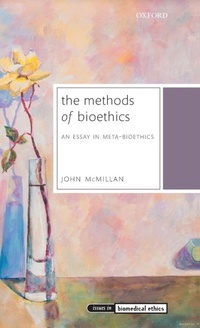
The Methods of Bioethics
An Essay in Meta-Bioethics
Published on 20. December 2018
Book
Hardback
198 pages
978-0-19-960375-6 (ISBN)
Description
This is the first book in bioethics that explains how it is that you actually go about doing good bioethics. Bioethics has made a mistake about its methods, and this has led not only to too much theorizing, but also fragmentation within bioethics. The unhelpful disputes between those who think bioethics needs to be more philosophical, more sociological, more clinical, or more empirical, continue. While each of these claims will have some point, they obscure what should be common to all instances of bioethics. Moreover, they provide another phantom that can lead newcomers to bioethics down blind alleyways stalked by bristling sociologists and philosophers. The method common to all bioethics is bringing moral reason to bear upon ethical issues, and it is more accurate and productive to clarify what this involves than to stake out a methodological patch that shows why one discipline is the most important. This book develops an account of the nature of bioethics and then explains how a number of methodological spectres have obstructed bioethics becoming what it should. In the final part, it explains how moral reason can be brought to bear upon practical issues via an 'empirical, Socratic' approach.
Reviews / Votes
I hope that this book becomes required reading for all students writing essays in bioethics, at the very least at postgraduate level. It should help to dispel the current confusion between the normative and descriptive aspects of the discipline. * Alastair Campbell, Institute of Medical Ethics, UK * The quality of the writing is high, and the coverage is broad and appropriate. Each chapter is clear and stands on its own feet, so that using the book will be straightforward. The accessibility of the writing is high, so that it is suitable for advanced students, but the arguments are presented clearly and robustly enough to interest the working scholar in the field. * Angus Dawson, Director of Sydney Health Ethics, University of Sydney * It is really surprising that there is so little written on the methodology of bioethics from the perspective of philosophical bioethics. This book will be central to all future discussion of these issues * Richard Ashcroft, Professor of Bioethics, Queen Mary University of London * This book can also be used to connect students of philosophy with students of medicine, law, sociology and history, with the aim of jointly exploring problematic practical situations. Thus, I highly recommend it to anyone who is interested in learning more and/or teach about the methodologies of bioethics. * Iva Martonic, European Journal of Analytic Philosophy * McMillan's analysis of bioethics will serve best as a solid foundation for advanced bioethical inquiry. * W. Simkulet, CHOICE * McMillan presents an innovative, historically aware, and zeitgeist-capturing manifesto for contemporary bioethics ... Overall, this book serves not only as a fresh foundation on which bioethicists from all disciplines can build, but as a provocative challenge to traditional theory-laden ways of "doing bioethics." * Jonathan Lewis, The American Journal of Bioethics *More details
Series
Language
English
Place of publication
Oxford
United Kingdom
Target group
Professional and scholarly
Dimensions
Height: 222 mm
Width: 145 mm
Thickness: 14 mm
Weight
387 gr
ISBN-13
978-0-19-960375-6 (9780199603756)
Copyright in bibliographic data and cover images is held by Nielsen Book Services Limited or by the publishers or by their respective licensors: all rights reserved.
Schweitzer Classification
Other editions
Additional editions
E-Book
11/2018
1st Edition
OUP eBook
€45.99
Available for download
E-Book
11/2018
1st Edition
OUP eBook
€45.99
Available for download
Person
John McMillan is a professor in the Bioethics Centre, Division of Health Sciences, at the University of Otago.
Content
1: How to find your footing in bioethics
Part I: Bioethics
2: What is bioethics?
3: Good bioethics
Part II: The spectres of bioethics
4: Four spectres of bioethics
5: The fact value spectre
Part III: The methods of bioethics
6: Empirical, Socratic bioethics
7: What is an ethical argument?
8: Speculative argument and bioethics
9: Drawing distinctions: defining, reclaiming and analysing moral concepts
10: Drawing distinctions: novel, sublime and slippery moral concepts
11: What it is to reason about ethics
Part I: Bioethics
2: What is bioethics?
3: Good bioethics
Part II: The spectres of bioethics
4: Four spectres of bioethics
5: The fact value spectre
Part III: The methods of bioethics
6: Empirical, Socratic bioethics
7: What is an ethical argument?
8: Speculative argument and bioethics
9: Drawing distinctions: defining, reclaiming and analysing moral concepts
10: Drawing distinctions: novel, sublime and slippery moral concepts
11: What it is to reason about ethics