

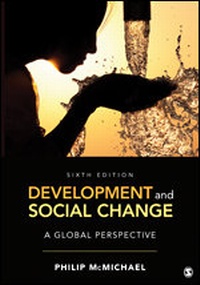
Development and Social Change
A Global Perspective
6th Edition
Published on 27. May 2016
Book
Paperback/Softback
424 pages
978-1-4522-7590-1 (ISBN)
Description
Philip McMichael describes a world undergoing profound social, political, and economic transformations, from the post-World War II era through the present. He tells a story of development in four parts - colonialism, developmentalism, globalization, and sustainability - that shows how the global development "project" has taken different forms from one historical period to the next.
Throughout the text, the underlying conceptual framework is that development is a political construct, created by dominant actors (states, multilateral institutions, corporations and economic coalitions) and based on unequal power arrangements. While rooted in ideas about progress and prosperity, development also produces crises that threaten the health and well-being of millions of people, and sparks organized resistance to its goals and policies. Frequent case studies make the intricacies of globalization concrete, meaningful, and clear.
Throughout the text, the underlying conceptual framework is that development is a political construct, created by dominant actors (states, multilateral institutions, corporations and economic coalitions) and based on unequal power arrangements. While rooted in ideas about progress and prosperity, development also produces crises that threaten the health and well-being of millions of people, and sparks organized resistance to its goals and policies. Frequent case studies make the intricacies of globalization concrete, meaningful, and clear.
Reviews / Votes
"The book does a fantastic job of laying out the history of development, and does so by dividing up different development eras into projects. It is packed with excellent and important information. The "case studies" in the book bring occasionally dry issues to life. And I value the book's overarching attention to inequality at all levels as a way to understand the world." -- Leif Jensen "I wanted one book that contained everything that I want my students to know. This book contains it all. The historical continuity woven across chapters allows me to teach development exactly like I want to...I like the emphasis on the environment and climate change, and land grabs / land-based investment." -- Cynthia Caron "The book is very well structured. Difficult concepts are well explained. McMichael makes it very clear what the stages of development are, and brings examples that help students recognize those stages in their own social environment. While reading, students easily find connections between the theory and their observations." -- Olena LeipnikMore details
Edition
6th Revised edition
Language
English
Place of publication
Thousand Oaks
United States
Target group
College/higher education
Edition type
Revised edition
Dimensions
Height: 229 mm
Width: 152 mm
Weight
506 gr
ISBN-13
978-1-4522-7590-1 (9781452275901)
Copyright in bibliographic data and cover images is held by Nielsen Book Services Limited or by the publishers or by their respective licensors: all rights reserved.
Schweitzer Classification
Other editions
New editions
Book
03/2021
7th Edition
SAGE Publications Inc
€169.36
Article exhausted; check for reprint
Previous edition
Book
01/2012
5th Edition
SAGE Publications Inc
€102.94
Article exhausted; check for reprint
Person
Philip McMichael grew up in Adelaide, South Australia, completing undergraduate degrees in economics and in political science at the University of Adelaide. After traveling in India, Pakistan, and Afghanistan and doing community work in Papua New Guinea, he pursued his doctorate in sociology at the State University of New York at Binghamton. He has taught at the University of New England (New South Wales), Swarthmore College, and the University of Georgia, and he is presently Emeritus Professor of Global Development at Cornell University, in Ithaca, NY. Other appointments include Visiting Senior Research Scholar in International Development at the University of Oxford (Wolfson College) and Visiting Scholar, School of Political Science and International Relations at the University of Queensland.
His book Settlers and the Agrarian Question: Foundations of Capitalism in Colonial Australia (1984) won the Social Science History Association's Allan Sharlin Memorial Award in 1985. In addition to authoring Food Regimes and Agrarian Questions (2013), McMichael edited The Global Restructuring of Agro-Food Systems (1994), Food and Agrarian Orders in the World Economy (1995), New Directions in the Sociology of Global Development (2005) with Frederick H. Buttel, Contesting Development: Critical Struggles for Social Change (2010), The Politics of Biofuels, Land and Agrarian Change (2011) with Jun Borras and Ian Scoones, and Finance or Food? The Role of Cultures, Values and Ethics in Land Use Negotiations, with Hilde Bjorkhaug and Bruce Muirhead (2020).
He has served twice as chair of his department, as director of Cornell University's International Political Economy Program, as chair of the American Sociological Association's Political Economy of the World-System Section, as president of the Research Committee on Agriculture and Food for the International Sociological Association. He is also an active member of the International Studies Association. He has also worked with the Food and Agriculture Organization of the United Nations (FAO) and the Civil Society Mechanism of the FAO's Committee on World Food Security (CFS), the UN Research Institute for Social Development (UNRISD), the international peasant coalition Via Campesina, and the International Planning Committee for Food Sovereignty.
His book Settlers and the Agrarian Question: Foundations of Capitalism in Colonial Australia (1984) won the Social Science History Association's Allan Sharlin Memorial Award in 1985. In addition to authoring Food Regimes and Agrarian Questions (2013), McMichael edited The Global Restructuring of Agro-Food Systems (1994), Food and Agrarian Orders in the World Economy (1995), New Directions in the Sociology of Global Development (2005) with Frederick H. Buttel, Contesting Development: Critical Struggles for Social Change (2010), The Politics of Biofuels, Land and Agrarian Change (2011) with Jun Borras and Ian Scoones, and Finance or Food? The Role of Cultures, Values and Ethics in Land Use Negotiations, with Hilde Bjorkhaug and Bruce Muirhead (2020).
He has served twice as chair of his department, as director of Cornell University's International Political Economy Program, as chair of the American Sociological Association's Political Economy of the World-System Section, as president of the Research Committee on Agriculture and Food for the International Sociological Association. He is also an active member of the International Studies Association. He has also worked with the Food and Agriculture Organization of the United Nations (FAO) and the Civil Society Mechanism of the FAO's Committee on World Food Security (CFS), the UN Research Institute for Social Development (UNRISD), the international peasant coalition Via Campesina, and the International Planning Committee for Food Sovereignty.
Content
Chapter 1: Development: Theory and Reality
Development: History and Politics
Development Theory
Social Change
Part I: The Development Project (Late 1940s to Early 1970s)
Chapter 2: Instituting the Development Project
Colonialism
Decolonization
Decolonization and Development
Postwar Decolonization and the Rise of the Third World
Ingredients of the Development Project
Framing the Development Project
Economic Nationalism
Chapter 3: The Development Project: International Framework
The International Framework
Remaking the International Division of Labor
The Food-Aid Regime
Remaking Third World Agricultures
Chapter 4: Globalizing Developments
Third World Industrialization in Context
Agricultural Globalization
Global Finance
Part II: The Globalization Project (1980s to 2000s)
Chapter 5: Instituting the Globalization Project
Securing the Global Market Empire
The Debt Regime
The Globalization Project
Global Governance
The World Trade Organization
Chapter 6: The Globalization Project in Practice
Poverty Governance
Outsourcing
Displacement
Informalization
Global Recolonization
Chapter 7: Global Countermovements
Environmentalism
Feminism
Food Sovereignty
Part III: Millennial Reckonings (2000s to Present)
Chapter 8: The Globalization Project in Crisis
Social Crisis
Legitimacy Crisis
Geopolitical Transitions
Ecological Crisis
Chapter 9: Sustainable Development?
The Challenge of Climate Change
Responses to the Sustainability Challenge
Business as Usual
Public Interventions
Grassroots Developments
Chapter 10: Rethinking Development
Development in the Gear of Social Change
Paradigm Change
Development: History and Politics
Development Theory
Social Change
Part I: The Development Project (Late 1940s to Early 1970s)
Chapter 2: Instituting the Development Project
Colonialism
Decolonization
Decolonization and Development
Postwar Decolonization and the Rise of the Third World
Ingredients of the Development Project
Framing the Development Project
Economic Nationalism
Chapter 3: The Development Project: International Framework
The International Framework
Remaking the International Division of Labor
The Food-Aid Regime
Remaking Third World Agricultures
Chapter 4: Globalizing Developments
Third World Industrialization in Context
Agricultural Globalization
Global Finance
Part II: The Globalization Project (1980s to 2000s)
Chapter 5: Instituting the Globalization Project
Securing the Global Market Empire
The Debt Regime
The Globalization Project
Global Governance
The World Trade Organization
Chapter 6: The Globalization Project in Practice
Poverty Governance
Outsourcing
Displacement
Informalization
Global Recolonization
Chapter 7: Global Countermovements
Environmentalism
Feminism
Food Sovereignty
Part III: Millennial Reckonings (2000s to Present)
Chapter 8: The Globalization Project in Crisis
Social Crisis
Legitimacy Crisis
Geopolitical Transitions
Ecological Crisis
Chapter 9: Sustainable Development?
The Challenge of Climate Change
Responses to the Sustainability Challenge
Business as Usual
Public Interventions
Grassroots Developments
Chapter 10: Rethinking Development
Development in the Gear of Social Change
Paradigm Change