

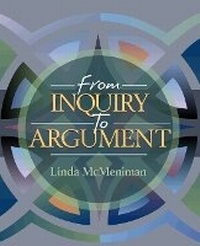
From Inquiry to Argument
Published on 25. June 1999
Book
Paperback/Softback
592 pages
978-0-205-20041-2 (ISBN)
Description
From Inquiry to Argument blends inquiry, research, and argument by interweaving a discussion of argumentation strategies with instruction in critical thinking and research skills and with writing tasks important to research and argument. Most textbooks emphasize either argument (and ignore the need to discover sources and information) or research (and de-emphasize argumentation as a motive for seeking source material). From Inquiry to Argument develops students' abilities in argumentation and research simultaneously. This approach gives students a reason to research - to find ideas and information for their arguments - and also helps them build better arguments by teaching them how to analyze and generate ideas and perform research in primary and secondary sources.
From Inquiry to Argument teaches the process of researching and constructing an argumentative research paper. It covers academic documentation in both MLA and APA styles, while also addressing informal source reference. Numerous professional readings as well as nine student writing samples expose students to different types of writing and provide a base for primary research. The coverage of argument addresses such related topics as critical thinking, logic and fallacies, and the appeals, and presents Toulmin logic as a touchstone for the discussion of argument.
From Inquiry to Argument teaches the process of researching and constructing an argumentative research paper. It covers academic documentation in both MLA and APA styles, while also addressing informal source reference. Numerous professional readings as well as nine student writing samples expose students to different types of writing and provide a base for primary research. The coverage of argument addresses such related topics as critical thinking, logic and fallacies, and the appeals, and presents Toulmin logic as a touchstone for the discussion of argument.
More details
Content
All chapters include "Works Cited," "Activities" and/or "Assignments."I.FROM INQUIRY ...
1.Inquiry and Argument.
From Inquiry ...
The Motives for Inquiry The Context of Inquiry The Civic and Academic Discourse Communities.
... To Argument.
The Elements of Argument The Subject of Argument The Appeals of Argument The Writer's Discourse Community.
Readings:
John Leo, The Unmaking of Civic Culture.
Josie Mazzaferro, Turned Off by Politics.
Chris Satullo, That's No Panacea.
Jay Chaskes, The First-Year Student as Immigrant.
2.Reading as Inquiry.
Understanding Reading.
The Collaborating Reader The Inquiring Reader Reading Argumentative Writing.
Reading and Discussing.
A Process for Reading Well From Reading to Discussion Improving Listening and Responding.
Techniques for Inquiry into Texts.
Annotating Outlining Mapping.
The Writing Reader.
Readings:
Louis W. Sullivan, Stop Peddling Tobacco to Kids.
Thomas L. Friedman, My Fellow Immigrants.
Renee Hobbs, Television and the Shaping of Cognitive Skills.
3.The Writing Reader: Inquiring into Meaning through Paraphrase, Summary, and Quotation.
Coming to Terms with Meaning.
Paraphrase and Summary Compared.
Attribution: Signaling the Use of Paraphrase and Summary.
Paraphrase.
Accuracy and Academic Honesty A Process for Writing Complete Paraphrases Cautions about Paraphrase Style When to Choose Paraphrase Blended Paraphrase.
Summary: Writing Your Understanding of a Source.
Types of Summaries A Process for Preparing a Formal Summary Hints and Tips.
Additional Considerations in Paraphrase and Summary.
A Source Written in the First Person A Caution about Interpretation A Source within a Source.
Quotation Skills.
Choosing Quotations How Much to Quote Quoting Statistics, Charts, and Specifications Insetting Quotations in Your Own Text The Mechanics of Including Quotations Acceptable Changes to Quotations: Ellipses and Brackets.
Guidelines for Informal Source Reference.
Readings:
George F. Will, Violence Is a Public Health Problem.
Albert Shanker, Are American Schools Too Easy?
Langdon Winner, The Destruction of Childhood.
David S. Broder, The Evidence Is Coming In: Dan Quayle Was Right.
4.Creating Dialogue between Sources: Comparing, Contrasting, and Synthesizing Arguments.
Comparison and Contrast of Arguments.
Process Ways in Which Sources Can Agree or Differ Ways to Use Comparison and Contrast Judging Sources.
Student Assignment: Honore Duncan, The NY Times and the Economist Oppose Internet Censorship.
Synthesis of Arguments.
Types of Syntheses A Process for Writing a Full Formal Synthesis.
Student Assignment: Seth Nobile, Mandatory Sentences Cause Many Problems.
Documentation Writing a Brief Formal Synthesis.
Locating Periodicals.
Process Using the Internet for Research Some Useful Site Addresses.
Readings:
David R. Henderson, The Case for Sweatshops.
Cathy Young, Sweatshops or a Shot at a Better Life?
Ellen Goodman, The Ethical Gray Zone: Assisted Suicide.
Charles Krauthammer, If Suicide Is Legally Sanctioned for the Terminally Ill, Why Not for the Rest of Society?
Myriam Miedzian, How We Can Tune out Children from Television Violence.
Marilyn Wheeler, Young People Get an Eye-Opening Look at the Violence on TV.
5.Inquiring about Facts and Information.
Understanding Facts and Interpretation.
Facts, Just the Facts Establishing Facts as Factual.
The Construction of Knowledge.
Inference Judgments Characteristics of Evidence.
Generating Evidence through Primary Research.
EyeWitness Reports and Personal Experiences Observations Interviewing Surveying Collecting Raw Data or Facts Experimenting.
Interpreting Research.
Student Assignment: Using Primary Research.
Writing Based on Primary Research.
Synthesizing Primary-Research Results Attributing Primary-Research Results.
Student Assignment: John McLarron, Helmet Laws Continue to Save Lives.
Getting the Facts: Using Reference Sources.
Locating Reference Works in the Library Types of Reference Works Electronic Reference Sources Using the Reference Section Effectively Using References Sources in Your Writing.
Readings:
Kathleen Hall Jamieson and Dan Romer, If It's (Black on White) Crime, Television Will Give It Time.
Editorial, Philadelphia Inquirer, Kids and Guns.
E.D. Hirsch, Jr., Cultural Literacy (excerpt).
6.Inquiring into Values: Reactions and Opinions.
What Are Values and How Do They Influence Our Opinions?
The Hierarchy of Values.
Values Conflict Values Change Values Serve Needs.
Value Activators.
Assumptions and Values in Reasoning: Toulmin Logic.
Expressing and Responding to Values.
Writing a Reaction Piece Writing a Personal Opinion Piece: The Op-Ed Commentary.
Student Assignment: Gina Kirtow, A View from the Crossroads.
Writing about Artistic Values: The Review.
Readings:
Luis J. Rodriguez, Turning Youth Gangs Around.
Sharon A. Sheehan, Another Kind of Sex Ed.
William D. Ehrhart, In a War, All Should Suffer.
John Veit, Futures So Bright in White Suburbia.
Karla Vermeulen, Growing up in the Shadow of AIDS.
II.... to Argument.
7.Preparing an Argumentative Position Paper.
Identifying an Issue.
Look for a Controversial Subject Explore the Conversations about the Subject Work within the Context of your Assignment.
Exploring and Analyzing the Issue.
Use Definition to Identify and Examine the Terms of the Argument Analyze for Cause and Effect.
Decide on a Claim.
Claims of Fact Claims of Value Claims of Policy Focusing and Moderating Claims.
Writing Support for a Claim.
Assess Audience Values and Choose Support Organize for Emphasis of Main Idea Generate an Overall Plan of Development.
Revising and Editing.
Approaches to Revising Revise Substance with Readers in Mind Revise Language and Style to Suit Your Purpose and Reader.
Student Assignment: Robyn C. Nichols, Down with Fraternities.
Readings:
R. Richard Banks, Education to Learn and Not for Money.
Ed Carson, Pay Organ Donors to Increase the Supply.
Christopher Lasch, The Lost Art of Political Argument.
8.Writing to Refute, Inquire, and Moderate Opposing Ideas.
Refutation.
Techniques Writing a Formal Refutation Argument.
Student Assignment: Tim Anglen, Marijuana as Medicine.
Writing an Argument with Refutation.
Exploring the Middle Ground: A Rogerian Approach to Argumentation.
Discovering the Middle Ground Writing with a Rogerian Approach.
The Inquiry Essay: Raising Questions.
Student Assignment: Sarah Carlyle, How Poor Is Really Poor?
Readings:
George F. Will, Healthy Inequality.
David Cole, Five Myths about Immigration.
Alysia Bennett, It's Not All Heroes and Demons.
Suzanne Pharr, A Match Made in Heaven.
Jane P. Eisner, Do Condoms in the Classroom Encourage Sex, or Safe Sex?
Richard A. Shweder, It's Called Poor Health for a Reason.
9.The Logic of Argument.
Two Types of Reasoning: Induction and Deduction
Inquiring into the Logic of Argument How Deduction Supports Argument: Syllogisms Conditional Arguments Induction.
Using Logic to Evaluate an Argument.
Using a Toulmin Approach.
Logical Fallacies.
Non Sequitur Red Herring and Straw Man Begging the Question False Dilemma Fallacies of False Causation Sweeping or Hasty Generalization Ad Hominem (Name Calling) Ad Populum Bandwagon False Analogy Appeal to (False) Authority.
Writing about Opposing Views.
Critiquing versus Attacking Guidelines for Writing a Critique.
Student Assignment: Eric Malloy, A Critique of Nicholas von Hoffman's Pro-Abortion Stance.
Readings:
Thomas Jefferson, The Declaration of Independence.
Ray Perkins, Jr., Sex and Drugs: Just Say "No No" and Flying Condoms.
Jim Weinstein, NATO Rearms the World.
Nicholas von Hoffman, Understand That Pro-Abortion is Pro-Life and Vice Versa.
10.Examining Style in Argument.
Language and Purpose in Argument.
Word Choice.
Denotations and Connotations Euphemisms Level of Abstraction Figurative Language Diction Level.
Point of View.
First Person Third Person Second Person.
Sentence Style.
Questions Imperatives.
Sentence Length and Pattern.
Length Pattern Interrupted Sentences and Fragments.
Tone.
Direct Statements of Attitude Repetition Format.
Arguing versus Persuading.
Propaganda.
Choosing a Style.
Writing an Analytic Paper about Style.
Student Assignment: Josh K. Zeller, Persuasive about Persuasion.
Readings:
Institute for Propaganda Analysis, How to Detect Propaganda.
William Lutz, Words and the World.
Evelina Giobbe, The Bargain Basement in the Marketplace of Ideas.
Ed Anger, Fry Death Row Creeps in Electric Bleachers!
David Walsh, Liberty Calls Us to a Higher Purpose.
11.Evaluating Sources: The World of Ideas in the Civic Discourse Community.
Evaluating Sources for Level.
Classification of Sources Evaluating Periodicals for Level Evaluating Books for Level Evaluating Nonprint Media for Level.
Evaluating Sources for Positioning.
The Continuum of Left to Right The Situation of the Media in Society Understanding Opinion, Partisanship, and Bias Bias in Argument Guidelines for Evaluating World Wide Web Sites Helpful Web Sites.
Readings:
Janine Jackson, Loaded Language and Secondary Sources: Economic News Speaks Loudly between the Lines.
Al Franken, Affirmative Action: The Case for the Mushball Middle.
Virginia Postrel, TV or Not TV?
Leon Botstein, Educating in a Pessimistic Age.
III.THE FORMAL RESEARCH PAPER.
12.Extended Inquiry and In-Depth Research.
Understand the Requirements.
Overview of the Research Process.
Discovering Your Topic.
Choosing an Appropriate Topic Inventorying the Topic.
Checking out the Topic: Preliminary Research.
Taking Notes in Preliminary Research Handling Reference Sources in Your Final Paper.
Choosing a Line of Inquiry.
Preliminary Claim Focusing Question Brainstorming for a Preliminary Claim or Focusing Question Getting Perspective on Your Line of Inquiry Developing a Preliminary Outline.
Writing a Research Proposal.
The Formal Research Proposal The Informal Research Proposal.
Student Assignment: Jenny Russo, Proposal for a Paper on Mental Health Care.
Planning the Research.
Having the Research Mentality Establishing a Working Bibliography.
Locating Sources and Taking Notes.
Preparing to Take Notes Taking Notes on Cards Using Quotation, Summary, and Paraphrase The Process of Note Taking Photocopying and Downloading.
13.Writing the Research Paper.
Preparing to Write.
Refocusing Your Preliminary Claim or Answering Your Research Question Planning Your Approach or Strategy Organizing Your Material Writing an Outline Organizing the Sample Student Research Paper.
Writing the Rough Draft.
Writing on a Computer Special Issues in Writing Research Papers Academic Honesty.
Documenting Your Sources.
Steps in Adding Documentation to a Paper Other Types of Notes: Footnotes or Endnotes.
Parenthetic Notes in MLA Format.
Parenthetic Note without Author's Name Parenthetic Note with Organizational Author or No Author Parenthetic Note without Page Number Quotation, Summary, or Paraphrase with No Parenthetic Citation Parenthetic Citation with Paragraph Number More Than One Author Two or More Sources by the Same Author Two Sources Source within a Source.
The Works Cited Page (MLA Format).
Contents Formats Overview of Format for Book Citations Citation Formats for Books Overview of Format for Citation of Articles in Periodicals Citation Formats for Periodicals Format for Citation of Electronic Sources Format for Citation of Nonprint Sources.
APA Citation.
Overview of Format for References Entries Citation Formats for Books Citation Formats for Periodicals Citation Formats for Electronic Sources Citation Formats for Nonprint Sources.
Preparing a Formal Outline.
Revising and Editing the Draft.
Revise for Organization and Logic Revise for Style and Language Edit for Correctness.
Preparing the Final Manuscript.
Use Correct Manuscript Format Proofread and Check Accuracy.
Student Research Paper: Scott Heste, Should Public Broadcasting Survive?
1.Inquiry and Argument.
From Inquiry ...
The Motives for Inquiry The Context of Inquiry The Civic and Academic Discourse Communities.
... To Argument.
The Elements of Argument The Subject of Argument The Appeals of Argument The Writer's Discourse Community.
Readings:
John Leo, The Unmaking of Civic Culture.
Josie Mazzaferro, Turned Off by Politics.
Chris Satullo, That's No Panacea.
Jay Chaskes, The First-Year Student as Immigrant.
2.Reading as Inquiry.
Understanding Reading.
The Collaborating Reader The Inquiring Reader Reading Argumentative Writing.
Reading and Discussing.
A Process for Reading Well From Reading to Discussion Improving Listening and Responding.
Techniques for Inquiry into Texts.
Annotating Outlining Mapping.
The Writing Reader.
Readings:
Louis W. Sullivan, Stop Peddling Tobacco to Kids.
Thomas L. Friedman, My Fellow Immigrants.
Renee Hobbs, Television and the Shaping of Cognitive Skills.
3.The Writing Reader: Inquiring into Meaning through Paraphrase, Summary, and Quotation.
Coming to Terms with Meaning.
Paraphrase and Summary Compared.
Attribution: Signaling the Use of Paraphrase and Summary.
Paraphrase.
Accuracy and Academic Honesty A Process for Writing Complete Paraphrases Cautions about Paraphrase Style When to Choose Paraphrase Blended Paraphrase.
Summary: Writing Your Understanding of a Source.
Types of Summaries A Process for Preparing a Formal Summary Hints and Tips.
Additional Considerations in Paraphrase and Summary.
A Source Written in the First Person A Caution about Interpretation A Source within a Source.
Quotation Skills.
Choosing Quotations How Much to Quote Quoting Statistics, Charts, and Specifications Insetting Quotations in Your Own Text The Mechanics of Including Quotations Acceptable Changes to Quotations: Ellipses and Brackets.
Guidelines for Informal Source Reference.
Readings:
George F. Will, Violence Is a Public Health Problem.
Albert Shanker, Are American Schools Too Easy?
Langdon Winner, The Destruction of Childhood.
David S. Broder, The Evidence Is Coming In: Dan Quayle Was Right.
4.Creating Dialogue between Sources: Comparing, Contrasting, and Synthesizing Arguments.
Comparison and Contrast of Arguments.
Process Ways in Which Sources Can Agree or Differ Ways to Use Comparison and Contrast Judging Sources.
Student Assignment: Honore Duncan, The NY Times and the Economist Oppose Internet Censorship.
Synthesis of Arguments.
Types of Syntheses A Process for Writing a Full Formal Synthesis.
Student Assignment: Seth Nobile, Mandatory Sentences Cause Many Problems.
Documentation Writing a Brief Formal Synthesis.
Locating Periodicals.
Process Using the Internet for Research Some Useful Site Addresses.
Readings:
David R. Henderson, The Case for Sweatshops.
Cathy Young, Sweatshops or a Shot at a Better Life?
Ellen Goodman, The Ethical Gray Zone: Assisted Suicide.
Charles Krauthammer, If Suicide Is Legally Sanctioned for the Terminally Ill, Why Not for the Rest of Society?
Myriam Miedzian, How We Can Tune out Children from Television Violence.
Marilyn Wheeler, Young People Get an Eye-Opening Look at the Violence on TV.
5.Inquiring about Facts and Information.
Understanding Facts and Interpretation.
Facts, Just the Facts Establishing Facts as Factual.
The Construction of Knowledge.
Inference Judgments Characteristics of Evidence.
Generating Evidence through Primary Research.
EyeWitness Reports and Personal Experiences Observations Interviewing Surveying Collecting Raw Data or Facts Experimenting.
Interpreting Research.
Student Assignment: Using Primary Research.
Writing Based on Primary Research.
Synthesizing Primary-Research Results Attributing Primary-Research Results.
Student Assignment: John McLarron, Helmet Laws Continue to Save Lives.
Getting the Facts: Using Reference Sources.
Locating Reference Works in the Library Types of Reference Works Electronic Reference Sources Using the Reference Section Effectively Using References Sources in Your Writing.
Readings:
Kathleen Hall Jamieson and Dan Romer, If It's (Black on White) Crime, Television Will Give It Time.
Editorial, Philadelphia Inquirer, Kids and Guns.
E.D. Hirsch, Jr., Cultural Literacy (excerpt).
6.Inquiring into Values: Reactions and Opinions.
What Are Values and How Do They Influence Our Opinions?
The Hierarchy of Values.
Values Conflict Values Change Values Serve Needs.
Value Activators.
Assumptions and Values in Reasoning: Toulmin Logic.
Expressing and Responding to Values.
Writing a Reaction Piece Writing a Personal Opinion Piece: The Op-Ed Commentary.
Student Assignment: Gina Kirtow, A View from the Crossroads.
Writing about Artistic Values: The Review.
Readings:
Luis J. Rodriguez, Turning Youth Gangs Around.
Sharon A. Sheehan, Another Kind of Sex Ed.
William D. Ehrhart, In a War, All Should Suffer.
John Veit, Futures So Bright in White Suburbia.
Karla Vermeulen, Growing up in the Shadow of AIDS.
II.... to Argument.
7.Preparing an Argumentative Position Paper.
Identifying an Issue.
Look for a Controversial Subject Explore the Conversations about the Subject Work within the Context of your Assignment.
Exploring and Analyzing the Issue.
Use Definition to Identify and Examine the Terms of the Argument Analyze for Cause and Effect.
Decide on a Claim.
Claims of Fact Claims of Value Claims of Policy Focusing and Moderating Claims.
Writing Support for a Claim.
Assess Audience Values and Choose Support Organize for Emphasis of Main Idea Generate an Overall Plan of Development.
Revising and Editing.
Approaches to Revising Revise Substance with Readers in Mind Revise Language and Style to Suit Your Purpose and Reader.
Student Assignment: Robyn C. Nichols, Down with Fraternities.
Readings:
R. Richard Banks, Education to Learn and Not for Money.
Ed Carson, Pay Organ Donors to Increase the Supply.
Christopher Lasch, The Lost Art of Political Argument.
8.Writing to Refute, Inquire, and Moderate Opposing Ideas.
Refutation.
Techniques Writing a Formal Refutation Argument.
Student Assignment: Tim Anglen, Marijuana as Medicine.
Writing an Argument with Refutation.
Exploring the Middle Ground: A Rogerian Approach to Argumentation.
Discovering the Middle Ground Writing with a Rogerian Approach.
The Inquiry Essay: Raising Questions.
Student Assignment: Sarah Carlyle, How Poor Is Really Poor?
Readings:
George F. Will, Healthy Inequality.
David Cole, Five Myths about Immigration.
Alysia Bennett, It's Not All Heroes and Demons.
Suzanne Pharr, A Match Made in Heaven.
Jane P. Eisner, Do Condoms in the Classroom Encourage Sex, or Safe Sex?
Richard A. Shweder, It's Called Poor Health for a Reason.
9.The Logic of Argument.
Two Types of Reasoning: Induction and Deduction
Inquiring into the Logic of Argument How Deduction Supports Argument: Syllogisms Conditional Arguments Induction.
Using Logic to Evaluate an Argument.
Using a Toulmin Approach.
Logical Fallacies.
Non Sequitur Red Herring and Straw Man Begging the Question False Dilemma Fallacies of False Causation Sweeping or Hasty Generalization Ad Hominem (Name Calling) Ad Populum Bandwagon False Analogy Appeal to (False) Authority.
Writing about Opposing Views.
Critiquing versus Attacking Guidelines for Writing a Critique.
Student Assignment: Eric Malloy, A Critique of Nicholas von Hoffman's Pro-Abortion Stance.
Readings:
Thomas Jefferson, The Declaration of Independence.
Ray Perkins, Jr., Sex and Drugs: Just Say "No No" and Flying Condoms.
Jim Weinstein, NATO Rearms the World.
Nicholas von Hoffman, Understand That Pro-Abortion is Pro-Life and Vice Versa.
10.Examining Style in Argument.
Language and Purpose in Argument.
Word Choice.
Denotations and Connotations Euphemisms Level of Abstraction Figurative Language Diction Level.
Point of View.
First Person Third Person Second Person.
Sentence Style.
Questions Imperatives.
Sentence Length and Pattern.
Length Pattern Interrupted Sentences and Fragments.
Tone.
Direct Statements of Attitude Repetition Format.
Arguing versus Persuading.
Propaganda.
Choosing a Style.
Writing an Analytic Paper about Style.
Student Assignment: Josh K. Zeller, Persuasive about Persuasion.
Readings:
Institute for Propaganda Analysis, How to Detect Propaganda.
William Lutz, Words and the World.
Evelina Giobbe, The Bargain Basement in the Marketplace of Ideas.
Ed Anger, Fry Death Row Creeps in Electric Bleachers!
David Walsh, Liberty Calls Us to a Higher Purpose.
11.Evaluating Sources: The World of Ideas in the Civic Discourse Community.
Evaluating Sources for Level.
Classification of Sources Evaluating Periodicals for Level Evaluating Books for Level Evaluating Nonprint Media for Level.
Evaluating Sources for Positioning.
The Continuum of Left to Right The Situation of the Media in Society Understanding Opinion, Partisanship, and Bias Bias in Argument Guidelines for Evaluating World Wide Web Sites Helpful Web Sites.
Readings:
Janine Jackson, Loaded Language and Secondary Sources: Economic News Speaks Loudly between the Lines.
Al Franken, Affirmative Action: The Case for the Mushball Middle.
Virginia Postrel, TV or Not TV?
Leon Botstein, Educating in a Pessimistic Age.
III.THE FORMAL RESEARCH PAPER.
12.Extended Inquiry and In-Depth Research.
Understand the Requirements.
Overview of the Research Process.
Discovering Your Topic.
Choosing an Appropriate Topic Inventorying the Topic.
Checking out the Topic: Preliminary Research.
Taking Notes in Preliminary Research Handling Reference Sources in Your Final Paper.
Choosing a Line of Inquiry.
Preliminary Claim Focusing Question Brainstorming for a Preliminary Claim or Focusing Question Getting Perspective on Your Line of Inquiry Developing a Preliminary Outline.
Writing a Research Proposal.
The Formal Research Proposal The Informal Research Proposal.
Student Assignment: Jenny Russo, Proposal for a Paper on Mental Health Care.
Planning the Research.
Having the Research Mentality Establishing a Working Bibliography.
Locating Sources and Taking Notes.
Preparing to Take Notes Taking Notes on Cards Using Quotation, Summary, and Paraphrase The Process of Note Taking Photocopying and Downloading.
13.Writing the Research Paper.
Preparing to Write.
Refocusing Your Preliminary Claim or Answering Your Research Question Planning Your Approach or Strategy Organizing Your Material Writing an Outline Organizing the Sample Student Research Paper.
Writing the Rough Draft.
Writing on a Computer Special Issues in Writing Research Papers Academic Honesty.
Documenting Your Sources.
Steps in Adding Documentation to a Paper Other Types of Notes: Footnotes or Endnotes.
Parenthetic Notes in MLA Format.
Parenthetic Note without Author's Name Parenthetic Note with Organizational Author or No Author Parenthetic Note without Page Number Quotation, Summary, or Paraphrase with No Parenthetic Citation Parenthetic Citation with Paragraph Number More Than One Author Two or More Sources by the Same Author Two Sources Source within a Source.
The Works Cited Page (MLA Format).
Contents Formats Overview of Format for Book Citations Citation Formats for Books Overview of Format for Citation of Articles in Periodicals Citation Formats for Periodicals Format for Citation of Electronic Sources Format for Citation of Nonprint Sources.
APA Citation.
Overview of Format for References Entries Citation Formats for Books Citation Formats for Periodicals Citation Formats for Electronic Sources Citation Formats for Nonprint Sources.
Preparing a Formal Outline.
Revising and Editing the Draft.
Revise for Organization and Logic Revise for Style and Language Edit for Correctness.
Preparing the Final Manuscript.
Use Correct Manuscript Format Proofread and Check Accuracy.
Student Research Paper: Scott Heste, Should Public Broadcasting Survive?