

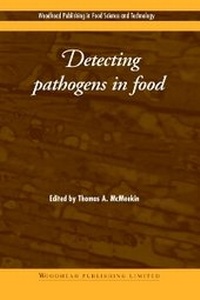
Detecting Pathogens in Food
Published on 23. June 2003
Book
Hardback
384 pages
978-1-85573-670-2 (ISBN)
Description
Identifying pathogens in food quickly and accurately is one of the most important requirements in food processing. The ideal detection method needs to combine such qualities as sensitivity, specificity, speed and suitability for on-line applications. Detecting pathogens in food brings together a distinguished international team of contributors to review the latest techniques in microbiological analysis and how they can best be used to ensure food safety.
Part one looks at general issues, beginning with a review of the role of microbiological analysis in food safety management. There are also chapters on the critical issues of what to sample and how samples should be prepared to make analysis effective, as well as how to validate individual detection techniques and assure the quality of analytical laboratories. Part two discusses the range of detection techniques now available, beginning with traditional culture methods. There are chapters on electrical methods, ATP bioluminescence, microscopy techniques and the wide range of immunological methods such as ELISAs. Two chapters look at the exciting developments in genetic techniques, the use of biosensors and applied systematics.
Detecting pathogens in food is a standard reference for all those concerned in ensuring the safety of food.
Part one looks at general issues, beginning with a review of the role of microbiological analysis in food safety management. There are also chapters on the critical issues of what to sample and how samples should be prepared to make analysis effective, as well as how to validate individual detection techniques and assure the quality of analytical laboratories. Part two discusses the range of detection techniques now available, beginning with traditional culture methods. There are chapters on electrical methods, ATP bioluminescence, microscopy techniques and the wide range of immunological methods such as ELISAs. Two chapters look at the exciting developments in genetic techniques, the use of biosensors and applied systematics.
Detecting pathogens in food is a standard reference for all those concerned in ensuring the safety of food.
Reviews / Votes
"Thomas McMeekin has brought together an appropriate range of international experience and expertise to produce a timely and significant text." --Food Science and Technology"...significant value to professionals involved in research and development, surveillance and statutory activities in the fields of food safety." --Food Science and Technology
"Material is consistently presented in clear, direct and informative terms. ...making a range of topics very comprehensible and accessible to novice and expert alike." --Food Science and Technology
More details
Series
Language
English
Place of publication
Cambridge
United Kingdom
Publishing group
Elsevier Science & Technology
Target group
Professional and scholarly
Dimensions
Height: 234 mm
Width: 156 mm
Weight
720 gr
ISBN-13
978-1-85573-670-2 (9781855736702)
Copyright in bibliographic data and cover images is held by Nielsen Book Services Limited or by the publishers or by their respective licensors: all rights reserved.
Schweitzer Classification
Other editions
Additional editions
Thomas A. McMeekin
Detecting Pathogens in Food
E-Book
06/2003
Woodhead Publishing
€215.00
Available for download
Person
Tom McMeekin is Emeritus Professor of Microbiology at the University of Tasmania.
Content
Part 1 General issues: Microbiological analysis and food safety management; GMP and HACCP systems; Sampling techniques; Separation and concentration of samples; Validating detection techniques; Quality assurance of laboratory performance. Part 2 Particular techniques: Culture methods; Electrical methods; ATP bioluminescence; Microscopy techniques: DEFT and flow cytometry; Immunological techniques: Immunochromatography, enzyme linked immunofluorescent assays and agglutination techniques; Immunological techniques: ELISA; Genetic techniques: PCR, NASBA, hybridisation and microarrays; Genetic techniques: Molecular subtyping methods; New biosensors for microbiological analysis; The use of applied systematics in identifying foodborne pathogens.