


Understanding Leadership
An arts and humanities perspective
1st Edition
Published on 8. April 2015
Book
Paperback/Softback
274 pages
978-0-415-72873-7 (ISBN)
Description
Lao Tzu, Marx, the Buddha, Ibsen, Machiavelli - these are just a few of the world's great thinkers who have weighed in on the subject of leadership over the centuries. Yet, the contemporary student of leadership often overlooks many of these names in favour of more recent theorists hailing from the social sciences. Understanding Leadership: An Arts and Humanities Perspective takes a different angle, employing the works of the great philosophers, authors and artists found in world civilization and presenting an arts and humanities perspective on the study of leadership.
The authors build their conceptual framework using The Five Components of Leadership Model, which recognizes the leader, the followers, the goal, the environmental context, and the cultural values and norms that make up the leadership process.
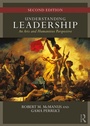
Supporting the text are a wealth of case studies which reflect on works such as Ayn Rand's novella Anthem, Eugene Delacroix's painting Liberty Leading the People, Charlie Chaplin's film Modern Times, Athol Fugard's play "Master Harold" . . . and the Boys, Lao Tzu's poetic work Tao Te Ching, and Antonin Dvorak's New World Symphony. The authors also introduce studies from various world cultures to particularly illustrate the role cultural values and norms play in leadership. This illuminating framework promotes the multidimensional thinking that is necessary for understanding and problem solving in a complex world.
Understanding Leadership: An Arts and Humanities Perspective will be a valuable textbook for both undergraduate and postgraduate leadership students, while leadership professionals will also appreciate the book's unique liberal arts and cultural approach.
The authors build their conceptual framework using The Five Components of Leadership Model, which recognizes the leader, the followers, the goal, the environmental context, and the cultural values and norms that make up the leadership process.
Supporting the text are a wealth of case studies which reflect on works such as Ayn Rand's novella Anthem, Eugene Delacroix's painting Liberty Leading the People, Charlie Chaplin's film Modern Times, Athol Fugard's play "Master Harold" . . . and the Boys, Lao Tzu's poetic work Tao Te Ching, and Antonin Dvorak's New World Symphony. The authors also introduce studies from various world cultures to particularly illustrate the role cultural values and norms play in leadership. This illuminating framework promotes the multidimensional thinking that is necessary for understanding and problem solving in a complex world.
Understanding Leadership: An Arts and Humanities Perspective will be a valuable textbook for both undergraduate and postgraduate leadership students, while leadership professionals will also appreciate the book's unique liberal arts and cultural approach.
Reviews / Votes
'There are thousands of books on leadership that answer some of the critical leadership questions. This is the only leadership book that addresses ALL of them. McManus and Perruci tackle the complexity of leadership, including the role of followers and context. They examine leadership from cultures ranging from West to East and from all continents, and they deal in depth with the critical question of "Leadership for what?" This is a must read for any true scholar of leadership.' - Ronald E. Riggio, Ph.D., Associate Dean of the Faculty, Kravis Leadership Institute, Claremont McKenna College, USA.'This book opens the door to understanding leadership for students, scholars, and practitioners alike. The authors present a wide array of theories and ideas that challenge us to gain our own insights on how these can work together, and help us to become effective leaders and followers in our complex world.' - Sadhana Hall, Deputy Director, The Nelson A. Rockefeller Center for Public Policy and the Social Sciences, Dartmouth College, USA
'In this much needed text McManus and Perruci extend the injunction to 'know thyself' by inviting us to know our wider world more fully. Readers will be informed, challenged and inspired through an artful examination of 'I'/'We' leadership paradoxes.' - Dr Ralph Bathurst, Massey University, New Zealand
More details
Language
English
Place of publication
London
United Kingdom
Publishing group
Taylor & Francis Ltd
Target group
College/higher education
Professional and scholarly
Illustrations
60 s/w Abbildungen, 11 s/w Tabellen, 15 s/w Photographien bzw. Rasterbilder, 45 s/w Zeichnungen
45 Line drawings, black and white; 15 Halftones, black and white; 11 Tables, black and white; 60 Illustrations, black and white
Dimensions
Height: 235 mm
Width: 159 mm
Weight
408 gr
ISBN-13
978-0-415-72873-7 (9780415728737)
Copyright in bibliographic data and cover images is held by Nielsen Book Services Limited or by the publishers or by their respective licensors: all rights reserved.
Schweitzer Classification
Other editions
New editions
Book
12/2019
2nd Edition
Routledge
€48.35
Shipment within 15-20 days
Additional editions
Book
04/2015
1st Edition
Routledge
€171.12
Article exhausted; check for reprint
Persons
Robert M. McManus is the McCoy Associate Professor of Leadership Studies and Communication at the McDonough Leadership Center at Marietta College in Ohio. He co-edited Leading in Complex Worlds (Jossey-Bass) and has served as the Chair of the Leadership Education MIG for the International Leadership Association.
Gama Perruci is the Dean of the McDonough Leadership Center at Marietta College in Ohio. He also serves as a consultant for The New York Times (nytimesinleadership.com) and leadership session facilitator for Dartmouth College's Rockefeller Center for Public Policy and the Social Sciences.
Gama Perruci is the Dean of the McDonough Leadership Center at Marietta College in Ohio. He also serves as a consultant for The New York Times (nytimesinleadership.com) and leadership session facilitator for Dartmouth College's Rockefeller Center for Public Policy and the Social Sciences.
Content
Part I: How to Think About Leadership 1.Understanding Leadership 2.The Leader 3.The Followers 4.The Goal 5.The Environmental Context Part II: The Cultural Context of Leadership 6.Leadership in a Western Cultural Context 7.Leadership in a Latin American Cultural Context 8.Leadership in an Islamic Cultural Context 9.Leadership in an African Cultural Context 10.Leadership in a Buddhist Cultural Context 11.Leadership in an East Asian Cultural Context Part III: Leadership For What? 12.Leadership to Develop Oneself 13.Leadership to Develop Others 14.Leadership for the Greater Good