

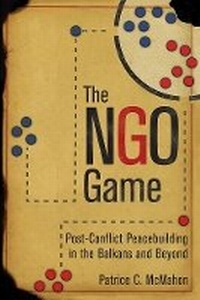
The NGO Game
Post-Conflict Peacebuilding in the Balkans and Beyond
Published on 13. June 2017
Book
Hardback
238 pages
978-1-5017-0923-4 (ISBN)
Description
In most post-conflict countries nongovernmental organizations are everywhere, but their presence is misunderstood. In The NGO Game Patrice McMahon investigates the unintended outcomes of what she calls the NGO boom in Bosnia and Kosovo. Using her years of fieldwork and interviews, McMahon argues that when international actors try to rebuild and reconstruct post-conflict countries, they often rely on and look to NGOs. Although policymakers and scholars tend to accept and even celebrate NGO involvement in post-conflict and transitioning countries, they rarely examine why NGOs have become so popular, what NGOs do, or how they affect everyday life.After a conflict, international NGOs descend on a country, local NGOs pop up everywhere, and money and energy flow into strengthening the organizations. In time, the frenzy of activity slows, the internationals go home, local groups disappear from sight, and the NGO boom goes bust. Instead of peace and stability, the embrace of NGOs and the enthusiasm for international peacebuilding turns to disappointment, if not cynicism. For many in the Balkans and other post-conflict environments, NGOs are not an aid to building a lasting peace but are part of the problem because of the turmoil they foster during their life cycles in a given country. The NGO Game will be useful to practitioners and policymakers interested in improving peacebuilding, the role of NGOs in peace and development, and the sustainability of local initiatives in post-conflict countries.
Reviews / Votes
A detailed, tough-minded study of what happened when a swarm of nongovernmental organizations rushed into Bosnia and Kosovo in the wake of conflicts during the 1990s.(Foreign Affairs) McMahon offers an objective assessment of the relationship between local and International NGOs in the peacebuilding proces which is both engaging and instructive.
(European Review of International Studies) There is nothing new in this. It's particularly sad to miss reference to the work by Michael Foley, for example, or Paul Stubbs on Bosnia, and her apparent misunderstanding of why Haitians label their country, devastingly, as The Republic of NGOs.... McMahon's evidence is largely from interviews, building in the biases of her interviewees and nothing systematic.
(Slavic Review) One would say that this book contributes an enormous amount to our understanding of the role and activities of NGOs in post-Cold War international peacebuilding efforts, especially in the Western Balkans.
(European Review of International Studies) The NGO Game....addresses the broader audience of those studying the specific conditions under which most NGOs operate: democratising societies suffering from particular identity-based divisions that are often perceived by external donors as the root cause of social inequalities, competition and, ultimately, conflict.
(Europe-Asia Studies)
More details
Language
English
Place of publication
Ithaca
United States
Product notice
Paper over boards
Illustrations
- 5 Tables, black and white
Dimensions
Height: 229 mm
Width: 152 mm
Thickness: 24 mm
Weight
907 gr
ISBN-13
978-1-5017-0923-4 (9781501709234)
Copyright in bibliographic data and cover images is held by Nielsen Book Services Limited or by the publishers or by their respective licensors: all rights reserved.
Schweitzer Classification
Other editions
Additional editions
E-Book
06/2017
Cornell University Press
€25.49
Available for download
Person
Patrice C. McMahon is Associate Professor of Political Science at the University of Nebraska. She is the author of Taming Ethnic Hatred, coauthor of American Exceptionalism Reconsidered and coeditor of several books, including most recently State Responses to Human Security.
Content
Introduction: Booms and Busts in Peacebuilding1. Uncertain Times2. Of Power and Promises3. Bosnia: Much Ado About NGOs4. Kosovo: Copy, Paste, and DeleteConclusion: The End of a Golden Era