

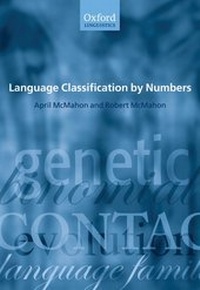
Language Classification by Numbers
Published on 24. November 2005
Book
Hardback
284 pages
978-0-19-927901-2 (ISBN)
Description
This book considers how languages have traditionally been divided into families, and asks how they should be classified in the future. It tests current theories and hypotheses, shows how new ideas can be formulated, and offers a series of demonstrations that the new techniques applied to old data can produce convincing results. It will be of great practical interest to all those concerned with the classification and diffusion of languages in fields such as comparative linguistics, archaeology, genetics, and anthropology.
Reviews / Votes
...this is a great book for raising questions. * Claire Bowern, Linguistic Typology * A gentle introduction... in which they address many of the fundamental questions concerning the application of quantitative and computational techniques, including phylogenetics, to questions in historical linguistics. * John Nerbonne, Linguistic Typology *More details
Language
English
Place of publication
Oxford
United Kingdom
Target group
Professional and scholarly
Scholars and advanced students of historical linguistics, language contact and change, and the classification of languages, including linguists, archaeologists, population geneticists, and anthopologists. Plus dedicated general readers interested in language families and language change.
Dimensions
Height: 254 mm
Width: 178 mm
Thickness: 21 mm
Weight
667 gr
ISBN-13
978-0-19-927901-2 (9780199279012)
Copyright in bibliographic data and cover images is held by Nielsen Book Services Limited or by the publishers or by their respective licensors: all rights reserved.
Schweitzer Classification
Other editions
Additional editions
April McMahon | Robert McMahon
Language Classification by Numbers
Book
11/2005
Oxford University Press
€96.50
Shipment within 15-20 days
Persons
April McMahon is Forbes Professor of English Language at the University of Edinburgh, and has previously worked at the Universities of Sheffield and Cambridge. Her main research interests are language change, language classification, phonological theory, and variation in English and Scots. She has published a number of books on these topics, including Understanding Language Change (CUP 1994), Lexical Phonology and the History of English (CUP 2000), and Change, Chance, and Optimality (OUP 2000). She and Robert McMahon have worked together for the last ten years on interdisciplinary issues including connections between evolutionary theory, genetics, and historical linguistics. This is their first joint book.
Robert McMahon took his BSc (in Agricultural Science) and PhD (in fruit fly genetics) at Edinburgh, and since graduation has worked as a clinical molecular geneticist in Cambridge, Sheffield, and now Edinburgh. His work involves tracing inherited conditions through families, and in particular he has researched and provided genetic services for cystic fibrosis, muscular dystrophy, inherited cancer and Osteogenesis Imperfecta (brittle bone disease). He has published a range of articles in professional and scientific journals, and maintains a research interest in issues of human genetics and evolution, and their relationship with language.
Robert McMahon took his BSc (in Agricultural Science) and PhD (in fruit fly genetics) at Edinburgh, and since graduation has worked as a clinical molecular geneticist in Cambridge, Sheffield, and now Edinburgh. His work involves tracing inherited conditions through families, and in particular he has researched and provided genetic services for cystic fibrosis, muscular dystrophy, inherited cancer and Osteogenesis Imperfecta (brittle bone disease). He has published a range of articles in professional and scientific journals, and maintains a research interest in issues of human genetics and evolution, and their relationship with language.
Content
1. How do Linguists Classify Languages? ; 2. Lexicostatistics ; 3. Tree-Based Quantitative Approaches - Computational Cladistics ; 4. Tree-Based Quantitative Approaches: Sublists ; 5. Correlations Between Genetic and Linguistic Data ; 6. Climbing Down from the Trees: Network Models ; 7. Dating ; 8. Quantitative Methods Beyond the Lexicon