

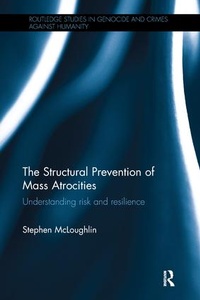
The Structural Prevention of Mass Atrocities
Understanding Risk and Resilience
1st Edition
Published on 2. December 2016
Book
Paperback/Softback
196 pages
978-0-415-79110-6 (ISBN)
Description
This book offers a different approach to the structural prevention of mass atrocities. It investigates the conditions that enable vulnerable countries to prevent the perpetration of such violence.
Structural prevention is commonly framed as the identifying and ameliorating of the 'root causes' of violent conflict, a process which typically involves international actors determining what these root causes are, and what the best courses of action are to deal with them. This overlooks why mass atrocities do not occur in countries that contain the presence of root causes. In fact, very little research has been conducted on what the causes of peace and stability are, particularly in relatively countries located in regions marred by civil war and mass atrocities. To better understand how such vulnerable countries prevent the commission of mass atrocities, this book proposes an analytical framework which enables not only an understanding of risk which arises from the presence of root causes, but also of the factors that build resilience in countries, and consequently mitigate and manage such risk. Using this framework, three countries - Botswana, Zambia and Tanzania, are analysed to account for their long term stability despite their location in neighbourhoods characterised by decades of civil war, ethnic repression and mass atrocities.
This work is a significant contribution to the field of genocide studies and crimes against humanity and will be of interest to students and scholars alike.
Structural prevention is commonly framed as the identifying and ameliorating of the 'root causes' of violent conflict, a process which typically involves international actors determining what these root causes are, and what the best courses of action are to deal with them. This overlooks why mass atrocities do not occur in countries that contain the presence of root causes. In fact, very little research has been conducted on what the causes of peace and stability are, particularly in relatively countries located in regions marred by civil war and mass atrocities. To better understand how such vulnerable countries prevent the commission of mass atrocities, this book proposes an analytical framework which enables not only an understanding of risk which arises from the presence of root causes, but also of the factors that build resilience in countries, and consequently mitigate and manage such risk. Using this framework, three countries - Botswana, Zambia and Tanzania, are analysed to account for their long term stability despite their location in neighbourhoods characterised by decades of civil war, ethnic repression and mass atrocities.
This work is a significant contribution to the field of genocide studies and crimes against humanity and will be of interest to students and scholars alike.
More details
Series
Language
English
Place of publication
London
United Kingdom
Publishing group
Taylor & Francis Ltd
Target group
College/higher education
Dimensions
Height: 234 mm
Width: 156 mm
Weight
294 gr
ISBN-13
978-0-415-79110-6 (9780415791106)
Copyright in bibliographic data and cover images is held by Nielsen Book Services Limited or by the publishers or by their respective licensors: all rights reserved.
Schweitzer Classification
Other editions
Additional editions
Book
07/2014
1st Edition
Routledge
€217.50
Shipment within 15-20 days
E-Book
07/2014
1st Edition
Routledge
€69.99
Available for download
E-Book
07/2014
1st Edition
Routledge
€69.99
Available for download
Person
Stephen McLoughlin is Research Fellow at the Griffith Asia Institute, Griffith University Australia.
Content
Introduction 1. A Review of Prevention 2. Examining the Root Causes of Mass Atrocities 3. Developing a Framework for Understanding the Prevention of Mass Atrocities 4. The Case of Botswana 5. The Case of Zambia 6. The Case of Tanzania 7. Conclusion