

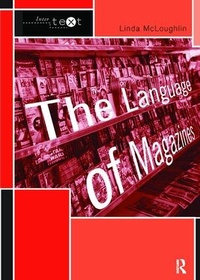
The Language of Magazines
1st Edition
Published on 28. June 2017
Book
Hardback
128 pages
978-1-138-42345-9 (ISBN)
Description
The Language of Magazines:shows how linguistic techniques such as puns and presuppositions are used by magazines to capture our attentionexamines how image and text combine to produce meaningdiscusses how ideological messages are conveyedanalyses how the sexes are constructed through languagelooks at how magazines relate to culture explores a wide variety of magazines, including Cosmopolitan, Mens Health, Bliss, Diva, FHM, Sugar and Viz.
Reviews / Votes
'This book is a helpful textbook for students of language and linguistics ... it is very easy to read and as such also a useful and entertaining book to everybody who wants to view his or her magazines a bit more critically.' - Irmeli Helin, Linguist ListMore details
Series
Language
English
Place of publication
London
United Kingdom
Publishing group
Taylor & Francis Ltd
Target group
Primary & secondary/elementary & high school
College/higher education
AS/A2 and Undergraduate
Dimensions
Height: 246 mm
Width: 174 mm
Weight
453 gr
ISBN-13
978-1-138-42345-9 (9781138423459)
Copyright in bibliographic data and cover images is held by Nielsen Book Services Limited or by the publishers or by their respective licensors: all rights reserved.
Schweitzer Classification
Other editions
Additional editions
Linda McLoughlin
The Language of Magazines
Book
03/2000
1st Edition
Routledge
€38.20
Shipment within 15-20 days
Person
Linda McLoughlin is a part-time lecturer in English language at Edge Hill College, Ormskirk, Lancashire. She has designed and taught BA and MA courses in English language, specialising in language and gender.
Content
Introduction Unit one: What is a magazine? What is a magazine? What types of magazines are there? Who produces magazines? Unit two: The wrapping: front covers; Ideal-reader images; What's in a name?: magazine titles; Visual images; Layout and graphology; The front cover as preview; Putting words together; Creating variety: sentence types; Sentence functions; Problems and solutions; Tricks of language; Unit three: Leafing through: the composition of the text; Front of house: the contents page; The composition of pages; Unit four: In-house: magazine contents; Horoscopes; Readers' letters; The problem page; Magazine narratives: readers' true stories; Dialogue within the text; Unit five: Who am I?: the relationship between the text producer and interpreter; Constructing subject positions; The ideal-reader; The identity of the text producer; The relationship between the text producer and reader; The editorial; Resisting subject positions; Unit six: The discourse of magazines; Discourse; Linguistic determinism: ideological Viewpoints; Text; Tracing patterns in language; Lexical cohesion; Grammatical cohesion; The discourse of magazines; Patterns of word choices; Unit seven: Representations of women and men: constructing femininity, masculinity and sexuality; Femininities and masculinities; Constructing femininities and masculinities: the advertorial; Constructing sexuality