

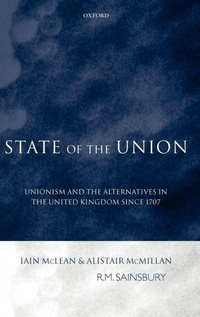
State of the Union
Unionism and the Alternatives in the United Kingdom Since 1707
Published on 29. September 2005
Book
Hardback
304 pages
978-0-19-925820-8 (ISBN)
Description
This is the first survey of Unionism, the ideology of most of the rulers of the United Kingdom for the last 300 years. Because it was taken so much for granted, it has never been properly studied. Now that we stand in the twilight of Unionism, it is possible to see it as it casts its long shadow over British and imperial history since 1707.
The book looks at all the crucial moments in the history of Unionism. In 1707, the parliaments and (more important) executives of England and Scotland were united. During the 18th century, although not immediately after 1707, that union blossomed and brought benefits to both parties. It facilitated the first and second British Empires. The Union of Great Britain and Ireland in 1800-01 was formally similar but behaviourally quite different. It was probably doomed from the start when George III refused to accept Catholic Emancipation. Nevertheless, no leading British politician heeded the Irish clamour for Home Rule until Gladstone in 1886. That cataclysmic year has determined the shape of British and Irish politics ever since. Having refused to concede Irish Home Rule through the heyday of primordial Unionism from 1886 to 1920, British politicians had to accept Irish independence in 1921, whereupon primordial Unionism fell apart except in Northern Ireland. Twentieth-century Unionism has been instrumental - valuing the Union for its consequences, not because it was intrinsically good.
As Unionism was inextricably tied up with the British Empire, it nevertheless remained as a strong but unexamined theme until the end of Empire. The unionist parties (Conservative and Labour) responded to the upsurge of Scottish and Welsh nationalism, and of violence in Northern Ireland, in the light of their mostly unexamined unionism in the 1960s. With the departure from politics of the last Unionists (Enoch Powell and John Major), British politics is now subtly but profoundly different.
The book looks at all the crucial moments in the history of Unionism. In 1707, the parliaments and (more important) executives of England and Scotland were united. During the 18th century, although not immediately after 1707, that union blossomed and brought benefits to both parties. It facilitated the first and second British Empires. The Union of Great Britain and Ireland in 1800-01 was formally similar but behaviourally quite different. It was probably doomed from the start when George III refused to accept Catholic Emancipation. Nevertheless, no leading British politician heeded the Irish clamour for Home Rule until Gladstone in 1886. That cataclysmic year has determined the shape of British and Irish politics ever since. Having refused to concede Irish Home Rule through the heyday of primordial Unionism from 1886 to 1920, British politicians had to accept Irish independence in 1921, whereupon primordial Unionism fell apart except in Northern Ireland. Twentieth-century Unionism has been instrumental - valuing the Union for its consequences, not because it was intrinsically good.
As Unionism was inextricably tied up with the British Empire, it nevertheless remained as a strong but unexamined theme until the end of Empire. The unionist parties (Conservative and Labour) responded to the upsurge of Scottish and Welsh nationalism, and of violence in Northern Ireland, in the light of their mostly unexamined unionism in the 1960s. With the departure from politics of the last Unionists (Enoch Powell and John Major), British politics is now subtly but profoundly different.
Reviews / Votes
Iain McLean and Alistair MacMillan provide the heavyweight academic background to [the] ferment of comment and controvesy, especially since McLean - the professor of politics at Oxford University - has been a long-term thinker about such matters. * Scotland on Sunday *More details
Language
English
Place of publication
Oxford
United Kingdom
Target group
Professional and scholarly
Illustrations
numerous line drawings and tables
Dimensions
Height: 240 mm
Width: 161 mm
Thickness: 21 mm
Weight
614 gr
ISBN-13
978-0-19-925820-8 (9780199258208)
Copyright in bibliographic data and cover images is held by Nielsen Book Services Limited or by the publishers or by their respective licensors: all rights reserved.
Schweitzer Classification
Persons
Content
1. The United Kingdom as a Union State ; 2. The Union of Westminster and Edinburgh Parliaments 1707 ; 3. Ireland's Incorporation: An 'Excusable Mistake'? ; 4. 1886 ; 5. The High Noon of Unionism - 1886-1921 ; 6. Ulster Unionism Since 1921 ; 7. Unionism Since 1961: Elite Attitudes ; 8. Unionism Since 1961: Mass Attitudes ; 9. Representation in a Union State ; 10. Public Finance in an Asymmetric Union ; 11. Conclusion: A Union State Without Unionism ; Appendix: Principal Characters in 1707 and 1800